



Mat vs. reformer Pilates: what's actually different?
Same method, same founder, same core work — routed through two different tools. Where the resistance comes from is the whole story, and it upends the usual assumption about which one is "advanced."
The short answer
Mat Pilates uses your own bodyweight against gravity — no equipment, and nowhere to hide, which makes it deceptively demanding. Reformer Pilates uses a spring-loaded machine with a sliding carriage, and those springs can be dialled to make a movement harder or easier.
That adjustability is why the reformer is a rehab staple and often the friendlier option for beginners — the opposite of how it's usually sold. For learning at home, mat is the realistic path. A reformer is a serious purchase.
The difference that explains everything
Strip away the marketing and there's one difference that generates all the others: where the resistance comes from.
On the mat, resistance is your bodyweight and gravity. That's it. It's fixed, it only pulls in one direction — down — and because nothing is holding you in place, your own deep stabilising muscles have to do that job. This is why a "beginner" mat exercise like the hundred can leave someone shaking. There's no machine sharing the load.
On the reformer, resistance comes from springs, and springs behave nothing like gravity. You can add or remove them, and each setting changes the load precisely. More than that — depending on how you're positioned on the carriage, a spring can resist your movement or assist it. It can make a movement harder, or it can hold part of your weight so you can perform something you couldn't yet do unsupported.
Read that last part again, because it quietly demolishes the most common assumption about Pilates: that the reformer is the advanced version you graduate to. It isn't. It's the variable-resistance, supportable version — which is exactly why physiotherapists reach for it with post-surgical patients who can't yet hold their own weight on a mat.
What both actually share
Before the differences run away with the article, the part that matters most: these are the same method. Joseph Pilates developed both, and he called the whole system Contrology — control being the entire point. The mat sequence and the reformer both train the same thing.
That thing is what Pilates practitioners call the powerhouse: the deep abdominal wall, the pelvic floor, the muscles wrapping your lower spine. Not the six-pack muscles you can see — the deeper layer underneath that stabilises everything. Every genuine Pilates exercise, on any equipment, is organised around controlling movement from that centre.
The shared principles carry across too: precise, controlled movement over repetition for its own sake, breath coordinated with effort, full attention on what the body is doing. Whether you're on a mat or a machine, sloppy fast reps aren't Pilates — they're just calisthenics with a Pilates label. This is also why live correction matters so much in both: the whole method is about how you move, which is exactly the thing a recorded video can't check.
Mat Pilates
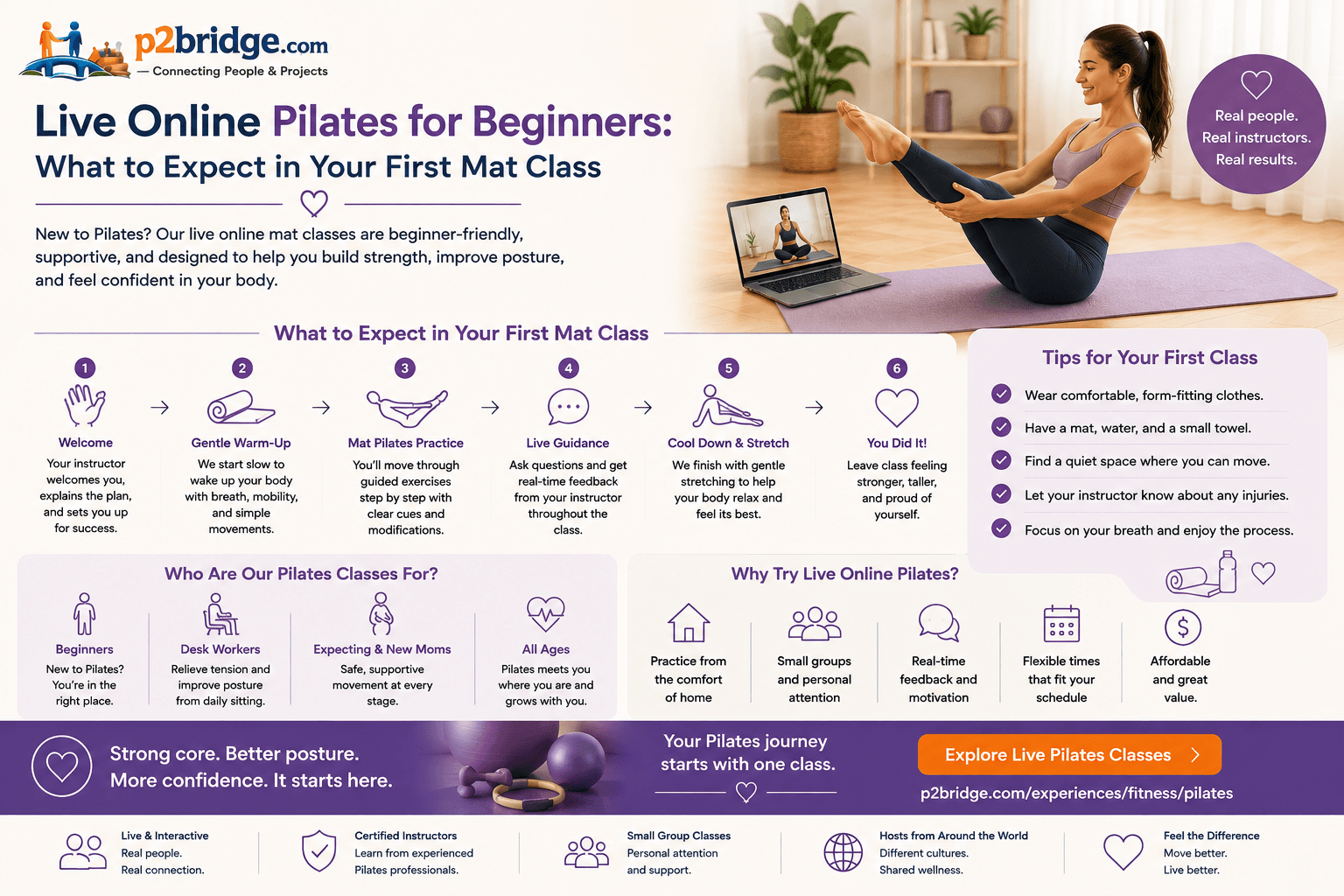
BodyweightHere's the fact that surprises people: the mat work is the original, and in a real sense it's the harder discipline. Joseph Pilates built the mat sequence first, and it's unforgiving precisely because nothing helps you. No springs to support a movement, no carriage to guide the path. Just you, the floor, and your own control.
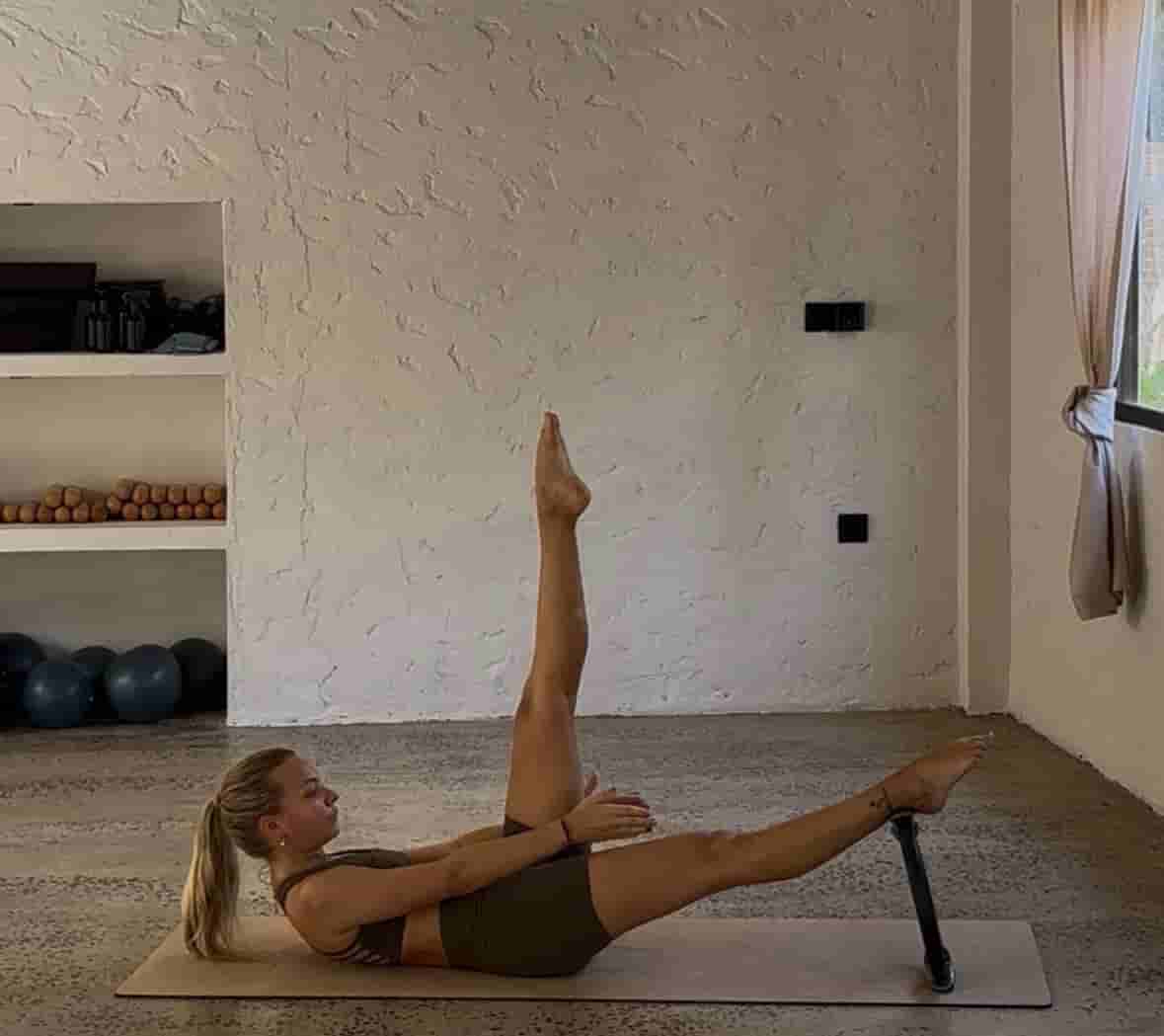
A mat class looks gentle from the outside — a lot of it happens lying down. Then you try to hold your legs at forty-five degrees, lift your head and shoulders, and pump your arms for a hundred counts while keeping your lower back pinned to the floor, and you discover exactly how weak your deep core actually is. The hundred is a "beginner" exercise. It humbles people who deadlift twice their bodyweight.
What it's good for: building genuine core control from the ground up, and doing it anywhere for the price of a mat. It's also the one form of Pilates that translates cleanly to learning online, which matters more than it sounds — more on that below.
If you want core strength as your specific goal, mat Pilates overlaps heavily with dedicated core training, and the two pair well.
Reformer Pilates
ApparatusThe reformer looks intimidating — a low bed-like frame with a sliding platform, straps, a footbar, and a bank of springs at one end. It photographs like a machine you'd need a licence to operate. In practice it's often the easier place to start, because the machine gives you feedback and support that the mat never does.
The carriage slides on rails, and the springs meter exactly how much resistance that slide meets. Set them heavy and a movement becomes serious strength work. Set them light and the same movement becomes accessible, or even assisted. The straps and footbar also guide the path of a movement, so there's a built-in sense of whether you're doing it right — something you have to develop internally on the mat.
The machine looks like the hard version. It's the one that can hold half your weight for you.
Take a plank. On the mat there's one setting: your full bodyweight, held by whatever your core can currently manage. On the reformer the same shape can be set up so the springs carry a meaningful portion of that load, letting someone hold correct position long enough to actually learn it. Then the springs come off, one at a time. That's not an easier exercise — it's a route into the same exercise for someone who isn't there yet.
That carriage does demand respect, though. Lose control of it under load and it wants to slam back to its stop, which is where the "the reformer is intense" reputation comes from. Under a good teacher's eye it's controlled. Freelancing on one you don't understand is how people tweak things.
What it's good for: progressive loading you can fine-tune, rehabilitation and return-to-movement after injury, and variety — the same machine trains strength, mobility, and control across hundreds of exercises.
Side by side
| Mat Pilates | Reformer Pilates | |
|---|---|---|
| Resistance from | Bodyweight + gravity | Adjustable springs |
| Resistance is | Fixed, one direction | Variable, can resist or assist |
| Equipment | A mat | A reformer machine |
| Cost to start | Near zero | High — studio fees or a machine |
| Stabilising demand | All on you | Partly shared with the machine |
| Beginner-friendly? | Yes, but genuinely hard | Yes — support makes it accessible |
| Rehab use | Limited | Extensive — a physio staple |
| Learn at home? | Yes, realistically | Only with a machine you own |
| Exercise variety | Wide, within bodyweight | Very wide, resistance-scaled |
The cost and access reality
This is the part most articles skate over, and it's usually the thing actually deciding your choice.
Mat Pilates costs almost nothing to begin. A mat, a bit of floor, and instruction. That's the entire barrier.
Reformer Pilates is a different financial conversation. Studio reformer classes run expensive per session — the machines are costly, they take up room, and each class is capped at however many reformers the studio owns, so you're paying for scarce equipment and small groups. Buying your own reformer means anywhere from a few hundred for a basic home model to several thousand for a studio-grade one. That's not a casual purchase.
None of this makes the reformer not worth it. It makes the reformer a considered commitment rather than a default. If you're curious about Pilates at all, starting on the mat costs you nothing and teaches you the control everything else is built on.
Start where it makes sense — the mat
P2Bridge hosts teach live mat Pilates you can do at home with a teacher watching your form, plus reformer technique for anyone with studio or home machine access. Fit Vicky, an Argentina-based wellness coach, teaches Pilates alongside functional training.
Browse live Pilates classes Meet the instructorsHow to choose, by goal
Forget which one sounds more impressive. Choose by what you're after.
- You're new to Pilates entirely. Start on the mat. It teaches the core control that makes everything else — including the reformer — make sense. And it costs nothing to find out whether you even like Pilates.
- You're recovering from injury or returning to movement carefully. Reformer, ideally with a teacher who can set the springs to support you. This is the machine's home turf.
- You want to practise at home, most days. Mat, with live online instruction so someone's actually watching your form. This is the realistic at-home path.
- You want progressive strength you can measure and increase. Reformer, where you can add spring load step by step — or pair mat Pilates with dedicated strength training.
- You're bored easily. Reformer offers more variety per session. Though a good mat teacher has more up their sleeve than you'd think.
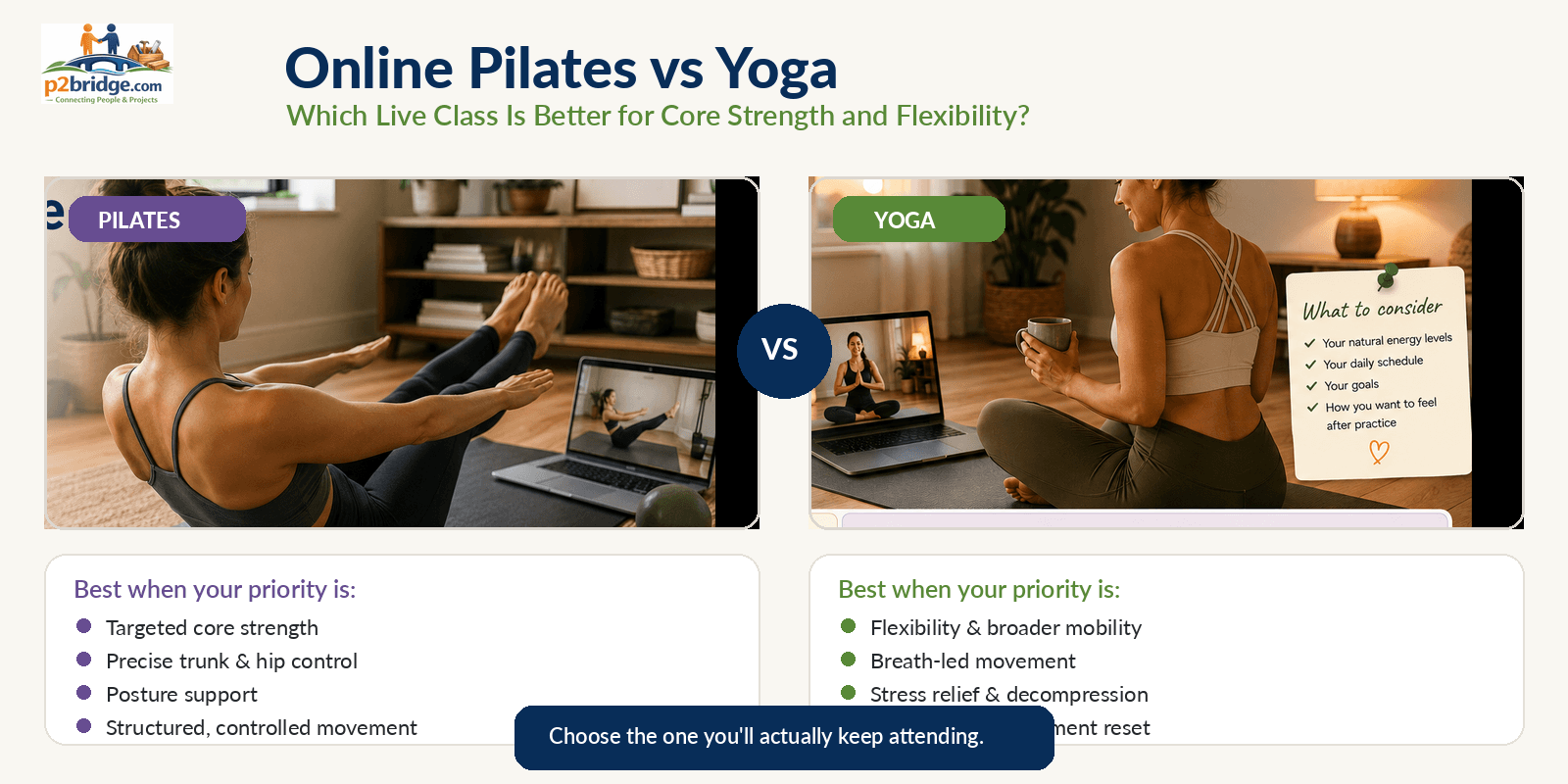
- You also do yoga and are weighing where Pilates fits. They're complementary, not competing — if that's your question, our guide to yoga styles pairs naturally with this one.
What people get wrong in each
In mat Pilates
Rushing. The whole method is control, and control is slow. People power through the reps like they're doing crunches and wonder why it doesn't feel like the Pilates everyone raves about. The magic is in doing fewer, slower, and actually feeling your deep core do the work — which is precisely the thing a teacher can see and you often can't.
In reformer Pilates
Two things. Letting the springs do the work — riding the machine's momentum instead of controlling the carriage, which turns a precise exercise into a glorified rowing motion. And over-loading the springs to feel like you're working hard, when heavier isn't harder in Pilates — control is harder, and control often lives at lighter settings.
Who should be careful
Worth knowing before you book
Pregnancy and the postpartum period. Pilates is often recommended during and after pregnancy, and for good reason — but not every exercise is safe at every stage, and some traditional mat exercises are actively unsuitable later in pregnancy. Look for a teacher experienced in prenatal and postnatal work, and tell them where you are.
Diastasis recti — the separation of the abdominal wall that's common after pregnancy. This is the sharpest example of why live correction matters: Pilates is frequently used to help close a diastasis, but the wrong exercises done the wrong way can widen it instead. If your belly domes or bulges down the midline during an exercise, that's the signal to stop and modify. A teacher watching you can catch that instantly. A recorded video cannot see your abdomen at all.
Recent abdominal or back surgery, or an acute back injury. The reformer's adjustable support is genuinely useful here, but only under a teacher who knows your history. This is a book-a-private-session situation, not a drop-into-a-group-class one.
If you're pregnant, postpartum, or managing an injury or medical condition, check with your doctor or physiotherapist before starting — then tell your teacher what they said. The NHS guide to Pilates is a sober, non-commercial overview of what it does and doesn't do.
Learning Pilates online, honestly
Here's the straight version, because it's different for the two.
Mat Pilates online works genuinely well. You need a mat and floor space, both of which you have, and the one thing a solo home practice lacks — someone to tell you your pelvis is tilting or your neck is straining — is exactly what a live class restores. This is the realistic, low-cost way to practise Pilates properly at home, and it's what most people asking about online Pilates classes actually want.
Reformer online is a narrower thing, and it's only honest to say so. You can't do reformer work without a reformer, so an online reformer class is for people who already own or have access to a machine. For that audience, live instruction is valuable — a teacher can guide your spring settings and catch carriage-control errors in real time. But if you don't have the machine, no online class changes that. Anyone telling you otherwise is selling.
The thread through both: it must be live. A pre-recorded Pilates video can't see whether you're moving from your centre or just going through the shapes, and moving from your centre is the entire method. That's the reason every class on P2Bridge is live rather than recorded.
Try a live mat class before you spend a penny on equipment
Group sessions are the low-stakes way to find out whether Pilates is for you. Prefer to work around an injury or go one-to-one? Book a private session instead.
See group classes Book a private sessionQuestions people ask
Is reformer Pilates better than mat Pilates?
Neither is better — they're the same method through different tools. The reformer offers adjustable resistance and support, which makes it excellent for rehab and progressive loading. The mat demands more from your own stabilising muscles because nothing assists you. Many people do both. The right one depends on your goal, your budget, and whether you have access to a machine.
Which should a complete beginner start with?
Either works, but mat is the sensible default for most people: it costs almost nothing, it teaches the core control everything else builds on, and you can start at home with live instruction. The reformer is beginner-friendly too, thanks to its support, but the cost and studio access make it a bigger commitment before you even know you like Pilates.
Is the reformer harder than the mat?
Not inherently — and often the reverse. The reformer's springs and straps can support your movement, which makes many exercises more accessible than their mat equivalents. The mat gives you no assistance at all, so exercises that look basic can be surprisingly demanding. "Harder" depends entirely on how the springs are set and what you're doing.
Can I do reformer Pilates at home?
Only if you own a reformer, which runs from a few hundred for a basic home model to several thousand for studio-grade. Without the machine there's no reformer practice to do at home. If home practice is your goal and you'd rather not make that purchase, live online mat Pilates gives you a proper Pilates practice with a teacher watching your form.
Do mat and reformer Pilates give the same results?
They train the same things — core control, stability, mobility, precise movement — so the fundamental benefits overlap heavily. The reformer adds finely adjustable resistance, which helps if progressive strength or injury rehab is your specific aim. For general core strength and body control, consistent mat practice delivers plenty.
How many times a week should I do Pilates?
Two to three sessions a week is enough to feel real change within a couple of months — better posture, a stronger midsection, easier movement. Pilates is low-impact enough to do more often than heavy strength training, though rest still matters. Consistency beats intensity: two sessions you actually keep up beat five you abandon.
Is Pilates enough on its own, or do I need other exercise?
Pilates builds core strength, stability, and mobility exceptionally well, but it isn't cardiovascular training and it isn't heavy strength work. Many people pair it with something that raises the heart rate and something that builds broader strength. It's a superb foundation and complement rather than a complete standalone programme for most goals.
What's the difference between classical and contemporary Pilates?
Classical Pilates stays close to Joseph Pilates' original exercises and sequence. Contemporary Pilates incorporates later insights from physiotherapy and exercise science, adapting or adding exercises. Both appear in mat and reformer forms. For a beginner the distinction rarely matters much — a good teacher matters far more than the lineage they follow.