











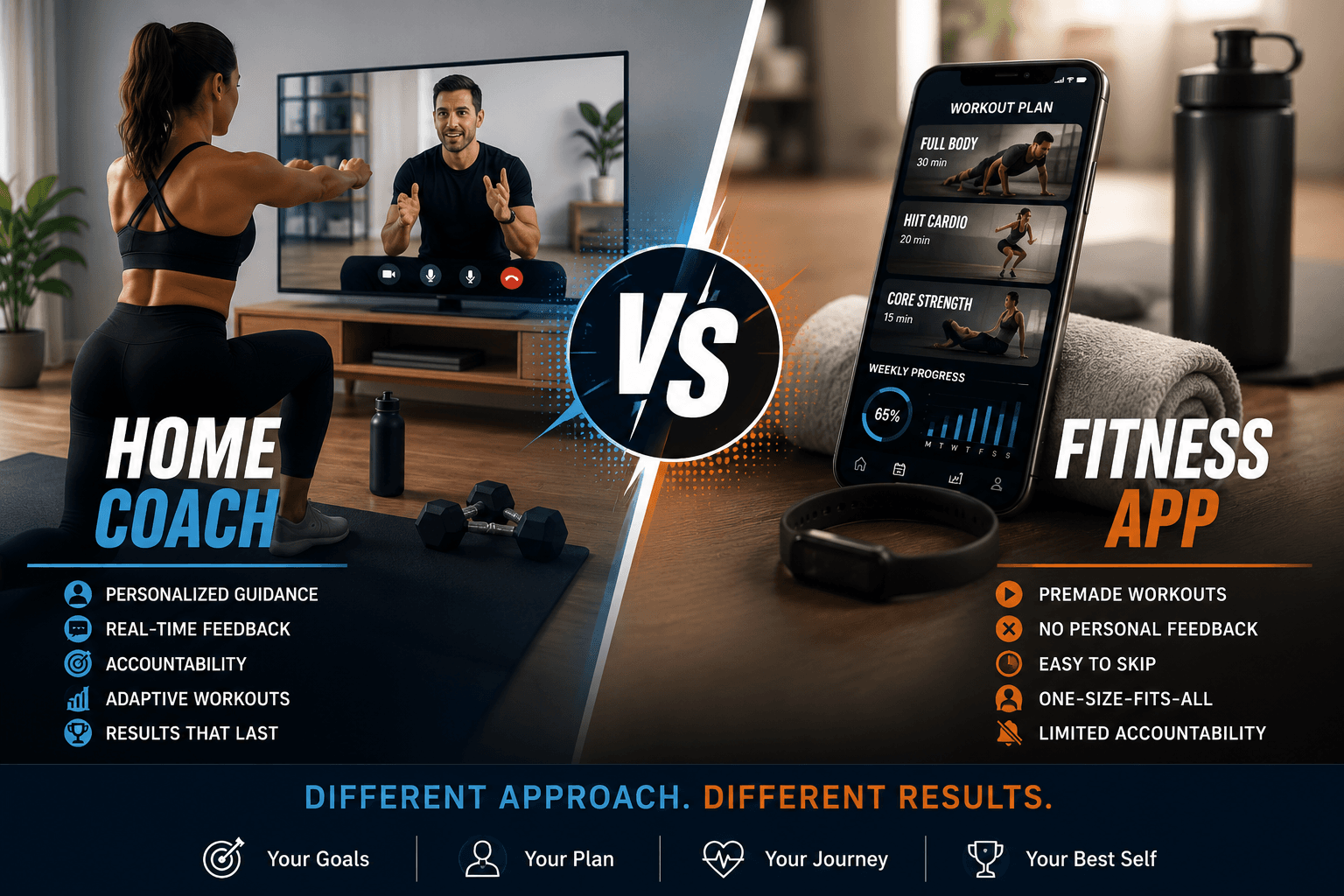
Home workout coaching vs. a fitness app: what you actually get
A live group session can cost less than a premium app subscription. Here's what the app is genuinely good at, what only a real coach can catch, and the real numbers behind both.
The short answer
How much does a personal trainer cost? A well-known fitness app runs roughly $10–20 a month. A live group coaching session with Younes Eddiki on P2Bridge costs $17 — a single session, not a subscription, with an actual coach watching you move. A private one-to-one session runs $50. Is a personal trainer worth it at that price? For most people getting started, yes — the app can't see your form, and a coach can.
The app gives you structure and a library of exercises. It cannot see that your knee is caving in on rep eight. That's the entire difference, and it's a smaller price gap than most people assume.
What a good fitness app actually does well
Worth saying plainly before making any case for coaching: fitness apps are not a scam and they are not useless. Dismissing them to make coaching look better is the kind of argument that falls apart the moment someone's actually used a good one.
A decent app gives you a personalized workout plan instead of guesswork, a large library of exercises with demonstration video, progress tracking that's more consistent than a notebook, and total schedule flexibility — no booking, no waiting for a slot, workout at 6am or 11pm without asking anyone. For someone chasing general fitness or a personal trainer for weight loss-style goal who already knows how to move well, that's most of what training actually requires.
If you've lifted for a couple of years, know what good form feels like in your own body, and mainly need programming rather than supervision, an app is a genuinely reasonable tool. No article should try to talk you out of that. This is also roughly where online fitness coaching apps and algorithm-driven platforms genuinely earn their subscription fee — structure at scale, cheaply.
What no app can do
Here's the part that actually matters, stated specifically rather than as a vague pitch: an app cannot see you. Not "doesn't see you well" — cannot, structurally, at all. A demo video shows what a rep should look like. It has no information about what your specific rep looked like five seconds ago.
Concretely, this is what goes uncaught:
- A knee drifting inward on a squat, usually starting around the point of fatigue where nobody's paying close attention to their own form anymore
- A lower back rounding on a hip-hinge movement, the single most common way people hurt themselves training at home alone
- Momentum replacing control on a press or a row — using body swing to move the weight rather than the target muscle, which feels like progress and isn't
- Breathing that's completely wrong for the effort, holding breath through a heavy set or breathing in exactly the wrong part of the rep
None of this shows up in a workout log. Reps completed, weight used, calories estimated — the app records all of it faithfully, and none of it tells you whether the movement itself was any good. A coach watching live catches the knee on rep eight, not the injury three months later.
How Much Does a Personal Trainer Cost, Really?
This is usually where the comparison gets vague — "coaching is an investment," "quality costs more" — so here are the actual numbers instead. How much is a personal trainer in the format that actually matters for someone training at home? Not the $80–150 a session you'd pay for in-person, one-to-one, in-studio training. Live online coaching is a different category entirely.
| Option | Cost | What you get |
|---|---|---|
| Fitness app | ~$10–20/mo | Programming, exercise library, tracking, full flexibility |
| Younes — group class | $17 | Live coaching, real-time form correction, single session |
| Younes — private session | $50 | Fully tailored one-to-one, built around your specific goals |
| Javier — functional bodybuilding | Varies by format | Biomechanics-focused coaching, form and longevity |
The honest read: an app wins decisively on flexibility and cost-per-workout if you're training four or five times a week. But if the real question is "can I get a real coach to actually watch me move," the answer isn't hundreds of dollars a month — it's the same as a single month of an app subscription, for one focused session with someone who can see you.
Younes Eddiki
Strength & CoachingYounes teaches from Morocco with six years of coaching experience, and his approach leans on something apps structurally can't offer: a real relationship with the person he's training, session to session, not just a program generated once and repeated. His Home Workout Coach class is built specifically for training at home with minimal equipment — functioning as an in home personal trainer without the in-home hourly rate, for the exact setup an app assumes you're managing alone.
The class runs $50 for a private session or $17 in a group setting, live, with Younes coaching in real time rather than a pre-recorded routine playing in the background while you guess whether you're doing it right.
Book Younes's $17 group class
Live strength and muscle-building coaching, for less than most people pay for an app they use twice a month.
See Younes's class Browse all hostsJavier Cano
Functional BodybuildingJavier's angle is different from Younes's, and it's worth understanding as a distinct case for coaching, not a repeat of the same argument. His specialty is functional bodybuilding — training that builds real strength and muscle while staying grounded in biomechanics: how a joint is supposed to move, how a movement pattern should feel, what "good form" is actually protecting against. It sits closer to high intensity functional training and a genuine bodybuilding and crossfit program hybrid than to traditional bodybuilding split routines. His focus on longevity, not just aesthetics, is a genuinely different pitch than the typical bodybuilding-app content built purely around sets and reps.
This is precisely the kind of coaching that resists being replaced by an app. Generic functional bodybuilding exercises pulled from a video library assume your joints, proportions, and injury history match whoever demonstrated the movement. Biomechanics feedback is inherently individual, and it depends on someone watching you move it, not comparing your rep count to a target number.
Train with a biomechanics-focused coach
Javier's functional bodybuilding class runs in the same accessible $17–$50 per-session range as Younes's coaching — check the live listing for current pricing. Focus is on movement quality and long-term training health, not just volume.
See Javier's class & pricing Browse strength classesWho should just use an app
- You've trained for a couple of years and already have reasonably solid form — you need programming, not supervision
- Your schedule is genuinely unpredictable and booking a fixed session time isn't realistic most weeks
- You're mainly tracking — calories, reps, progressive overload numbers — more than you're learning new movement
- Budget is the deciding factor and you're training frequently enough that per-session coaching adds up fast
Who needs a real coach
- You're new to strength training and don't yet know what correct form actually feels like from the inside
- You've been training a while but plateaued, which is often a sign a technique issue has been quietly capping your progress
- You've had a previous injury and want someone watching specifically for the compensations that lead back to it
- You've never had anyone correct you and genuinely don't know what you don't know — the most common and least discussed reason people get hurt training alone
Getting the most out of a live session
A few things make a real difference in how much a coached session actually gives you, beyond just showing up.
Position your camera so your coach can see your whole body, not just your torso — form issues usually show up in the knees, hips, or feet first, and a close-up crop hides exactly what needs watching. Say what you're working around — a previous injury, a tight shoulder, anything relevant — before the session starts, not mid-set. Ask the obvious question if a cue doesn't make sense; a live coach can rephrase it three different ways until it clicks, which is the entire advantage over a fixed video demonstration.
See What Live Coaching Actually Costs
Group sessions start at $17 — about the same as one month of a typical app subscription, but for a real coach watching your form live.
Browse fitness classes See group sessionsQuestions people ask
How much does a personal trainer cost?
In-person personal training commonly runs anywhere from $50 to well over $100 per session, which is where a lot of the "trainers are expensive" assumption comes from. Live online group coaching is a different price category entirely — Younes Eddiki's group class on P2Bridge is $17 per session, with a private one-to-one option at $50.
Is a personal trainer worth it?
It depends on what you already know. If your form is solid and you mainly need a plan to follow, an app covers most of what you need. If you're newer to training, coming back from injury, or have plateaued without knowing why, a coach who can actually watch you move typically closes that gap faster than any app can, since the core problem — not being able to see your own form — is one an app structurally cannot solve.
Can a fitness app really not tell if my form is wrong?
Correct — a standard app has no way to observe your specific rep in real time. It can show a demonstration video of correct form, but it has no information about what your body actually did five seconds ago. Some newer apps use phone-camera motion tracking for limited feedback, but this remains far less reliable than a trained human watching you move.
What's the difference between Younes's classes and Javier's?
Younes focuses on home-based strength and muscle-building coaching, with an emphasis on real-time guidance for people training with minimal equipment. Javier specializes in functional bodybuilding, centered specifically on biomechanics, movement quality, and training for long-term joint and movement health rather than aesthetics alone.
Do I need to be experienced to book a coaching session?
No — coaching is often more useful for beginners than for experienced lifters, since it establishes correct movement patterns from the start rather than correcting habits that have already set in. Mention your experience level when booking so the session can be paced appropriately.
Can live online coaching really replace an in-person trainer?
For most of what coaching actually provides — real-time form correction, personalized cueing, accountability — yes, live video is close to equivalent, since a coach watching you clearly on camera can see the same issues they would in a room. The main thing in-person offers that online can't is physical spotting for genuinely heavy lifts, which matters for advanced strength training more than for most general fitness goals.
What equipment do I need for a home workout coaching session?
It depends on the specific class — Younes's Home Workout Coach sessions are built around minimal equipment by design, since the whole point is training effectively at home. Check the class listing or ask before booking if you're unsure what a specific session assumes.
Can I become an online personal trainer or online bodybuilding coach on P2Bridge?
Yes — P2Bridge hosts, including Younes and Javier, teach as independent coaches on the platform. If you're wondering how to become an online personal trainer or an online bodybuilding coach yourself, becoming a P2Bridge host is a genuine path, separate from booking as a learner.