





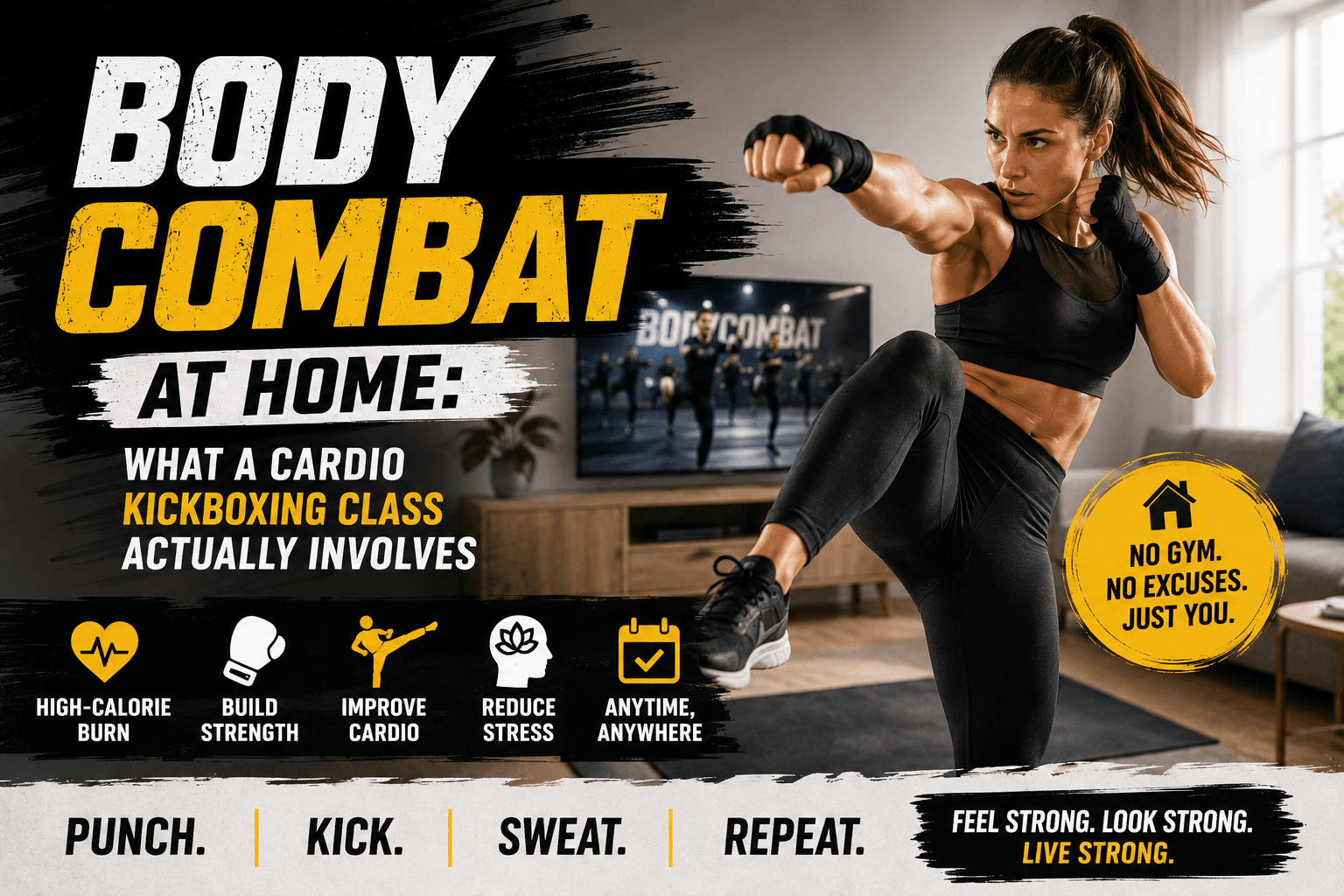
Body Combat at home: what a cardio kickboxing class actually involves
There's no bag in your living room. What you're really doing is shadow boxing — and that changes the workout more than most people expect.
The short answer
A home cardio kickboxing class is shadow boxing to a count — punches and kicks thrown into open air, in combinations, for around forty minutes. A typical session runs 10 minutes warm-up, 40 minutes of work, 10 minutes cool-down. You need a mat, water, and enough clear space to fully extend an arm and a leg without hitting furniture.
The one rule that prevents most injuries: never lock out a punch. With no bag to absorb it, your own elbow has to stop the arm. Keep a soft bend and snap it back.
At home, it's shadow boxing
Most cardio kickboxing content is written by studios, and it shows. Bag work, pad drills, partner rounds. None of which you have in a living room at seven in the morning.
What you actually do at home is shadow boxing — or shadowboxing, written either way — throwing punches and kicks into open air, following a count. Learning how to shadowbox properly is most of what a beginner class teaches. That's not a watered-down version of the real thing. Shadow boxing is a genuine training method that boxers use every session of their careers, and doing it for forty continuous minutes is harder than it sounds.
But it is different, in three ways that matter and that nobody explains.
Nothing absorbs the punch. When you hit a bag, the bag stops your arm. Throwing into air, your own elbow joint has to decelerate a limb moving at full speed. Do that with a locked-out arm a few hundred times and you'll find out why hyperextension is the most common home-kickboxing injury. This is the single most important thing to understand about how shadow boxing works — and if you've searched how does shadow box work and got vague answers, this is the concrete one — and it's why every good instructor says the same thing: soft elbow, snap it back.
Nothing sets your rhythm. A bag gives feedback — thud, thud, thud — and that rhythm paces you. Alone in a room, pacing comes entirely from the count. Which is a real argument for a live class over a recording: a video can't notice you've quietly slowed down in round three. A person watching can.
The conditioning demand goes up, not down. No bag means no micro-pauses to reset. You are moving continuously, and forty minutes of that is a serious cardiovascular session.
What a session actually looks like
Younes Eddiki, who teaches both cardio classes on P2Bridge, publishes his structure openly, and it's a sensible template for any shadow boxing routine:
His class notes are refreshingly plain about what's required: "Beginner-friendly class. No martial arts experience required. Low equipment needed. Make sure you have enough space to move safely. Stop if you feel pain or dizziness." That last line is worth taking literally.
The four punches
Every combination you'll ever throw is built from four punches. Of all the techniques for boxing, these are the only ones you strictly need before a first class. Learn these properly and boxing exercises for beginners stop feeling like flailing.
1 — The Jab
Lead hand · straight
Lead hand fires straight out from your guard, palm rotating down as it extends, and returns immediately along the same line. Fast, light, constant. It's the punch you'll throw more than all others combined.
Form error: dropping the rear hand as the jab goes out. Your guard hand stays at your cheek.
2 — The Cross
Rear hand · straight · power
Rear hand, straight down the middle, driven by the back foot pivoting and the hip rotating through. The power comes from the ground, not the arm — which is the thing beginners take longest to feel.
Form error: punching with the arm alone while the feet stay planted. If your back heel doesn't turn, you're arm-punching.
3 — The Hook
Either hand · horizontal arc
Elbow bent at roughly ninety degrees, arm swinging horizontally, rotating from the hips and pivoting the lead foot. The arm shape stays fixed — the body turns it.
Form error: swinging from the shoulder with a loose elbow. The angle stays locked; the rotation does the work.
4 — The Uppercut
Either hand · vertical
Drop slightly at the knees, then drive upward with the fist travelling vertically, palm facing you. Short range, and it comes from the legs more than any other punch.
Form error: winding up first. A telegraphed uppercut is a slow one, and in a cardio context it wrecks your rhythm.
Learning how to shadow box with hands correctly positioned matters more than power. Guard up, chin down, elbows in. Nobody is scoring your punch shadow work on force — you're training how to move.
The kicks
This is what separates kickboxing from boxing, and where most beginners discover their hips are tighter than they thought.
Front kick (teep). Knee lifts to chest height, foot extends forward, ball of the foot leading, then snaps back to the chambered position. Push, not swing.
Roundhouse. Pivot the standing foot until the heel points at the target, turn the hip over, and swing the shin through in an arc. The pivot is everything — if the standing foot doesn't turn, the hip can't open and the knee takes the strain.
Knee strike. Drive the knee upward and forward, hips pushing through. Short range, very high effort, and a good way to raise heart rate fast.
Kickboxing for beginners has one near-universal rule about kicks, and this is it: start every kick low. Waist height is plenty. Height comes from hip mobility you build over weeks, and chasing it early is how people strain hip flexors.
Try It With Someone Counting
Younes Eddiki's Body Combat Full Body Burn is 60 minutes, beginner level, $17 group or $50 private — rated 4.6★ from 27 reviews. No martial arts experience required.
Book a kickboxing class — $17 Browse fitness classesCombinations worth learning
Punches are numbered — jab is 1, cross is 2, lead hook is 3, rear hook is 4, lead uppercut is 5, rear uppercut is 6. Instructors call numbers, you throw the sequence. These are the shadow box combos worth knowing before your first class.
| Called as | Sequence | What it trains |
|---|---|---|
| 1–2 | Jab, cross | The foundation. Hip rotation and returning to guard. |
| 1–1–2 | Jab, jab, cross | Rhythm and not over-committing on the lead hand. |
| 1–2–3 | Jab, cross, lead hook | Switching from straight to horizontal — the hardest transition. |
| 1–2–5–2 | Jab, cross, lead uppercut, cross | Changing levels mid-combination. |
| 1–2 + roundhouse | Jab, cross, rear roundhouse | The full kickboxing shape — hands then feet. |
| 3–2–3 | Lead hook, cross, lead hook | Continuous rotation. Genuinely tiring. |
Plenty of shadow boxing ideas exist beyond numbered drills — mirror work, moving around an imaginary opponent, adding footwork between combinations. But a structured shadow boxing routine built on numbers is the fastest way in, because you can follow it without knowing anything yet.
Is shadow boxing actually a good workout?
Yes, with one honest caveat that most articles skip.
As cardio, it's excellent. Continuous full-body movement, high heart rate, no equipment. The CDC's physical activity guidelines ask adults for 150 minutes of moderate activity per week — but vigorous activity counts double, so 75 minutes covers it. One hour-long class plus a short second session and you've met the adult aerobic guideline for the week. That's a genuinely useful way to think about it.
Does shadow boxing build muscle? Not meaningfully. This is where honesty matters: throwing punches with no resistance builds muscular endurance and coordination, not size or maximal strength. Your shoulders will get better at working for forty minutes. They won't get bigger. If that's your goal, you need actual resistance work alongside it — the CDC also asks for muscle-strengthening on two days a week, and shadow boxing doesn't cover that.
The genuine benefits of shadowboxing — and the reason shadow boxing for cardio has become a mainstream format rather than a fighter's warm-up — are cardiovascular conditioning, coordination, a surprising amount of core work from rotation, and — the one people don't expect — stress. There's something about throwing a hundred punches that resolves a bad day more efficiently than most things. Younes's own class description names it directly: endurance, conditioning, and stress release.
Equipment: what you genuinely need
Shadow boxing equipment is a short list, which is most of the appeal.
- Clear space. Enough to fully extend an arm and throw a kick without hitting a lamp. Roughly two metres square.
- A mat. For the warm-up and cool-down floor work more than the standing portion.
- Water. You will need more than you expect.
- Supportive shoes, or bare feet on a non-slip surface. Pivoting on carpet in socks is how ankles roll.
That's it. No gloves — there's nothing to hit. No bag, no wraps, no pads. Some people add light hand weights, which I'd discourage for beginners: weighted punches into air significantly increase joint stress at exactly the moment your form is least reliable.
Making it a HIIT session
Boxing adapts unusually well to interval structure, which is why boxing HIIT workout formats have become common. The natural unit is already there: a boxing round is three minutes, and intervals map onto it cleanly.
A simple HIIT boxing training structure: 40 seconds of continuous combinations at high output, 20 seconds of light footwork or rest, repeated eight to ten times. That's high intensity interval training boxing in its simplest form, and it's brutal in a way that steady-pace work isn't.
Worth knowing: HIIT training for boxing is a different goal than HIIT training boxing as general fitness. Fighters use it for sport-specific conditioning. For most people, a high intensity boxing workout is simply an efficient way to get a lot of cardiovascular stimulus into a short window. Both are legitimate. Only one requires you to learn to take a punch.
A note on intensity
Boxing HIIT is genuinely demanding, and the format encourages you to push. If you're new to vigorous exercise, start with the steady-paced version of the class and add intervals once the movements are automatic. Learning technique while gasping is a reliable way to build bad habits.
What it does to your shoulders and hips
An hour of combinations loads two areas harder than people anticipate.
Shoulders. Hundreds of repetitions of a small, fast movement with the arms held up throughout. The deltoids and rotator cuff work continuously, and the guard position itself is a sustained isometric hold most people never train.
Hips. Kicking demands rotation and flexion at ranges that a desk-bound body doesn't have. This is where the "my hips are tighter than I thought" realisation happens, usually about ten minutes in.
Which is why the recovery classes below aren't padding. They're the specific counterweight to what this class does.
A kickboxing class near you vs. live online
Searching cardio kickboxing classes near me is the obvious move, and for some people a studio is genuinely the right answer — particularly if you want bag work, sparring, or the atmosphere of a room full of people.
But for the shadow-boxing version specifically, the online case is stronger than it looks:
- You need space, not equipment. Unlike weight training, there's nothing at a gym you can't replicate at home.
- Form correction is entirely visual. Whether your elbow is locking, whether your back heel pivots — an instructor sees all of that on camera.
- Nobody is watching you be bad at it. A real consideration for a lot of beginners, and one studios rarely acknowledge.
The honest counterpoint: if you want to actually hit something, no video call solves that. Bag work is a different and legitimate thing.
Who should be careful
Check before starting
Shoulder injuries or instability — repeated fast extension is exactly the loading pattern that aggravates them. Knee problems — the roundhouse pivot rotates a loaded knee, and doing it badly is worse than not doing it. Hip issues — kicking demands range you may not currently have; keep kicks low. Cardiovascular conditions — this is vigorous exercise, and it raises heart rate fast.
Younes's own class notes say to stop if you feel pain or dizziness, which is the right instruction. If you have a diagnosed condition or a recent injury, speak with a doctor or physiotherapist first — the National Institute on Aging's guidance on exercising with chronic conditions is a sensible non-commercial starting point.
Learning it live
One honest note before the classes: Younes is the only instructor teaching cardio kickboxing on P2Bridge. The other three below teach recovery and mobility work that pairs with it — they're not alternatives, they're what your shoulders and hips will want afterwards.
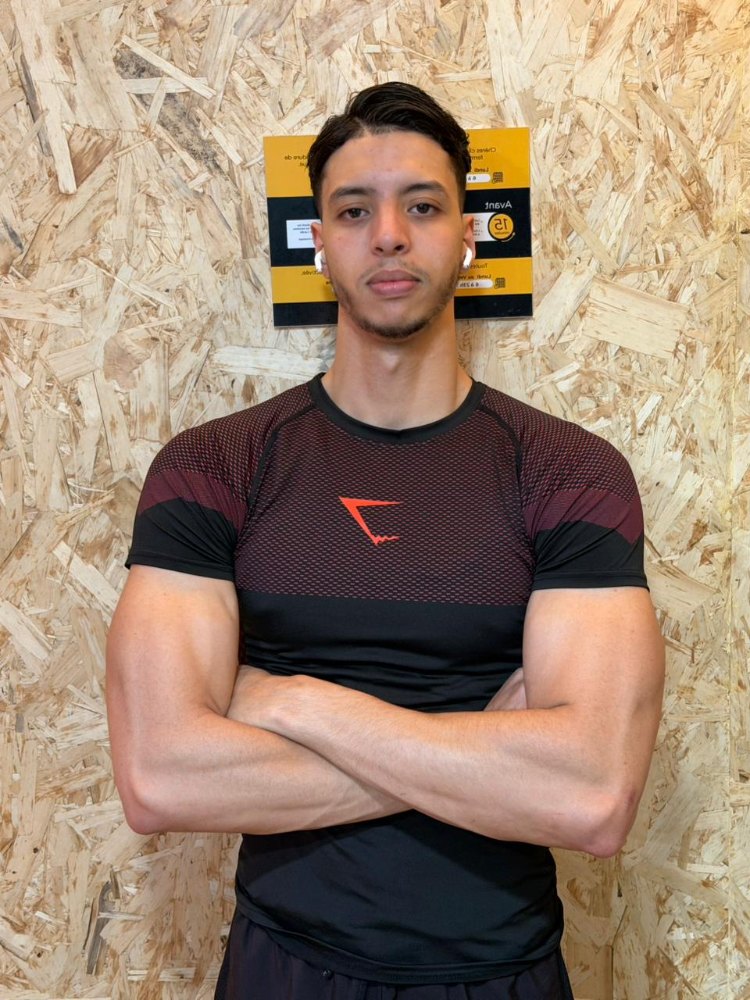
Body Combat Full Body Burn
★★★★★4.6 (27 Reviews)High-energy cardio built on boxing and martial arts movements, explicitly beginner-friendly with no martial arts background required. Six years coaching people across a wide range of ages and fitness levels — and his stated aim is as much about the community and the mindset as the workout itself.
Book — $17 group Younes's profile
Full Body Fat Burn
★★★★★4.6 (27 Reviews)Same coach, same 10/40/10 structure, without the boxing technique. If you want the conditioning but don't want to learn combinations, this is the simpler entry point — mat, water, small space, follow along.
Book — $17 group His stretch class
Posture Reset: Yoga for Better Alignment
★★★★★4.5 (4 Reviews)An hour with your guard up is a sustained shoulder and upper-back load most people never train for. This targets exactly that — alignment work for the area kickboxing tightens most.
Book — $25 group Unnati's profile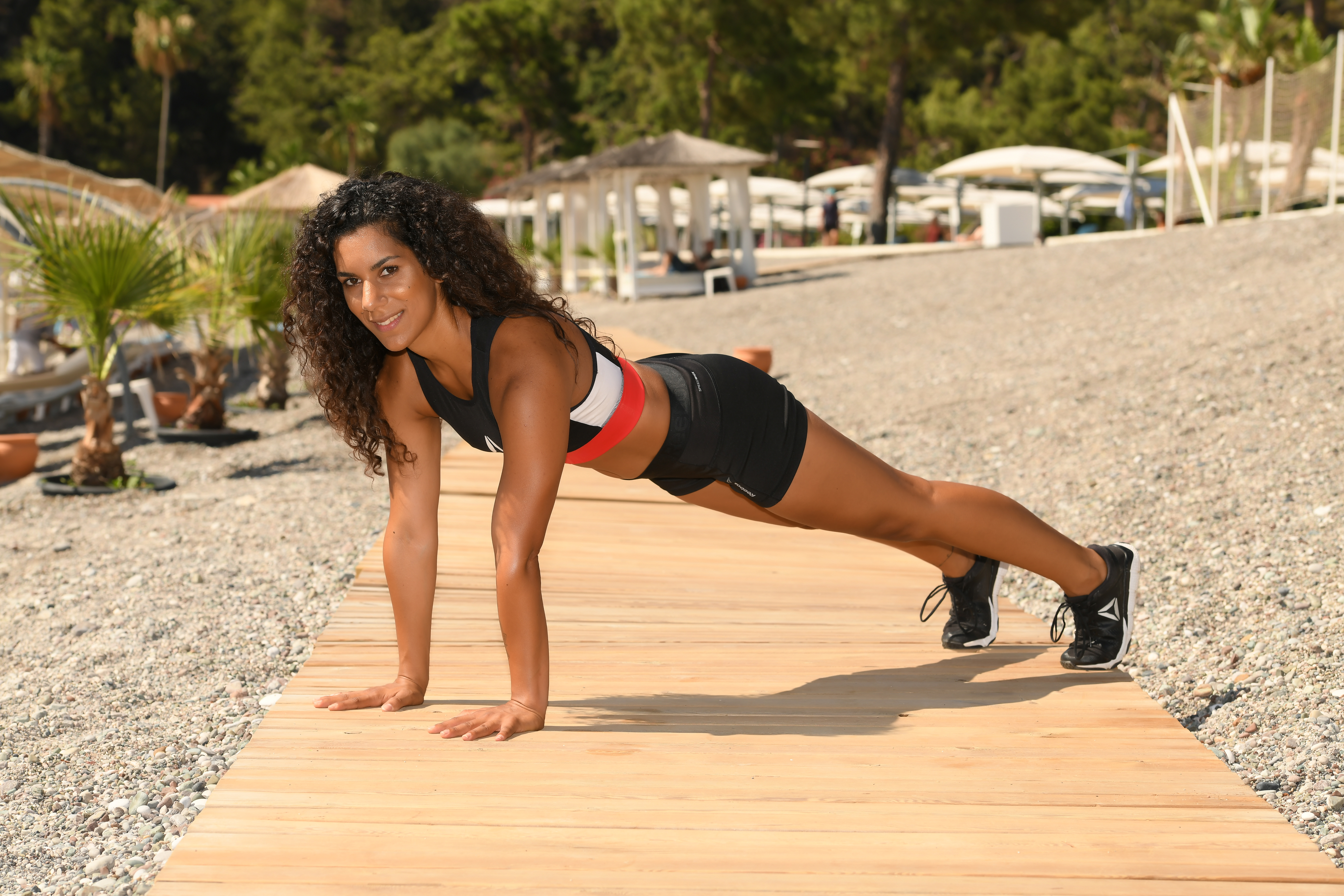
Morning Mobility
★★★★★5.0 (8 Reviews)Kicking asks for hip rotation and flexion that most bodies don't currently have. Ten years of experience, no equipment needed, and the highest-rated class on this page.
Book — $18 group Sarah's profile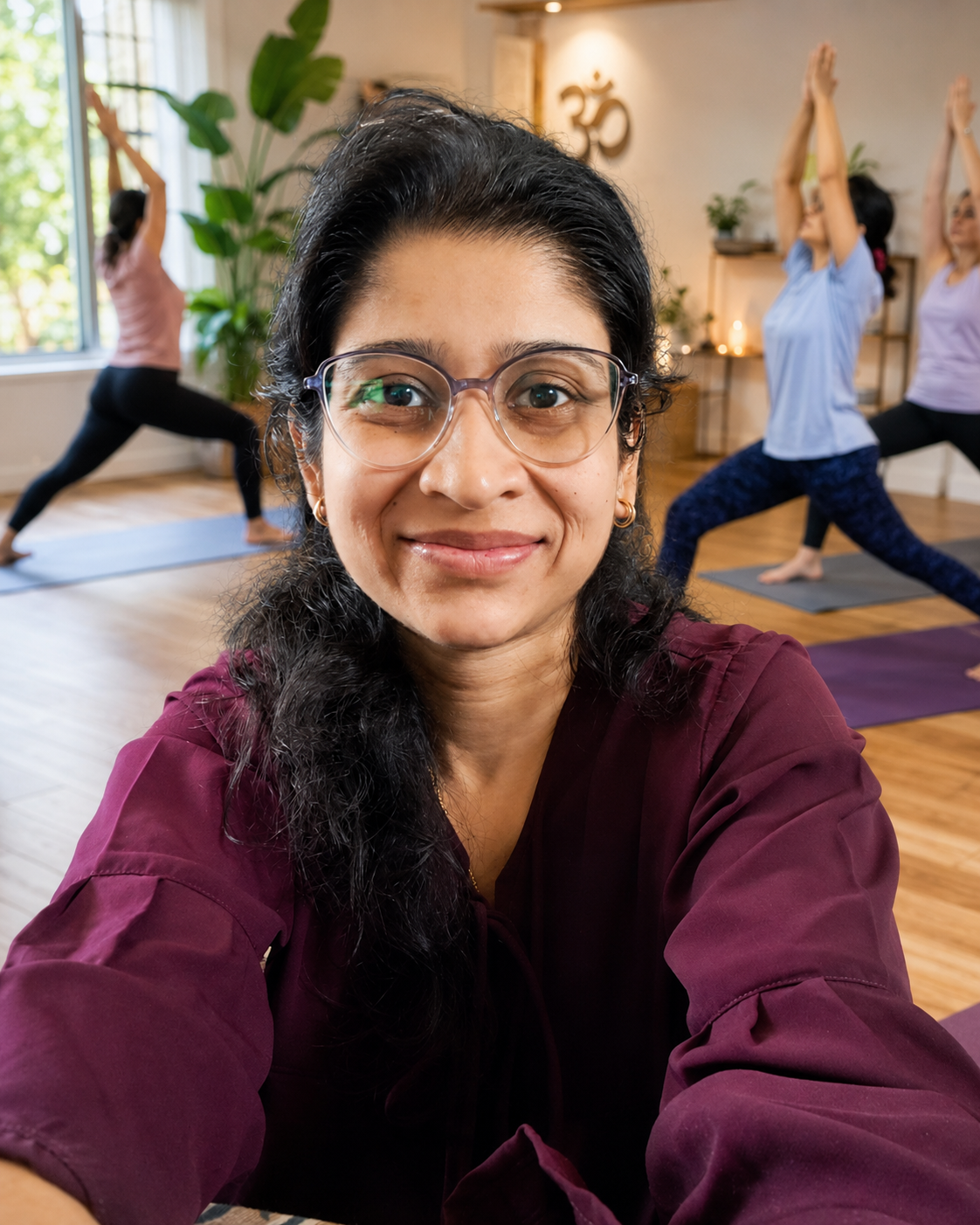
Yoga for Arms Strength
★★★★★4.9 (39 Reviews)Since shadow boxing builds endurance rather than strength, this fills the gap directly — bodyweight arm and shoulder work from the platform's most-reviewed yoga host.
Book — $10 group Rabab's profileBuild the Whole Week Around It
Kickboxing twice ($17, 4.6★), mobility once ($18, 5.0★), posture work once ($25, 4.5★). That's a complete week — and it meets the CDC aerobic guideline on the kickboxing alone.
See all group classes Book a private sessionFor structuring the rest of your training, our guide to building a weekly practice covers combining hard cardio with recovery, and morning mobility routines is the short-session version. If the strength gap matters to you, see home workout coaching vs. a fitness app. Browse the full strength category, the yoga category, the host directory, or more writing on the blog. Teams can book together via P2Bridge for Teams, and if you teach this, you can become a host.
Questions people ask
Is shadow boxing a good workout?
As cardiovascular exercise, yes — genuinely. Continuous full-body movement with no equipment, sustaining an elevated heart rate for the length of the session. Because it counts as vigorous activity, roughly 75 minutes a week meets the adult aerobic guideline, so one long class plus a short second session covers it. What it doesn't do is build significant muscle.
Does shadow boxing build muscle?
Not meaningfully. Throwing punches against no resistance develops muscular endurance and coordination rather than size or maximal strength. Your shoulders get better at working for forty minutes; they don't get bigger. If muscle is the goal, pair it with actual resistance training twice a week.
What equipment do I need for shadow boxing at home?
Very little: clear space roughly two metres square, a mat for floor work, water, and either supportive shoes or bare feet on a non-slip surface. No gloves or wraps, since there's nothing to hit. Light hand weights are best avoided by beginners — they raise joint stress at the point where form is least reliable.
How does shadow boxing work if there's nothing to hit?
The resistance isn't the point — the movement is. You're training coordination, rotation, footwork and cardiovascular endurance by throwing full-speed combinations into air. The key technical difference is that your own joints must decelerate each limb, which is why you never lock out a punch and always keep a soft elbow.
Do I need martial arts experience for a cardio kickboxing class?
No. Beginner classes assume zero background — instructors call combinations by number and demonstrate everything. Learning the four punches and two or three kicks is enough to follow a full session, and technique refines over subsequent classes rather than being a prerequisite.
What are the benefits of shadow boxing beyond fitness?
Coordination and rhythm improve noticeably, core rotation gets trained more than people expect, and there's a real stress-release effect that most participants mention before they mention the cardio. It also requires enough concentration on sequences that it occupies your attention completely, which is its own form of break.
Can I turn shadow boxing into a HIIT workout?
It adapts to interval structure unusually well. A common format is 40 seconds of continuous combinations at high output followed by 20 seconds of light footwork, repeated eight to ten rounds. Learn the movements at a steady pace first — building technique while gasping tends to embed bad habits.
Why do my shoulders hurt after kickboxing?
Two likely causes. Holding a guard position for an hour is a sustained isometric load most people never train. And if you're locking out punches rather than keeping a soft elbow and snapping back, you're asking the joint to absorb deceleration hundreds of times. Fix the elbow first, then add shoulder and posture work between sessions.
Is a live class better than following a video?
For this specifically, yes — because pacing and form both drift without feedback. A recording can't see that your back heel never pivots, or that you slowed down in round three. Live instruction catches both in the moment, which matters more in kickboxing than in most formats because bad punching mechanics cause real joint problems.