



Yoga · Choosing a practice
Hatha vs. Vinyasa vs. Yin: which style is actually right for you?
They aren't three difficulty levels. They load different tissue, for different lengths of time, toward different ends — and once you know which, the choice makes itself.
The short answer
Hatha holds poses for roughly thirty seconds to a minute and teaches you what each one is supposed to feel like. Vinyasa links poses to your breath in continuous movement and builds heat. Yin holds a handful of floor poses for two to five minutes with the muscles deliberately relaxed, which loads connective tissue instead of muscle.
New to yoga? Start with Hatha. Want a workout that leaves you sweating? Vinyasa. Stiff, stressed, or sitting at a desk nine hours a day? Yin — and probably sooner than you think.
The one distinction that explains all three
Almost every article on this subject gives you three definitions and leaves. Which is why they all blur together and none of them help you pick.
Here's the thing that actually separates these practices, and it isn't difficulty or spirituality or how much you sweat. It's which tissue you're loading, and how long you load it.
Muscle responds well to rhythmic, repetitive, relatively brief effort. Contract, release, repeat. That's what a Vinyasa flow does, and it's what almost every form of exercise you've ever done does.
Connective tissue behaves differently. Fascia, ligaments, joint capsules — this stuff is less vascular, slower to adapt, and largely indifferent to short bursts of effort. What it responds to is sustained, gentle load. Not intense. Sustained. That single fact is the entire reason Yin poses are held for minutes rather than breaths, and it's why your teacher keeps telling you to let your muscles go slack in a Yin shape. If you grip, the muscle absorbs the load and the connective tissue never receives the signal. You can hold a pose for four minutes and get almost nothing from it by clenching through the whole thing.
Everything else — the pace, the props, the lighting, whether there's music — follows from that.
Hatha
FoundationalStart with a small piece of trivia that clears up a lot of confusion: hatha technically refers to essentially all physical yoga. Ha and tha, sun and moon. By that definition Vinyasa is Hatha, and so is nearly everything else with poses in it.
But that's not what the word means on a class schedule. On a schedule, "Hatha" means slower. You come into a pose, you stay there for a handful of breaths, the teacher talks about where your weight should be and what your front rib cage is doing, and then you come out and do another one. There's no continuous flow. There's time to think.
That time is the whole point. In a fast class you're too busy keeping up to notice that your shoulders are creeping toward your ears. In Hatha you have forty-five seconds and nothing to do but notice.
What it's good for: learning what the poses are, building baseline strength honestly, and developing the self-awareness that makes every other style safer afterward.
People sometimes dismiss it as the easy option. That's a mistake — holding a well-aligned Warrior II for a full minute is genuinely hard, just not in the cardio sense.
Vinyasa
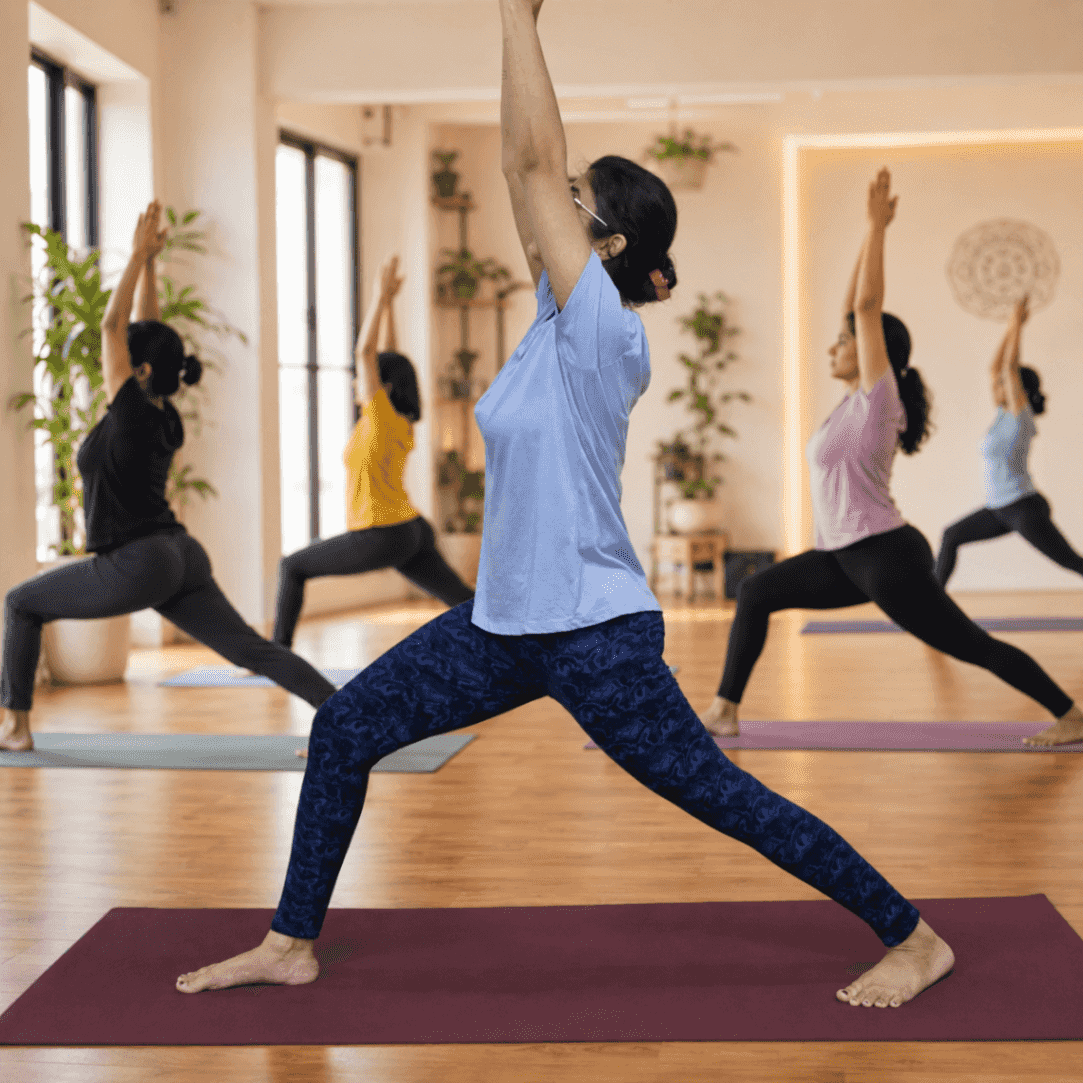
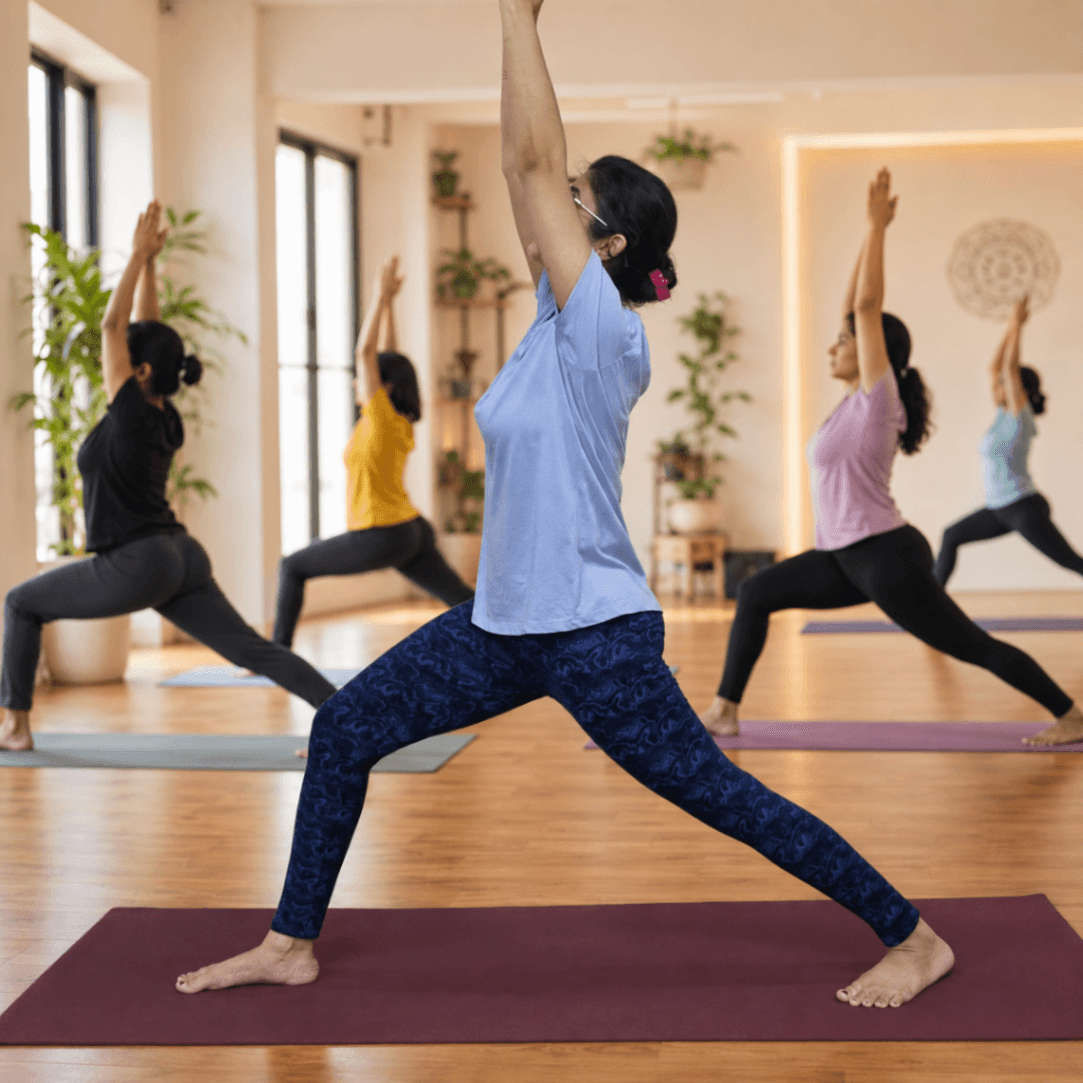
DynamicVinyasa roughly means to place in a particular way, and in practice it means one movement per breath. Inhale, arms up. Exhale, fold. The breath sets the tempo and the sequence keeps going, which is why people call it flow.
It grew out of the Ashtanga tradition, where a fixed sequence is repeated, though most Vinyasa classes today are choreographed fresh by the teacher. Two Vinyasa classes from different teachers can feel like different disciplines. That's normal.
This is the closest yoga gets to a workout in the conventional sense. Your heart rate goes up, you sweat, you finish tired. If you're coming from running or the gym and want yoga to feel like training, this is the one.
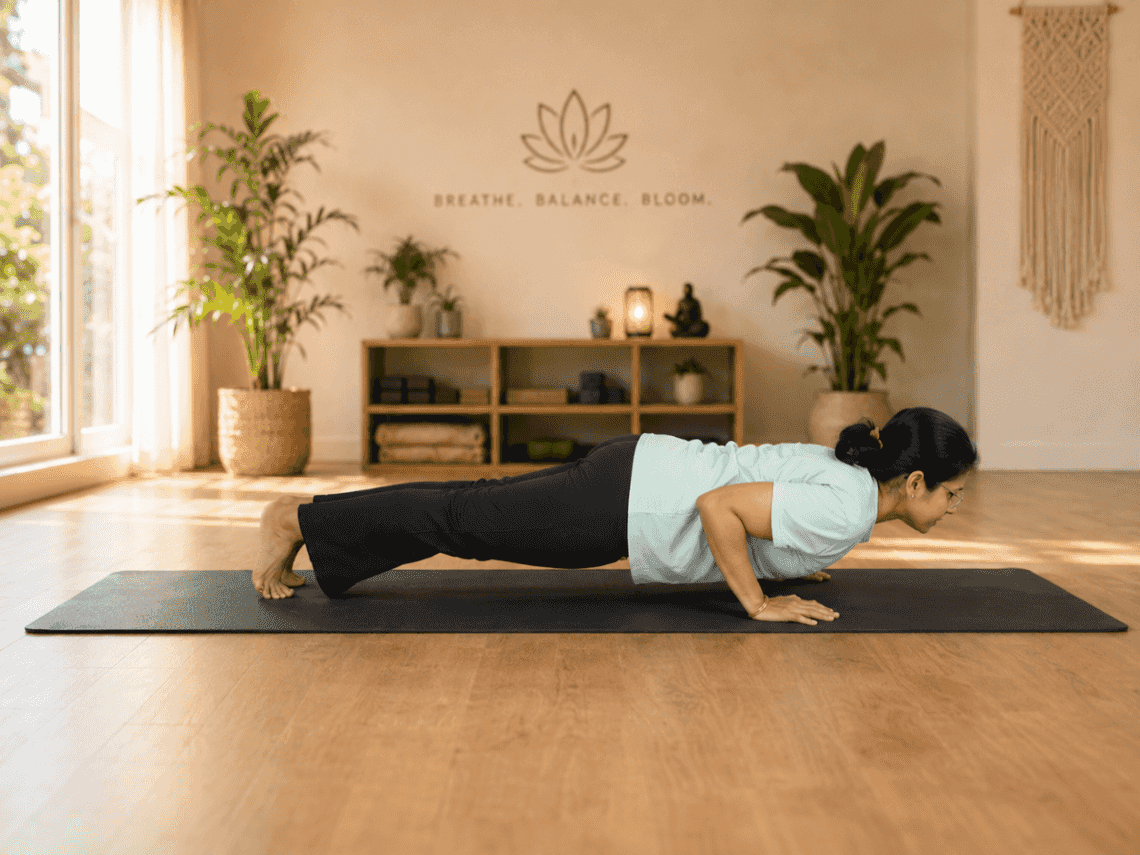
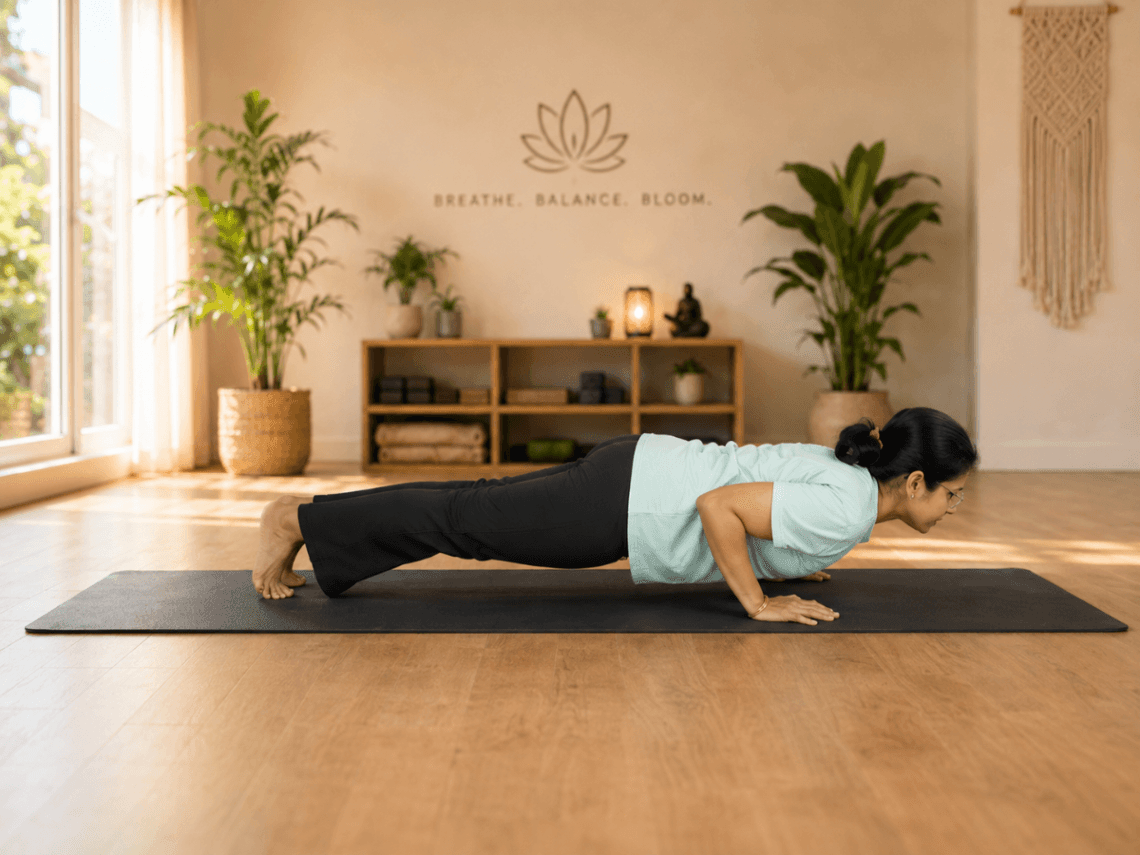
The catch is that speed hides sloppiness. Chaturanga — the low push-up-shaped pose that appears dozens of times in a typical flow — is where a lot of shoulder injuries come from, because it's easy to dump your weight forward and let the shoulders roll in when you're moving fast and trying to keep up. A teacher watching you can catch that in the first round. A video cannot.
Yin
Yin is the one people misjudge, usually in both directions at once. They assume it's easy because nothing is moving, then find the third minute of a shape genuinely difficult in a way a hard flow never is.
The modern practice traces through Paulie Zink's Taoist yoga into the work of Paul Grilley and Sarah Powers, and it runs on three instructions: find an appropriate edge, be still, hold for time. Note that "appropriate edge" doesn't mean maximum depth. Back off to somewhere around seventy percent of what you could reach. You have to stay there for three minutes, and what feels reasonable in the first fifteen seconds will feel very different at minute two.
Beginners treat depth as the goal. In Yin, depth is what you give up in exchange for time.
That trade is the entire discipline. In a Vinyasa class you might be in a forward fold for five seconds, so you go as deep as you can reach. In Yin you're there for three minutes, and the depth that felt fine on the way in becomes something else entirely by minute two. Set up at a depth you could imagine tolerating for the full hold, then let the pose come to you rather than the other way round.
Because the muscles are released, sensation shows up around the joints and along the connective tissue, which feels unfamiliar if all your movement experience is muscular. Dull and broad, not sharp. Sharp is a signal to come out.
What it's good for: long-term flexibility, joint mobility, and the nervous-system downshift that comes with staying still and breathing for an hour. Desk workers and endurance athletes tend to get the most out of it, for opposite reasons.
Side by side
| Hatha | Vinyasa | Yin | |
|---|---|---|---|
| Hold length | 30–60 seconds | 1–5 breaths | 2–5 minutes |
| Pace | Slow, with pauses | Continuous | Still |
| Muscles | Engaged | Engaged, continuously | Deliberately released |
| Primary tissue | Muscle | Muscle | Fascia, ligament, joint capsule |
| Intensity | Moderate | High | Low effort, high sensation |
| Sweat | A little | A lot | None |
| Props | Occasional | Rare | Constant — bolsters, blocks, blankets |
| Good first class? | Yes | Only with a patient teacher | Yes, though it feels odd at first |
| Main benefit | Alignment and foundation | Strength and cardiovascular work | Mobility and nervous-system downshift |
How to choose, by what you actually want
Pick by goal, not by reputation.
- You've never done yoga. Hatha. You want time to figure out what your body is doing before anyone asks you to do it quickly.
- You want it to count as exercise. Vinyasa, two or three times a week.
- You're stiff — hips, hamstrings, lower back. Yin. Stretching harder in a fast class won't fix this; duration will do more than intensity.
- You're stressed and not sleeping well. Yin, or Yin paired with guided meditation. Stillness is the active ingredient.
- You run, lift, or cycle seriously. Vinyasa will feel familiar; Yin is what your training is actually missing.
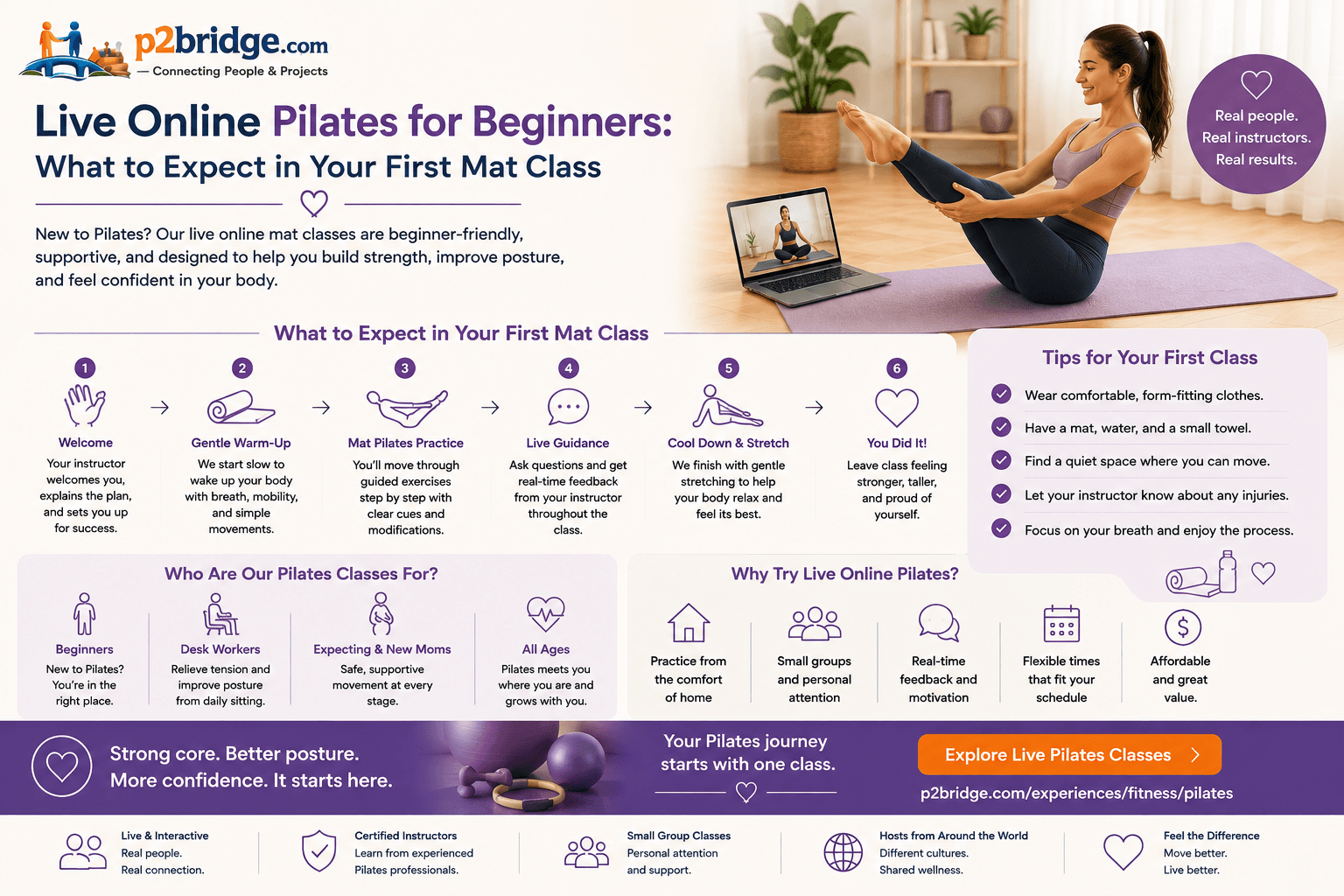
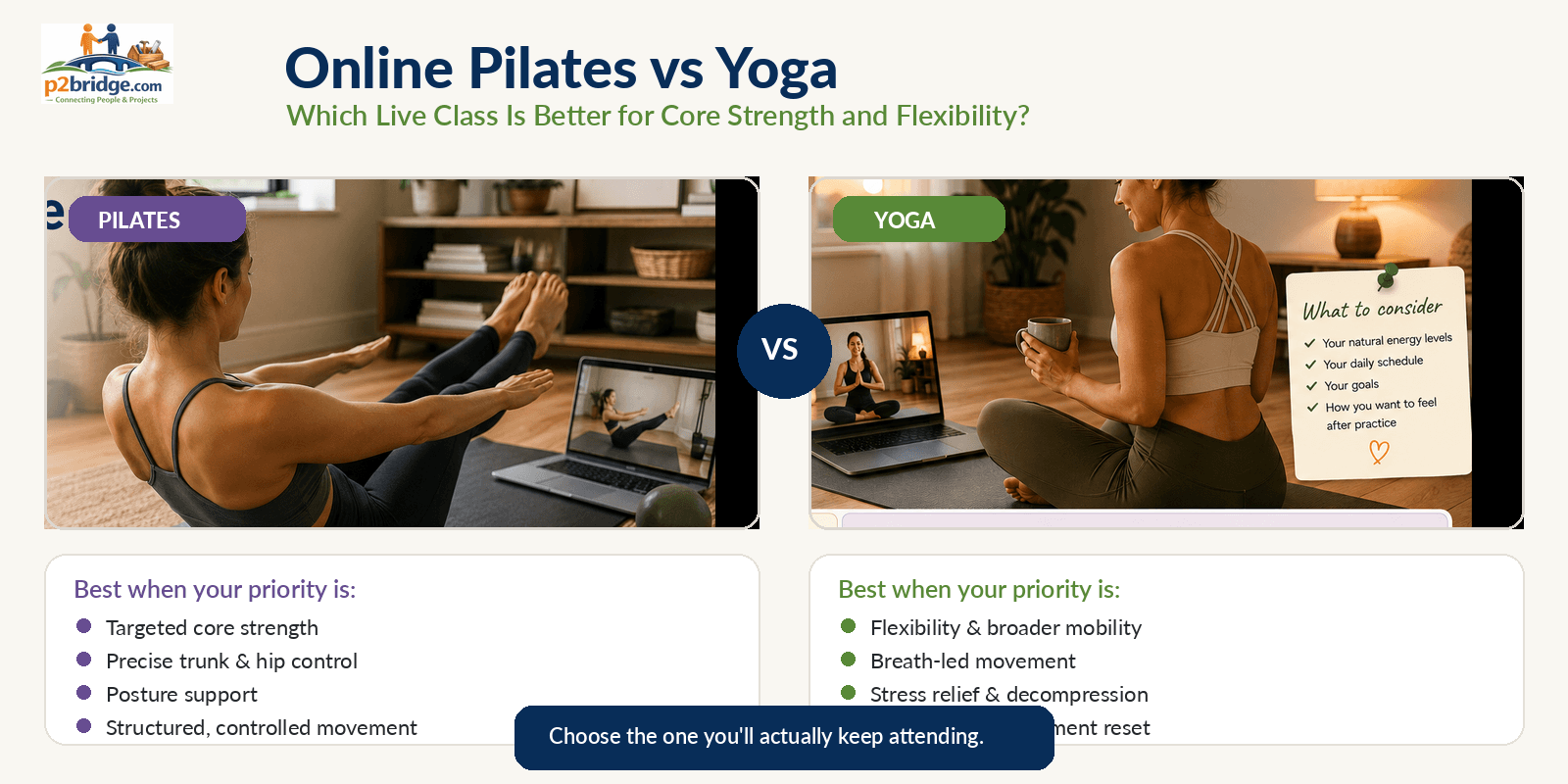
- You want core strength specifically. Yoga helps, but Pilates or dedicated core training is more direct.
- You're managing an injury. Book a private session so the teacher can build around it, rather than joining a group class and improvising modifications.
Most people who stick with yoga end up doing two of these. Vinyasa and Yin is the classic pairing, for the same reason you'd lift weights and stretch rather than choose between them.
Know which one you want?
P2Bridge hosts teach all three live — Vinyasa, Hatha, Yin, restorative, prenatal and chair yoga — from India, Nicaragua, Argentina, Mexico and beyond. Group classes or one-to-one.
Browse live yoga classes Meet the teachersWhat people get wrong in each
In Hatha
Treating it as filler. Because it's slow, people mentally file it under "rest day" and stop paying attention — which wastes the one style built specifically for paying attention. The instruction about your back foot in Warrior II is the class. Not a preamble to it.
In Vinyasa
Chasing the teacher. The sequence moves at a pace, and the reflex is to keep up even when your form has fallen apart three poses back. Skip a vinyasa. Drop to your knees in chaturanga. Nobody is watching, except the one person whose job it is to watch, and they'll be pleased you did.
In Yin
Two things, both common. First, going straight to maximum depth — you have three minutes to grow into a shape, so start well short of your limit. Second, holding muscular tension the entire time, which is the single most common reason people finish a Yin class wondering what it was for. If you can't release the muscle in a shape, you're too deep in it. Come out a little and try again.
Who should be careful
Worth knowing before you book
Joint hypermobility. If your joints move beyond a normal range easily — including diagnosed conditions such as hypermobile Ehlers-Danlos syndrome — long passive end-range holds deserve real caution. Yin's whole method is sustained load at the edge of your range, and for hypermobile bodies that can push already-lax tissue further rather than helping. This gets discussed far less than it should. Tell your teacher before class, and consider strength-focused practice instead.
Pregnancy. Relaxin increases ligament laxity, so deep passive stretching carries more risk than usual, and range of motion can feel misleadingly easy. Look for prenatal-specific classes with a teacher experienced in adapting poses.
Acute injury or inflammation. Sustained load on an actively inflamed joint isn't the moment for Yin. Wait, or work privately with a teacher who knows the details.
Shoulder history. Fast Vinyasa involves repeated chaturangas. If your shoulders are a known problem area, tell the teacher and modify from the first round rather than the round where it starts hurting.
If you're managing a medical condition or recovering from surgery, talk to your doctor or physiotherapist before starting — and then tell your teacher what they said. The US National Center for Complementary and Integrative Health keeps a plain-language summary of what the research does and doesn't support.
Can you really learn this over video?
Honest answer: mostly yes, with one real caveat and one real advantage.
The caveat. A teacher in the room can put a hand on your hip and rotate it. Over video they can't, so they have to describe the correction instead, and you have to translate it. For most people that works fine. For a complex injury or something structural, in-person is still better, and any honest teacher will tell you the same.
The advantage, which is larger than people expect: you stop being limited to whoever teaches within driving distance. If you want traditional Hatha from a teacher trained in India, or Yin from someone who has taught it for years, geography stops being the constraint. That's a much bigger deal for a specific style than for a generic fitness class.
The one thing that matters more than the format: live, not recorded. A pre-recorded video can't see that your knee is collapsing inward. That's not a small difference — it's the difference between practising and being taught. Every class on P2Bridge is live for exactly this reason.
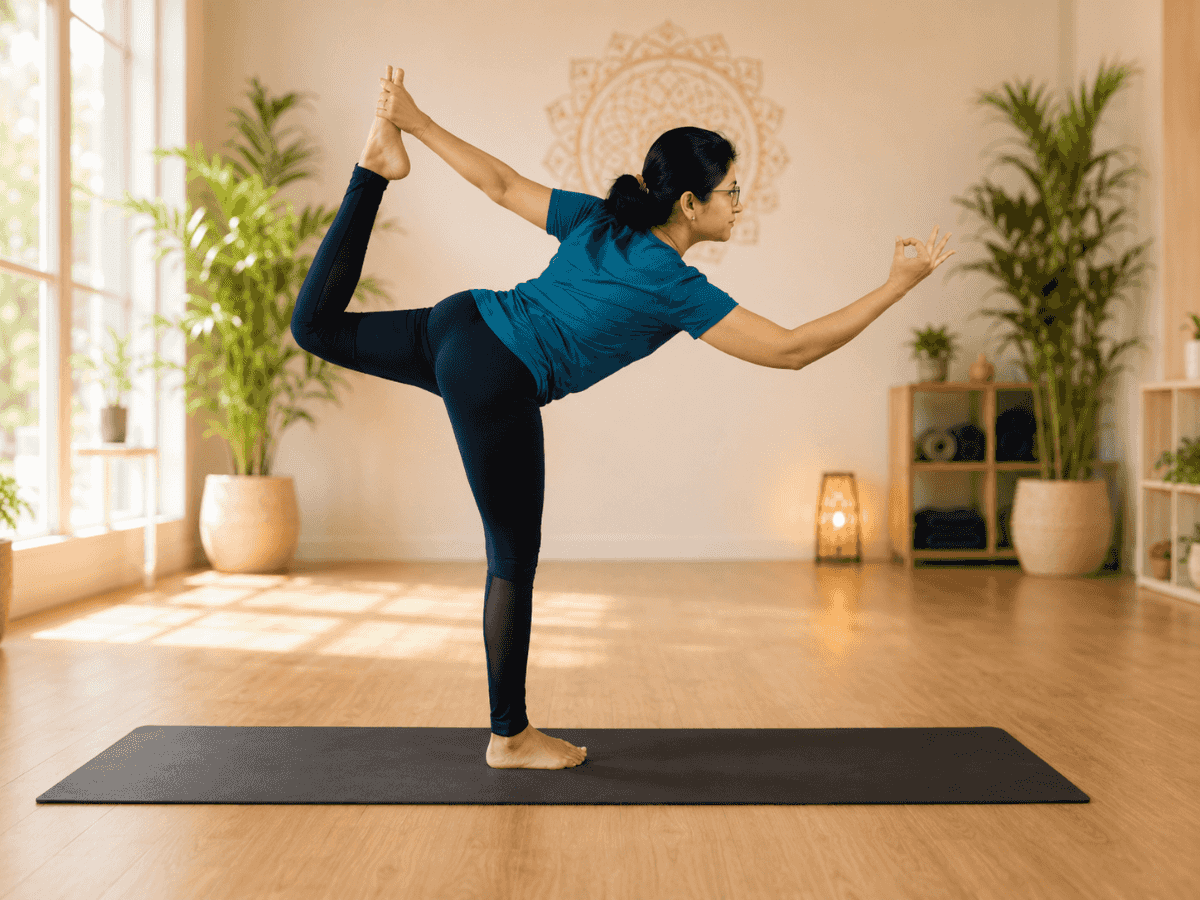
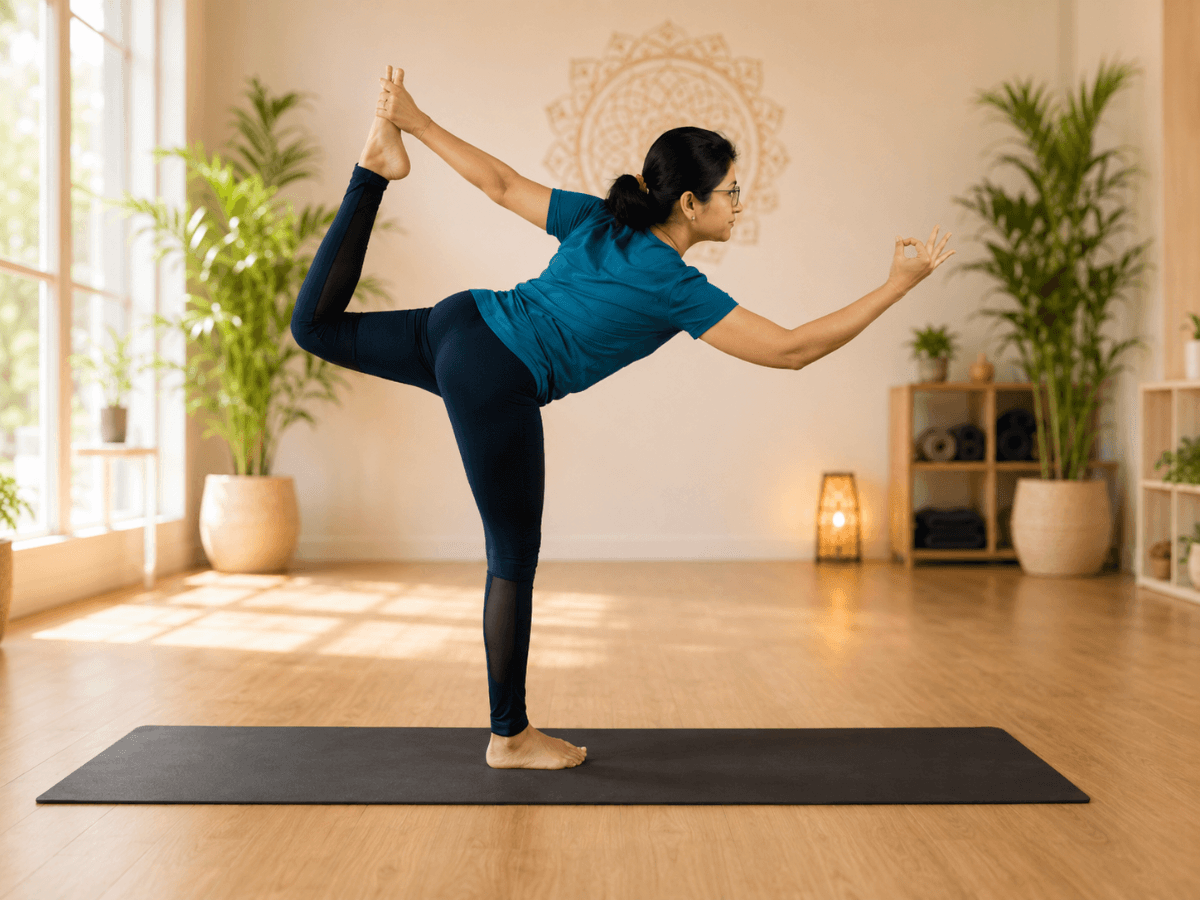
Practical setup, briefly: position your device side-on so the teacher can see your whole body in profile, which is the angle alignment actually shows up in. Clear a mat's length plus a little. Keep your camera on — a teacher can't correct what they can't see, and turning it off gives away the only real advantage you're paying for.
Try one live class before committing to a style
Group sessions are the low-stakes way to test whether a style suits you. If you'd rather work around an injury or go at your own pace, book a private session instead.
See group classes Book a private sessionQuestions people ask
Is Hatha yoga just beginner yoga?
No, though it's often a good place to begin. Hatha technically describes all physical yoga — the word covers Vinyasa too. On a class schedule it signals a slower pace with poses held for a handful of breaths, which suits beginners well, but an advanced Hatha class holding demanding poses for a full minute is not remotely easy.
Which style is best for weight loss?
Vinyasa burns the most during class, since it's continuous and raises your heart rate. That said, yoga on its own is a modest calorie burn compared with running or cycling, and body composition is driven far more by overall activity and diet than by class choice. Pick the style you'll actually keep doing — consistency beats intensity over any real timeframe.
What's the difference between Yin and restorative yoga?
They look similar and aren't the same. Yin applies mild, deliberate stress to connective tissue — you should feel a broad, dull sensation. Restorative aims for the opposite: complete support with props so nothing is stretched at all, letting the nervous system fully switch off. Yin asks something of the tissue. Restorative asks nothing.
Can I do Vinyasa as a complete beginner?
Yes, with two conditions: pick a class labelled beginner or all-levels, and tell the teacher it's your first time. The risk isn't that you can't keep up — it's that you'll try to, at the cost of your form. In a live class the teacher can slow you down and offer modifications, which is precisely what a recorded flow can't do.
How often should I practise?
Twice a week is enough to notice real change within a couple of months. Three or four is plenty for most people. If you're doing Vinyasa, spacing sessions out gives your body time to recover; Yin is gentle enough that it can sit between harder sessions without interfering.
Do I need to be flexible to start?
No — that's roughly like saying you need to be fit before you're allowed to exercise. Flexibility is an outcome, not a prerequisite. Yin in particular is aimed at exactly the people who feel too stiff for yoga.
What equipment do I need for a class at home?
A mat, and space to lie down with your arms out. Yin benefits from props, but cushions and folded blankets stand in for bolsters and blocks perfectly well when you're starting out. Your teacher will tell you in advance if a particular class needs anything specific.
Can I combine styles in the same week?
Yes, and most regular practitioners do. Vinyasa plus Yin is the most common pairing because they complement each other — one builds strength and heat, the other restores range and calms things down. Combining them is closer to the norm than picking one and staying there.