



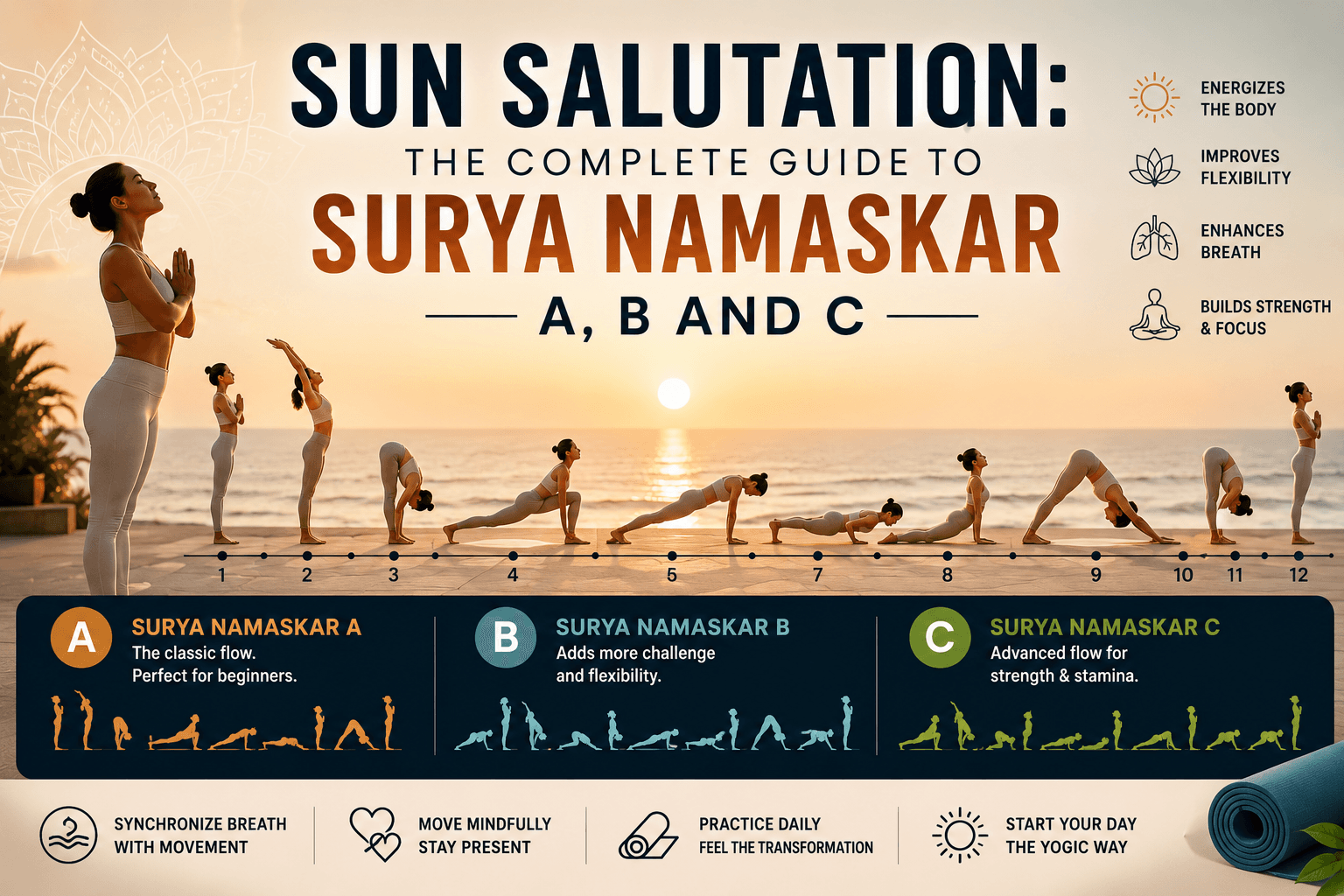
Sun salutation: the complete guide to Surya Namaskar A, B and C
The full pose sequences, the breath cues, the twelve mantras — and the piece of history almost every guide gets wrong.
The short answer
A sun salutation (Surya Namaskar) is a flowing sequence of yoga poses linked to the breath, one movement per inhale or exhale. The classical Hatha version runs twelve poses. Sun Salutation A is the shorter Ashtanga version built around chaturanga, upward dog and downward dog. Sun Salutation B adds chair pose and warrior I, making it longer and harder. Sun Salutation C is a gentler variant using low lunges and a backbend.
The part most guides get wrong: reverence for the sun in India is genuinely ancient, but this particular flowing sequence was codified in the early 1900s. That's not a debunking — it's what explains why A, B and C exist at all.
What most guides get wrong
Almost every article about the sun salutation opens the same way: this five-thousand-year-old sequence… It's half right, and the half that isn't is the more interesting story.
The reverence is genuinely ancient. Surya, the sun, appears throughout the Rig Veda as a divine being and the source of life. The word namaskar comes from namas — to bow to, to adore — the same root that gives us namaste, which is why the practice is sometimes called yoga namaskar. Some traditions call it a sun greeting, which is closer to the literal meaning than salutation. Salutation of the sun as a devotional act in India goes back millennia, and for many practitioners it still is one.
The flowing twelve-pose sequence is modern. The anthropologist Joseph Alter has documented that this sequence appears in no Hatha yoga text before the nineteenth century — it isn't in the Hatha Yoga Pradipika at all. The choreography we practise was codified in the early 1900s, most influentially by Bhavanrao Pant Pratinidhi, the Raja of Aundh, and then within the teaching of T. Krishnamacharya at the Mysore Palace, who set out a structured version in his 1934 text Yoga Makaranda. Swami Sivananda promoted a simplified form in the 1920s.
Two of Krishnamacharya's students carried it worldwide: K. Pattabhi Jois, who founded Ashtanga yoga, and B. K. S. Iyengar, who founded Iyengar yoga.
This isn't trivia. It's the thing that makes the rest of this guide make sense. Sun Salutation A and B come from Pattabhi Jois's Ashtanga system — that's precisely why they look different from the classical twelve-pose Hatha sequence, and why nobody can quite agree on what "the" sun salutation is. There isn't one. There's an ancient devotional impulse and about a century of different people arranging poses around it.
Classical Surya Namaskar: the twelve poses
This is the Hatha version — the one usually meant by surya namaskar poses, surya namaskar yoga, or surya pranam steps. Twelve positions, each paired with one breath, returning to where it started. Here is the step by step surya namaskar sequence in order. Each individual sun salutation yoga pose has its own name and its own breath, and the full sun salutation yoga sequence is those twelve linked together.
- Pranamasana — Prayer pose, also called the salute pose. Stand at the top of the mat, palms together at the heart. Exhale
- Hasta Uttanasana — Raised arms pose. Reach overhead and slightly back. Inhale
- Padahastasana — Standing forward fold. Hinge from the hips, hands toward the floor. Exhale
- Ashwa Sanchalanasana — Equestrian pose. Right foot steps back into a low lunge, chest lifts. Inhale
- Dandasana — Plank. Left foot joins the right, body in one line. Exhale
- Ashtanga Namaskara — Eight-limbed salutation. Knees, chest and chin to the floor, hips lifted. Hold
- Bhujangasana — Cobra. Slide forward, chest lifts, elbows soft. Inhale
- Adho Mukha Svanasana — Downward-facing dog. Hips up and back. Exhale
- Ashwa Sanchalanasana — Equestrian pose. Right foot steps forward between the hands. Inhale
- Padahastasana — Standing forward fold. Left foot joins, fold over the legs. Exhale
- Hasta Uttanasana — Raised arms pose. Rise and reach overhead. Inhale
- Pranamasana — Prayer pose. Hands return to the heart. Exhale
One full round is those twelve. Most traditions then repeat leading with the left leg, and count that pair as one complete cycle. If someone says they did twelve rounds, ask which they mean — practitioners genuinely differ.
Sun Salutation A
If you have taken a Vinyasa class, this is almost certainly what you did in the first ten minutes. Surya Namaskar A comes from the Ashtanga system, and it's shorter and more athletic than the classical form. Often abbreviated to sun a on class plans, or written simply as sun salute yoga on studio timetables.
- Samasthiti / Tadasana — Standing at the front of the mat. Settle
- Urdhva Hastasana — Arms sweep overhead. Inhale
- Uttanasana — Fold forward over the legs. Exhale
- Ardha Uttanasana — Halfway lift, spine long, hands to shins. Inhale
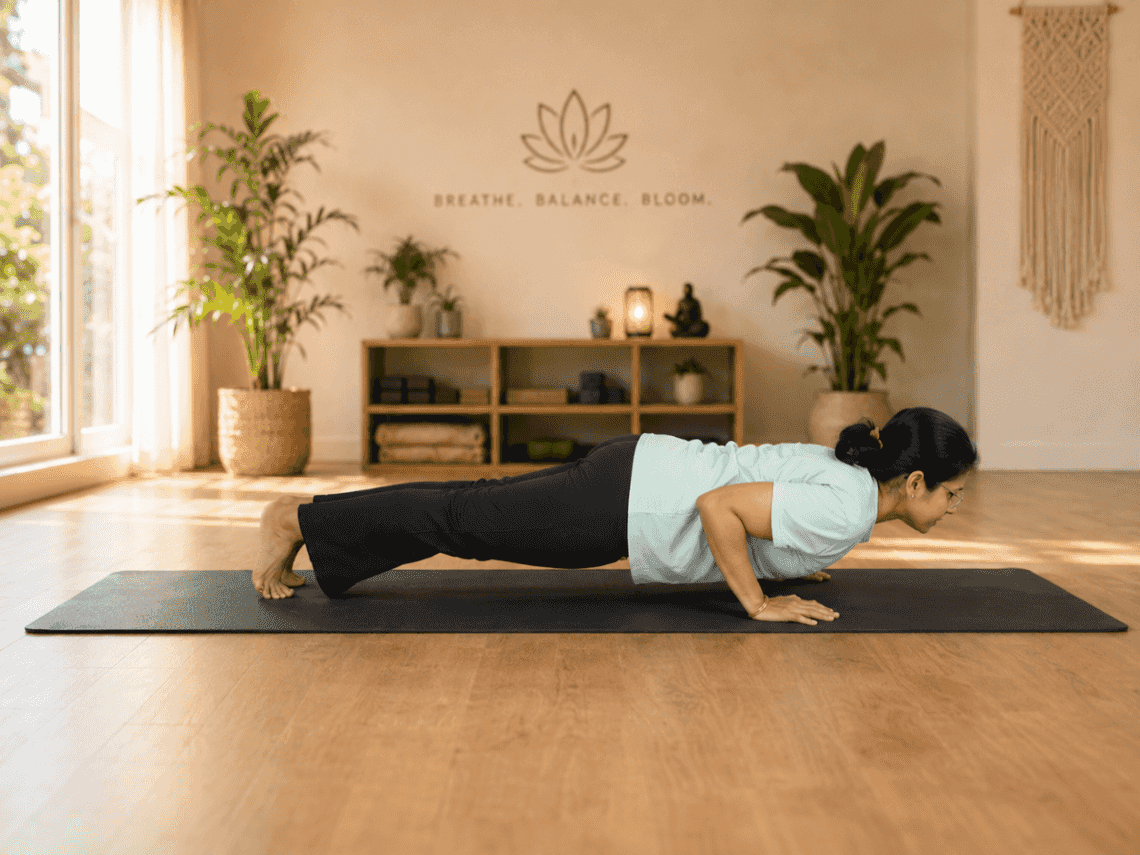
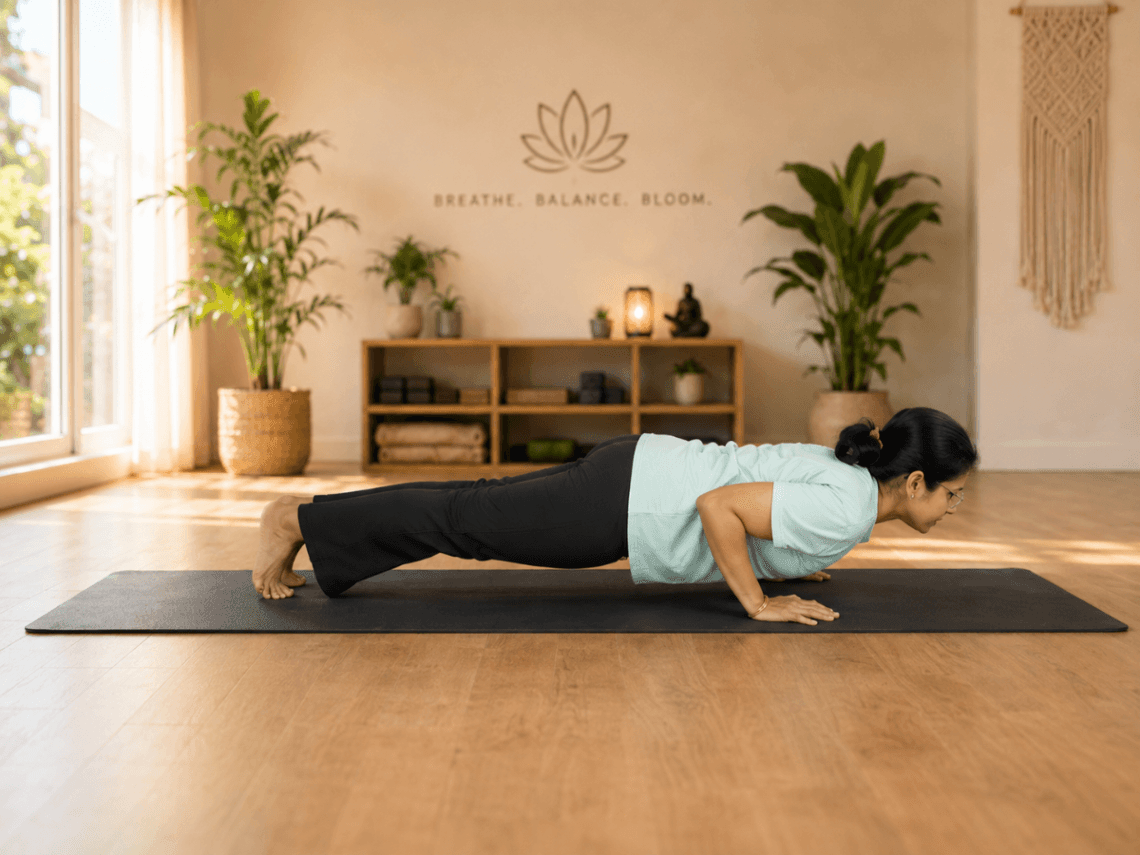
- Chaturanga Dandasana — Step or jump back, lower halfway with elbows in. Exhale
- Urdhva Mukha Svanasana — Upward-facing dog, chest open, thighs off the floor. Inhale
- Adho Mukha Svanasana — Downward-facing dog, held for five breaths. Exhale, then five
- Ardha Uttanasana — Step or jump forward, halfway lift. Inhale
- Uttanasana — Fold. Exhale
- Urdhva Hastasana — Rise, arms overhead. Inhale
- Samasthiti — Hands to heart, or arms down. Exhale
The key difference from the classical version is chaturanga. It replaces the knees-chest-chin position, and it's considerably harder on the shoulders — which is exactly where most Vinyasa injuries come from. Dropping the knees for chaturanga is not a lesser version. It's the correct version if your shoulders aren't ready.
Sun Salutation B
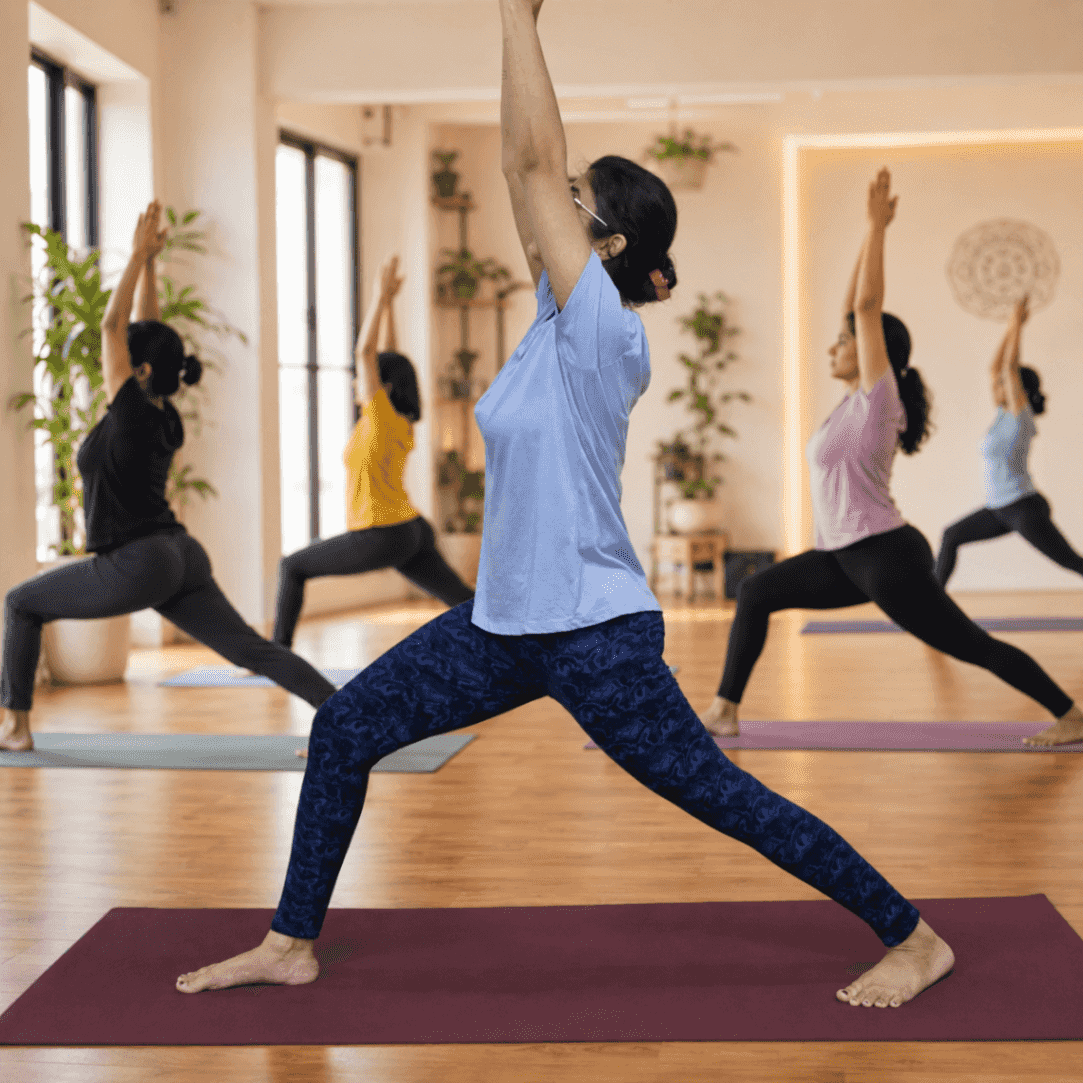
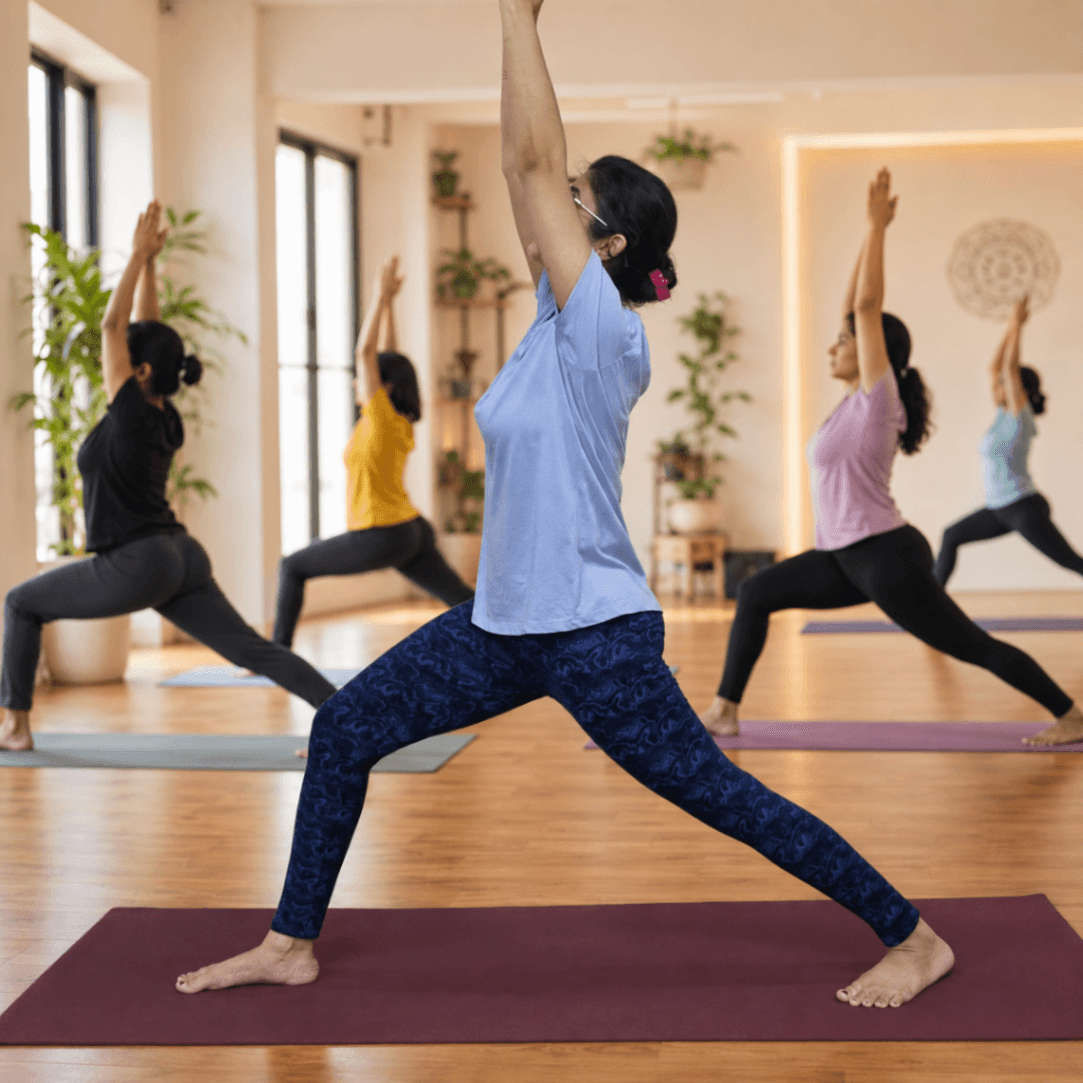
Surya Namaskar B — sun b for short — keeps the spine of A and adds two things: Utkatasana (chair pose) at the start and finish, and Virabhadrasana I (warrior I) on each side in the middle. That makes it noticeably longer — and considerably more demanding on the legs and lungs.
- Utkatasana — Chair pose, knees bent, arms overhead. Inhale
- Uttanasana — Fold forward. Exhale
- Ardha Uttanasana — Halfway lift. Inhale
- Chaturanga Dandasana — Lower halfway. Exhale
- Urdhva Mukha Svanasana — Upward dog. Inhale
- Adho Mukha Svanasana — Downward dog. Exhale
- Virabhadrasana I — Warrior I, right foot forward. Inhale
- Chaturanga → Up dog → Down dog — The vinyasa again. Exhale, inhale, exhale
- Virabhadrasana I — Warrior I, left foot forward. Inhale
- Chaturanga → Up dog → Down dog — Held five breaths at the end. Exhale, inhale, exhale
- Ardha Uttanasana → Uttanasana → Utkatasana — Return to the front. Inhale, exhale, inhale
Ashtanga practice traditionally runs five rounds of A followed by five of B. If you've ever wondered why people talk about sun a sun b as a pair, that's why — they're a matched opening set, not alternatives.
Sun Salutation C
Sun salute c is the gentlest of the three, and it's the one most commonly taught in Hatha and beginner classes. It swaps chaturanga for a low lunge with the back knee down, and replaces upward dog with cobra — a much smaller backbend.
The rough shape: mountain, reach up, fold, low lunge with the right leg back, plank, knees down, cobra, downward dog, low lunge forward, fold, rise. It's essentially the classical sequence with a softer transition, which makes it a good bridge for anyone whose shoulders or wrists aren't ready for the Ashtanga version.
A vs B vs C, side by side
| Classical (12) | Sun A | Sun B | Sun C | |
|---|---|---|---|---|
| Lineage | Hatha | Ashtanga | Ashtanga | Hatha / beginner |
| Chest-lowering | Knees, chest, chin | Chaturanga | Chaturanga | Knees down |
| Backbend | Cobra | Upward dog | Upward dog | Cobra |
| Adds | — | — | Chair + Warrior I | — |
| Difficulty | Moderate | Moderate | Hardest | Gentlest |
| Best for | Traditional practice | Vinyasa warm-up | Building heat | Beginners, sore shoulders |
Practise Sun Salutations in Context
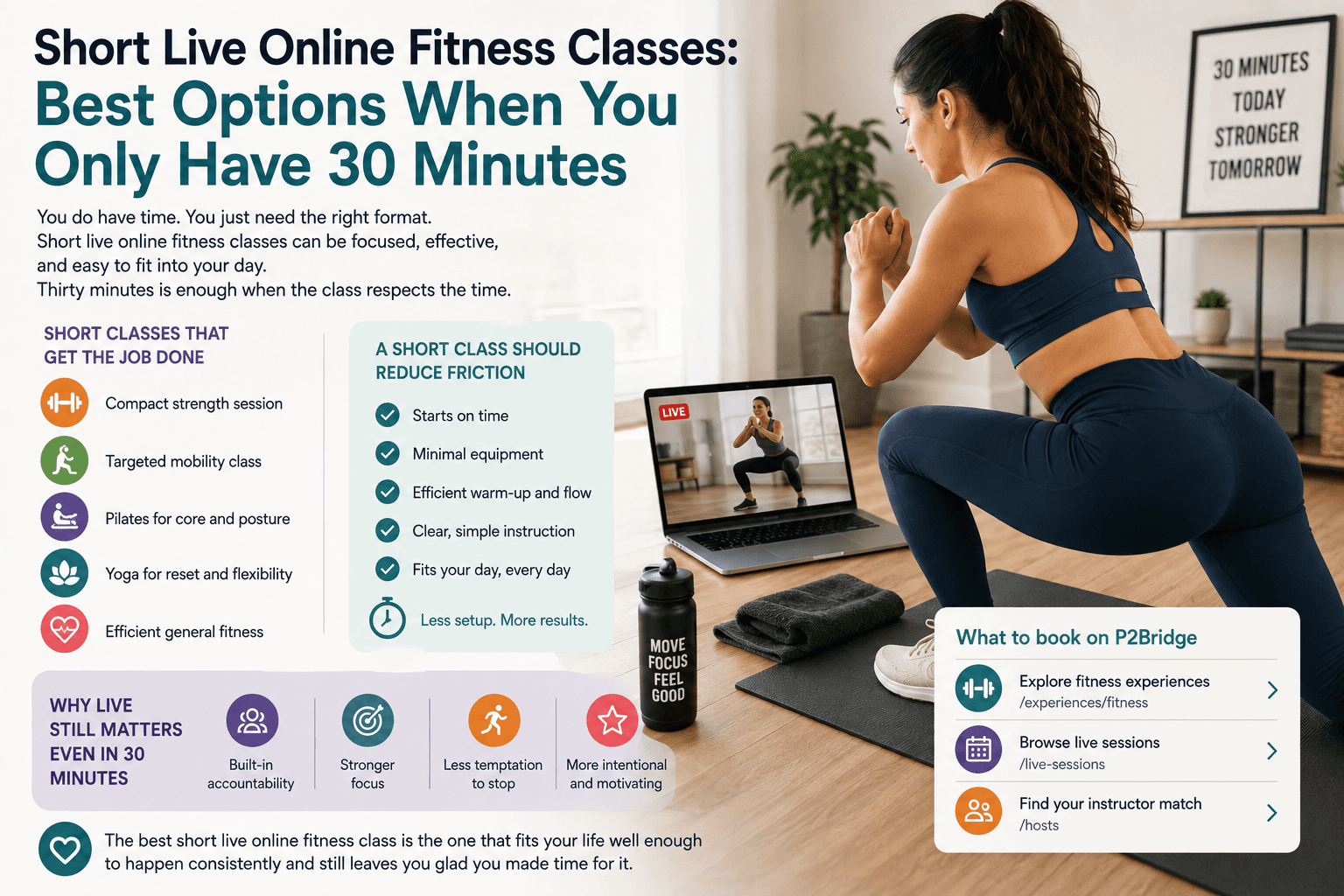
Sun A and B are the opening of nearly every Vinyasa class. Yanina Nesteruc's Beginner Vinyasa Flow runs $10 group or $30 private — 4.9★ from 25 reviews.
Book Beginner Vinyasa — $10 Browse all yoga classesHalf sun salutation
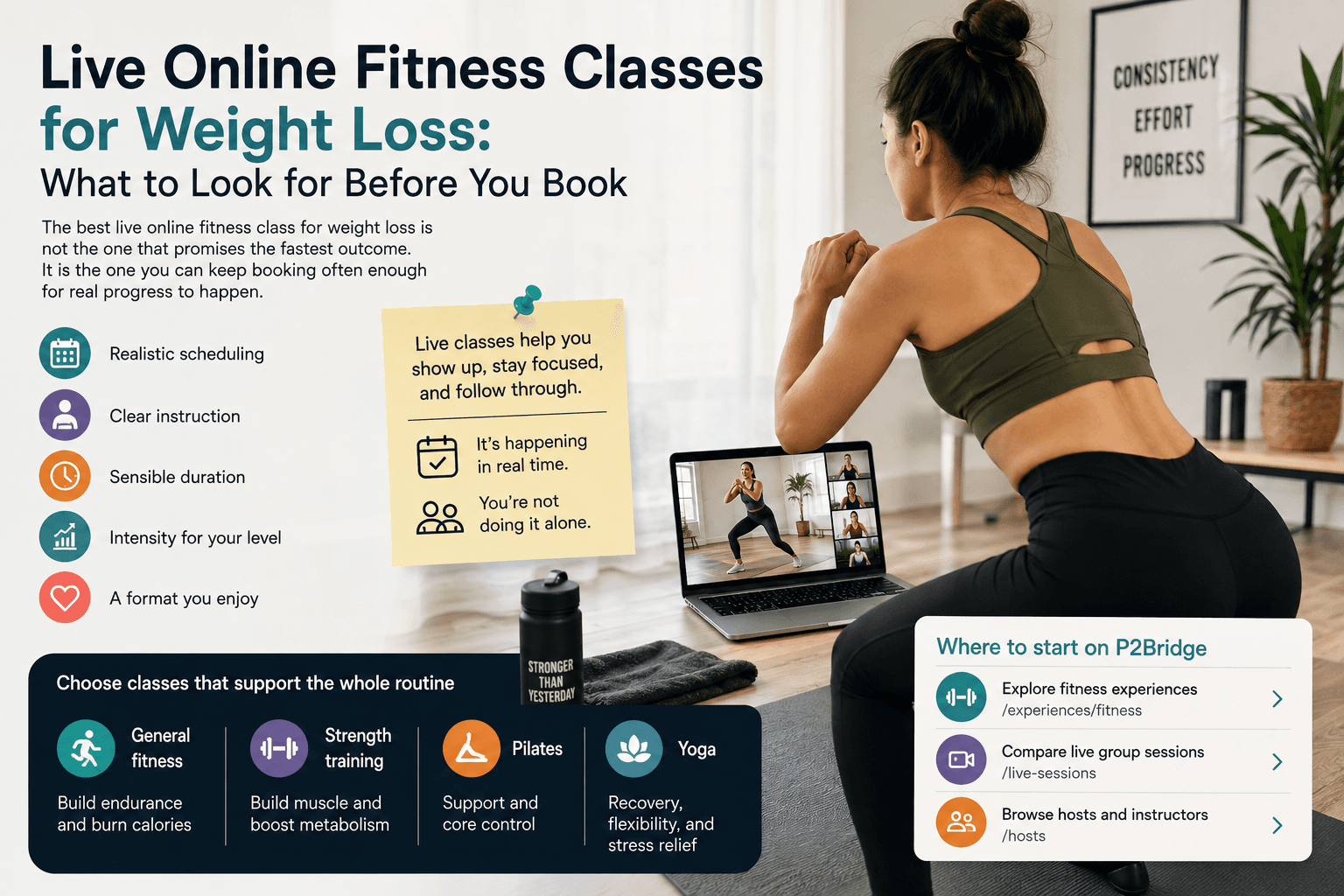
The half sun salutation is the abbreviated version, and it's genuinely useful rather than a consolation prize. Four movements: reach up, fold, halfway lift, fold, rise. No floor work at all.
It's used as a warm-up before the full sequence, as a standalone practice for anyone with limited mobility, and as a way to move when getting down to the mat and back up isn't practical. If a full round feels like too much today, this is the honest answer rather than skipping entirely.
The twelve mantras
Traditional practice pairs each of the twelve poses with a mantra, each invoking a different name of Surya. The traditional mantra for sun salutation — the sun salutation mantra sequence — mantra yoga surya namaskar — usually runs: Om Mitraya Namaha, Om Ravaye Namaha, Om Suryaya Namaha, Om Bhanave Namaha, Om Khagaya Namaha, Om Pushne Namaha, Om Hiranyagarbhaya Namaha, Om Marichaye Namaha, Om Adityaya Namaha, Om Savitre Namaha, Om Arkaya Namaha, Om Bhaskaraya Namaha.
Each name points at a different quality — friend, shining one, dispeller of darkness, giver of nourishment, and so on. They are a devotional element from the Hindu tradition, not a performance-enhancement technique, and it's worth being straightforward about that. Many people practise the sequence without them and that's entirely normal. Many others find the mantra is the point and the movement is the vehicle.
A note on practising respectfully
If you're drawn to the mantras and don't come from this tradition, learning them from someone who does is meaningfully better than learning them phonetically from an article. Three of the four instructors below are based in India and teach the sequence within the tradition it comes from rather than as an imported warm-up.
What it actually does for you
Honest version, because the benefits of sun salutation get oversold constantly.
What it genuinely does: it moves your spine through flexion and extension, loads the shoulders and arms, opens the hips and hamstrings, and links all of it to breath. That's an unusually complete package for something that takes a few minutes. As a warm-up it raises temperature and prepares the joints for harder work. Practised as a standalone, a handful of rounds is a real, if modest, whole-body session.
What is traditional rather than demonstrated: claims about detoxifying organs, balancing the solar plexus chakra, or absorbing solar energy come from the practice's devotional and yogic framework. They're meaningful within that framework. They aren't physiological findings, and any guide presenting them as such is blurring two different kinds of claim.
The advantages of sun salutation that hold up plainly: it's efficient, it needs no equipment, it scales from gentle to demanding, and it's short enough that people actually keep doing it.
Who should be careful
Worth knowing before you start
Wrists and shoulders. Chaturanga in Sun A and B is where most Vinyasa injuries happen. If your shoulders are unhappy, use Sun C or drop the knees — that's the correct modification, not a compromise.
Lower back. The backbends are small, but repeated rounds add up. Keep cobra low and led by the chest rather than the arms.
High blood pressure, glaucoma, or recent abdominal surgery. Repeated forward folds and inversions of the head below the heart may not be appropriate — check with a doctor first.
Pregnancy. The standard sequence needs real modification, particularly after the first trimester. Work with an instructor experienced in prenatal practice.
If you have a diagnosed condition or a recent injury, speak with a doctor or physiotherapist before starting and tell your instructor beforehand. The National Institute on Aging's guidance on exercising with chronic conditions is a sensible, non-commercial starting point.
Learning it live
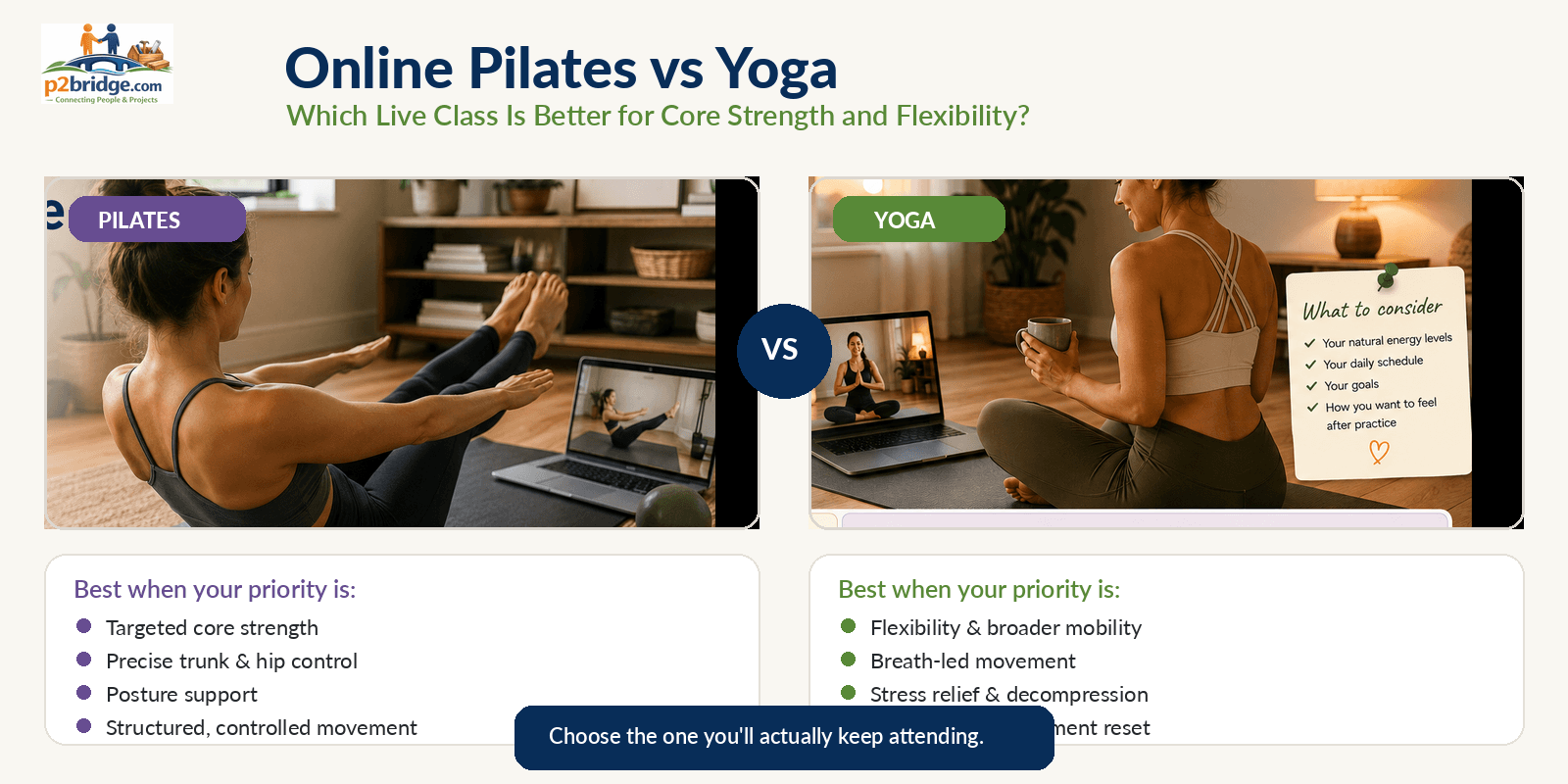
A sun salutation is a chain, and the whole chain is only as good as its weakest link. These four instructors each teach a component the sequence depends on — and three of them are based in India, teaching within the tradition rather than adapting it from outside.
Yoga for Backbends
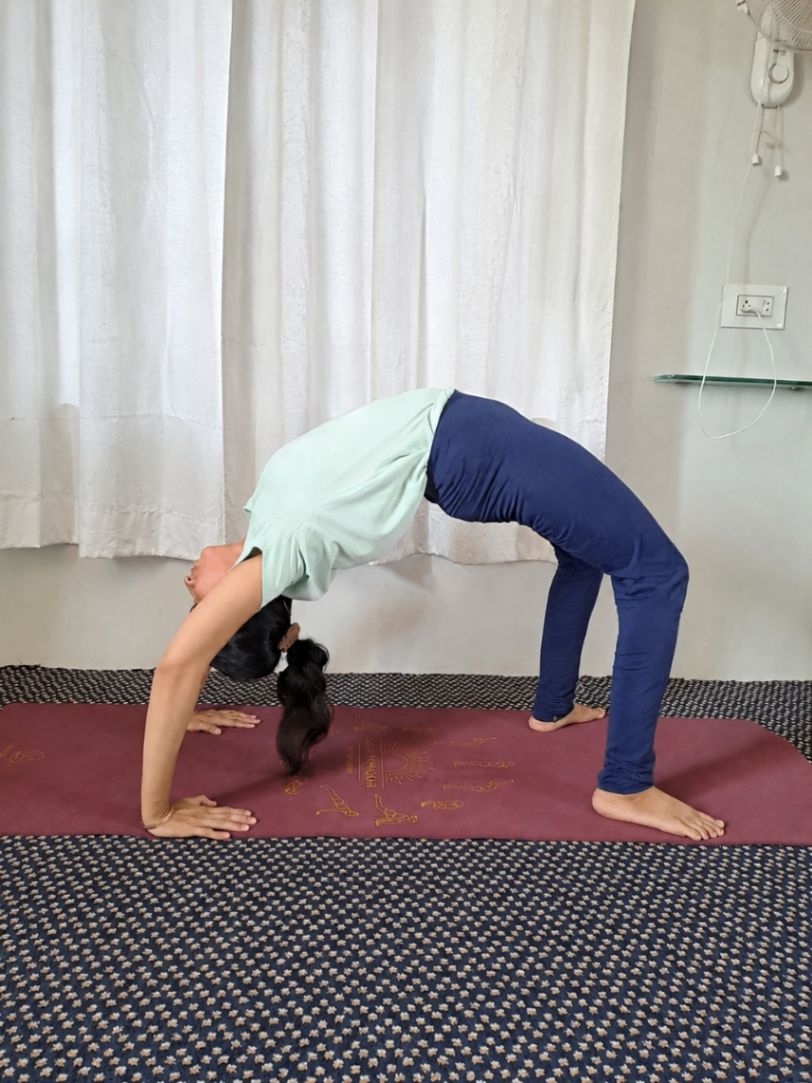
★★★★★4.9 (41 Reviews)Poses 7 and 6 of the classical sequence, and the upward dog in Sun A and B, are all backbends — the part people most often force. Rabab is the most-reviewed yoga host on the platform, at 41 reviews.
Book Backbends — $10 group Rabab's profile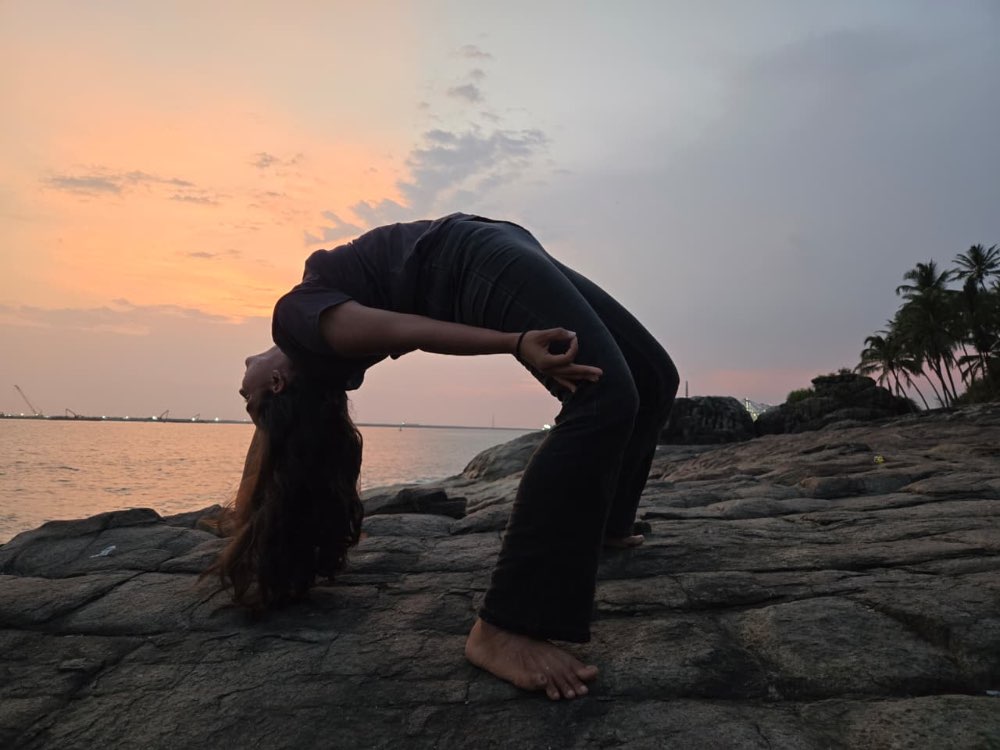
Hip Opener Yoga
★★★★★4.6 (11 Reviews)Poses 4 and 9 are deep lunges, and tight hips are what make them feel impossible. Warrior I in Sun B asks for the same opening. At 45 minutes this is the shortest option here.
Book Hip Opener — $10 group Anahita's profile
Beginner Gentle Yoga
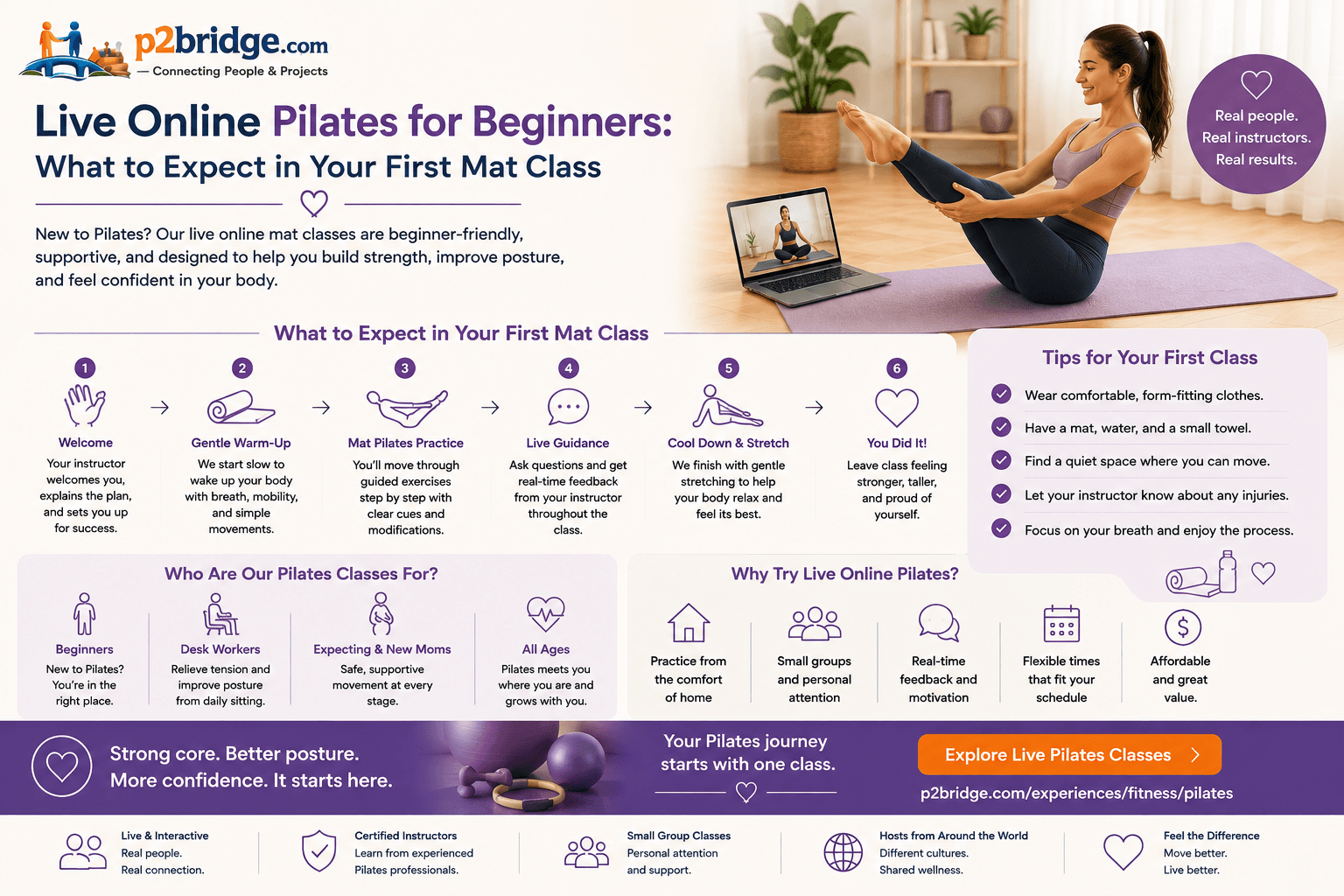
★★★★★5.0 (7 Reviews)If you have never done a sun salutation and the pose lists above look daunting, start here rather than jumping into a flow. The highest-rated class on this page.
Book Gentle Yoga — $10 group Dhwani's profile
Beginner Vinyasa Yoga Flow
★★★★★4.9 (25 Reviews)Reading a sequence and flowing through it are different skills. A Vinyasa class is where Sun A and Sun B are actually practised — repeatedly, with someone watching whether your chaturanga is holding up by round four.
Book Vinyasa Flow — $10 group Yanina's profileStart Where You Actually Are
All four classes run $10 group / $30 private, rated 4.6★ to 5.0★. Beginner? Start with Dhwani. Already flowing? Go to Yanina. Shoulders complaining? Rabab.
See group classes Book a private sessionIf you'd like to understand where sun salutations sit within the wider styles, our guide to Hatha, Vinyasa and Yin covers how the lineages differ. For gentler entry points there's chair, gentle and restorative yoga, and if you're building a morning habit around this, morning mobility routines covers the consistency side. More at the blog, or browse the full host directory.
Questions people ask
What is a sun salutation?
A sun salutation, or Surya Namaskar, is a flowing sequence of yoga poses linked to the breath — one movement per inhale or exhale. The classical Hatha version has twelve poses that begin and end in the same standing position. It functions as a warm-up, a breath practice and, traditionally, a morning act of reverence toward the sun.
What's the difference between Sun Salutation A and B?
Sun Salutation B contains everything in A, plus two additions: Utkatasana (chair pose) at the beginning and end, and Virabhadrasana I (warrior I) on each side in the middle. That means three full vinyasas per round instead of one, making B noticeably longer and more demanding on the legs and breath. Ashtanga practice traditionally opens with five rounds of A followed by five of B.
How many poses are in Surya Namaskar?
The classical Hatha sequence has twelve poses. Sun Salutation A has around eleven movements, and Sun Salutation B around nineteen because of the added chair and warrior poses. Counts vary slightly between lineages, which is one reason different sources give different numbers.
Is Surya Namaskar really 5,000 years old?
Reverence for Surya in India is genuinely ancient — the sun appears throughout the Rig Veda. The specific flowing twelve-pose sequence is much more recent. The anthropologist Joseph Alter has documented that it appears in no Hatha yoga text before the nineteenth century, and it was codified in the early 1900s, notably by Bhavanrao Pant Pratinidhi and T. Krishnamacharya. The reverence is old; the choreography is modern.
What is a half sun salutation?
An abbreviated version with no floor work: reach the arms overhead, fold forward, lift halfway with a long spine, fold again, then rise. It's used as a warm-up before full rounds, and as a complete practice in itself for anyone with limited mobility or anyone who can't easily get down to the mat and back up.
What are the mantras for sun salutation?
Traditional practice pairs each of the twelve poses with a mantra invoking a different name of Surya, beginning with Om Mitraya Namaha and ending with Om Bhaskaraya Namaha. They are a devotional element from the Hindu tradition rather than a technique for improving the physical practice, and many people practise the sequence without them.
How many rounds should a beginner do?
Two to four rounds is a reasonable starting point, building gradually as strength and stamina improve. Quality matters far more than quantity here — four well-executed rounds with correct breath beats twelve rushed ones, and the repeated chaturangas in Sun A and B are where form tends to break down first.
Can beginners do sun salutations?
Yes, with the right variant. Sun Salutation C, or the classical twelve-pose version with knees down, is far more approachable than the Ashtanga A and B, which rely on chaturanga. Dropping the knees is the correct modification rather than a lesser version, and a live instructor can tell you which variant suits your shoulders today.
Should sun salutations be done in the morning?
Traditionally yes, facing the rising sun, as an act of greeting the day. Practically, morning suits the sequence well because it warms and mobilises the whole body before the day begins. There's nothing wrong with practising at other times — a sunset salutation is a perfectly reasonable variation on the idea.