

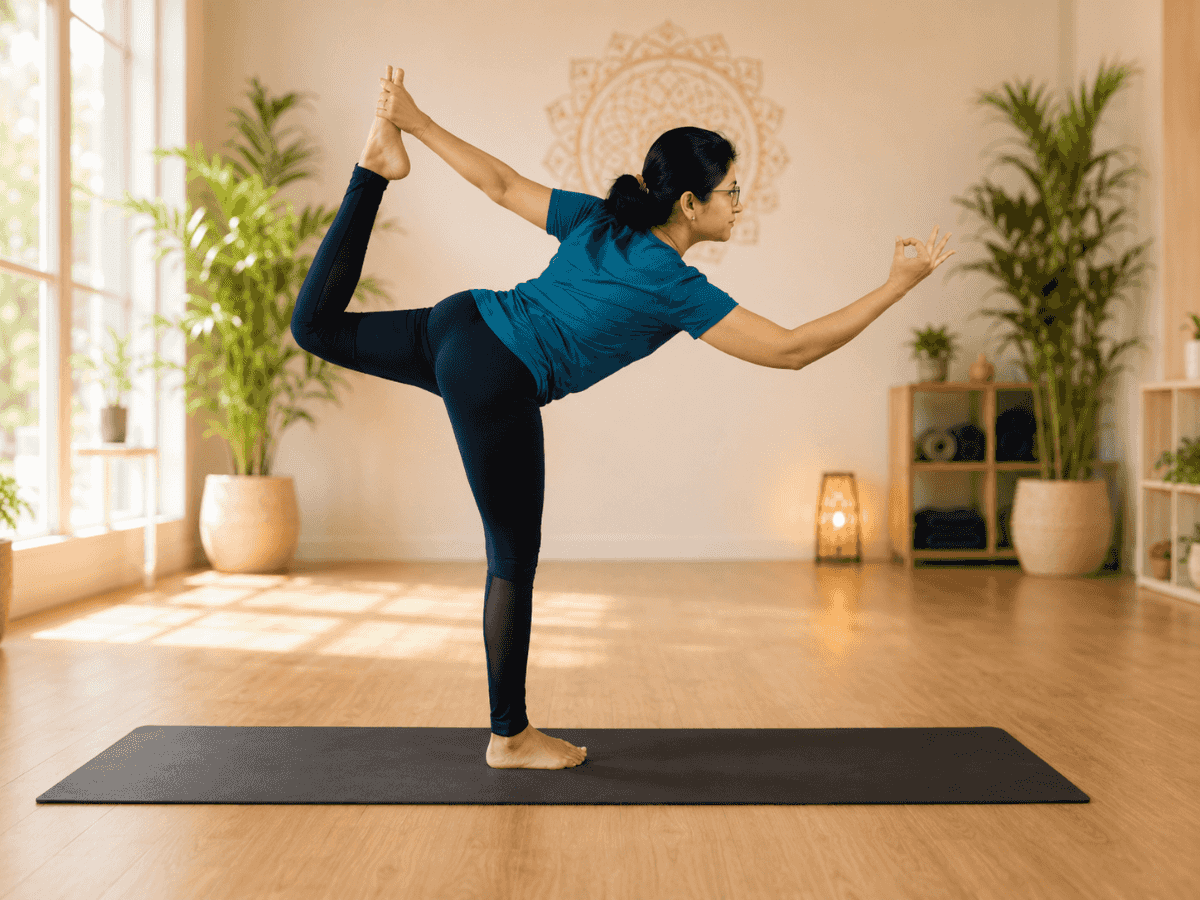
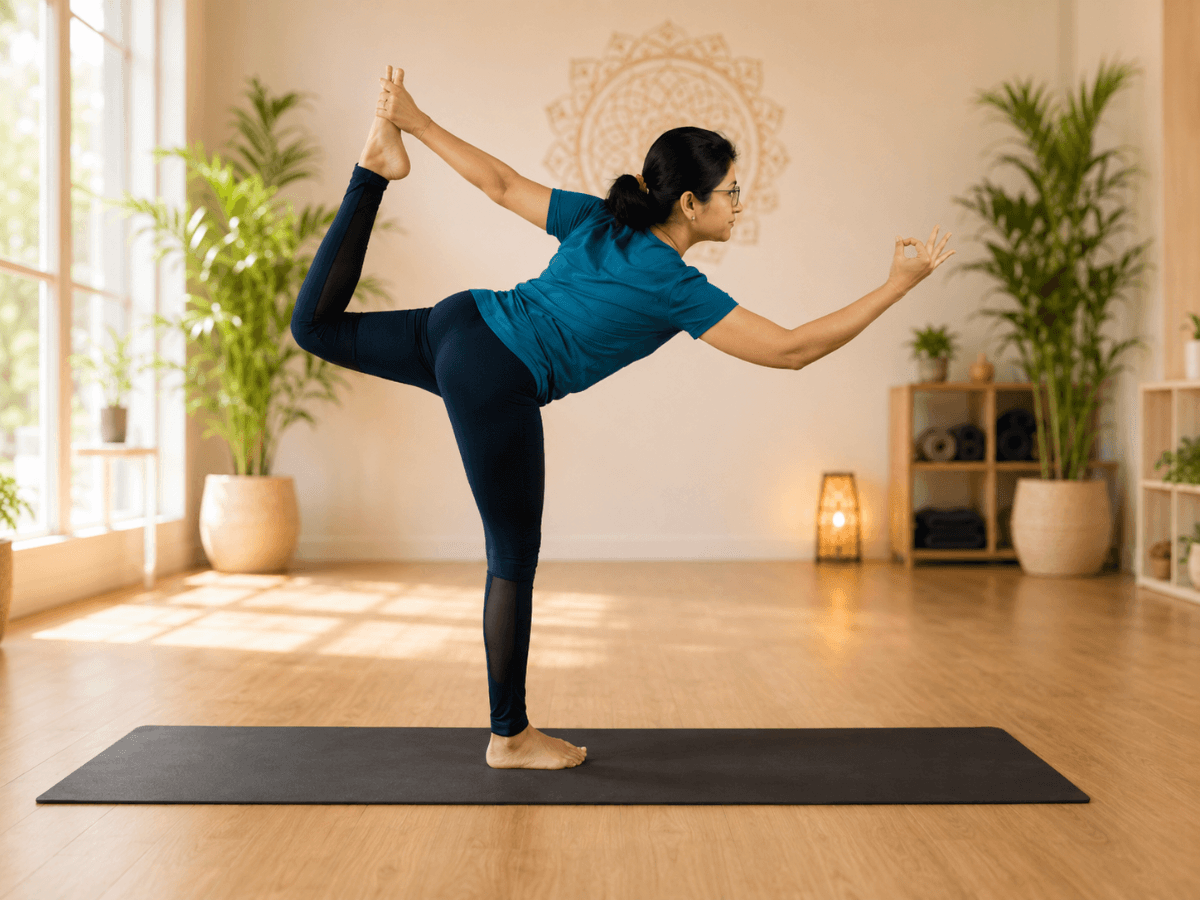
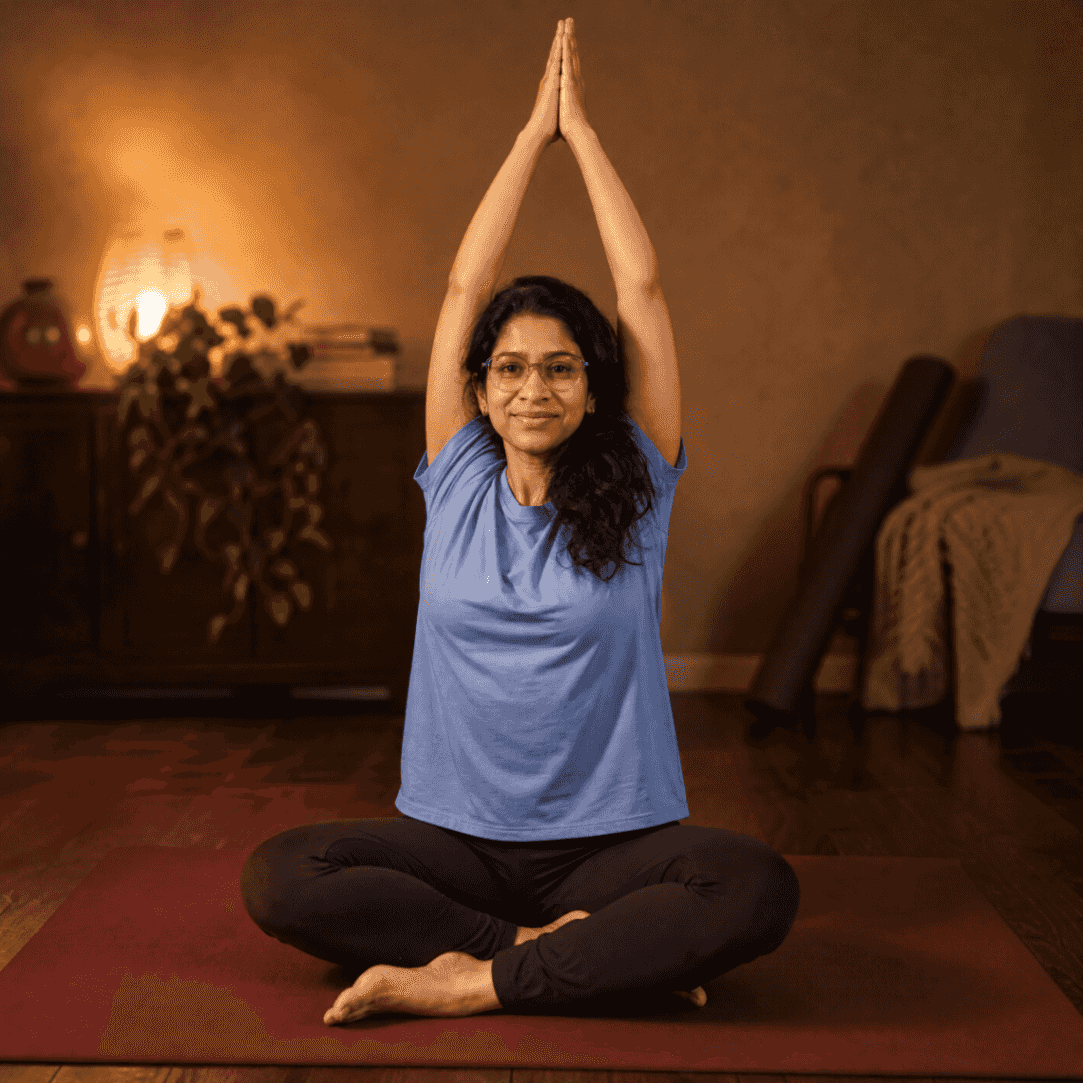
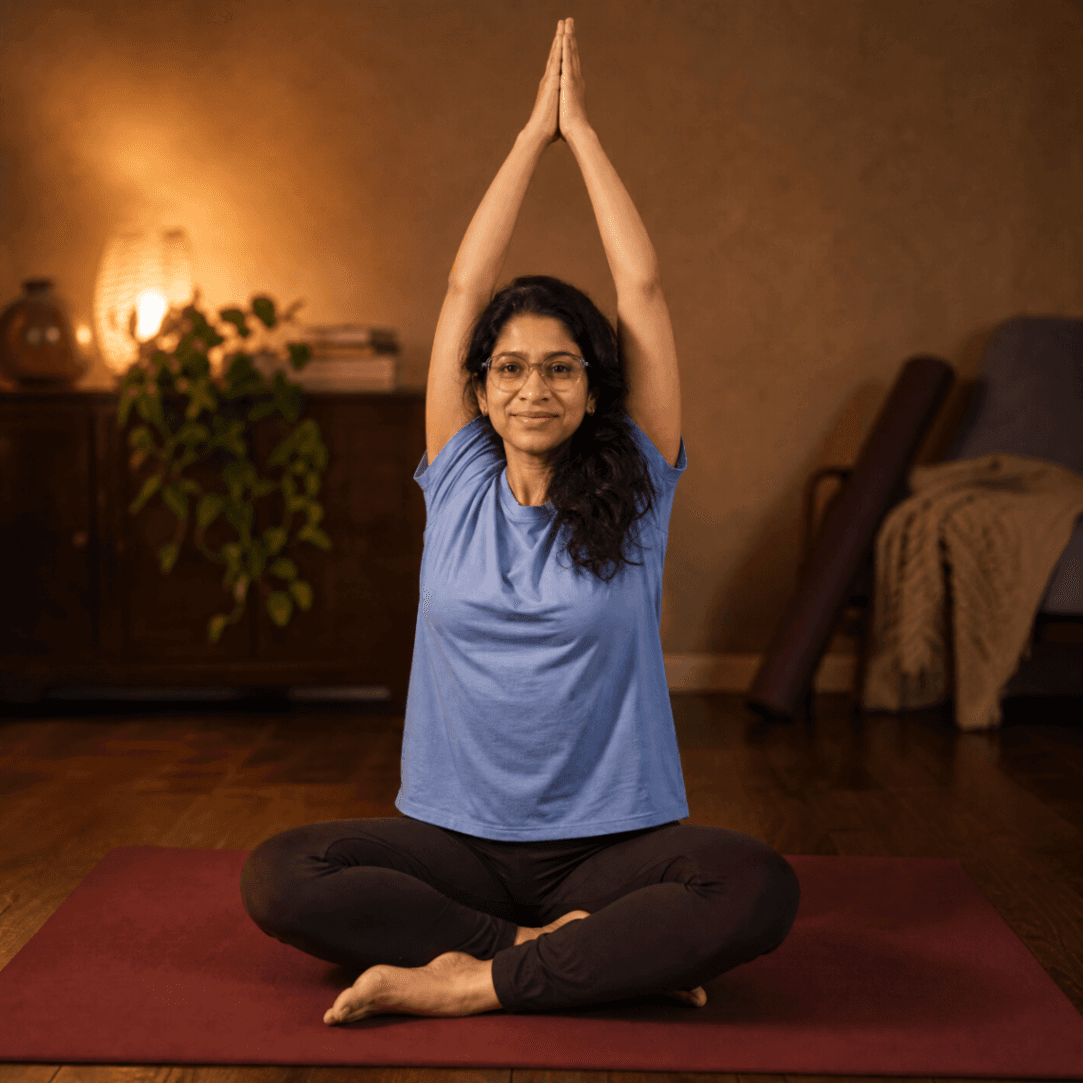
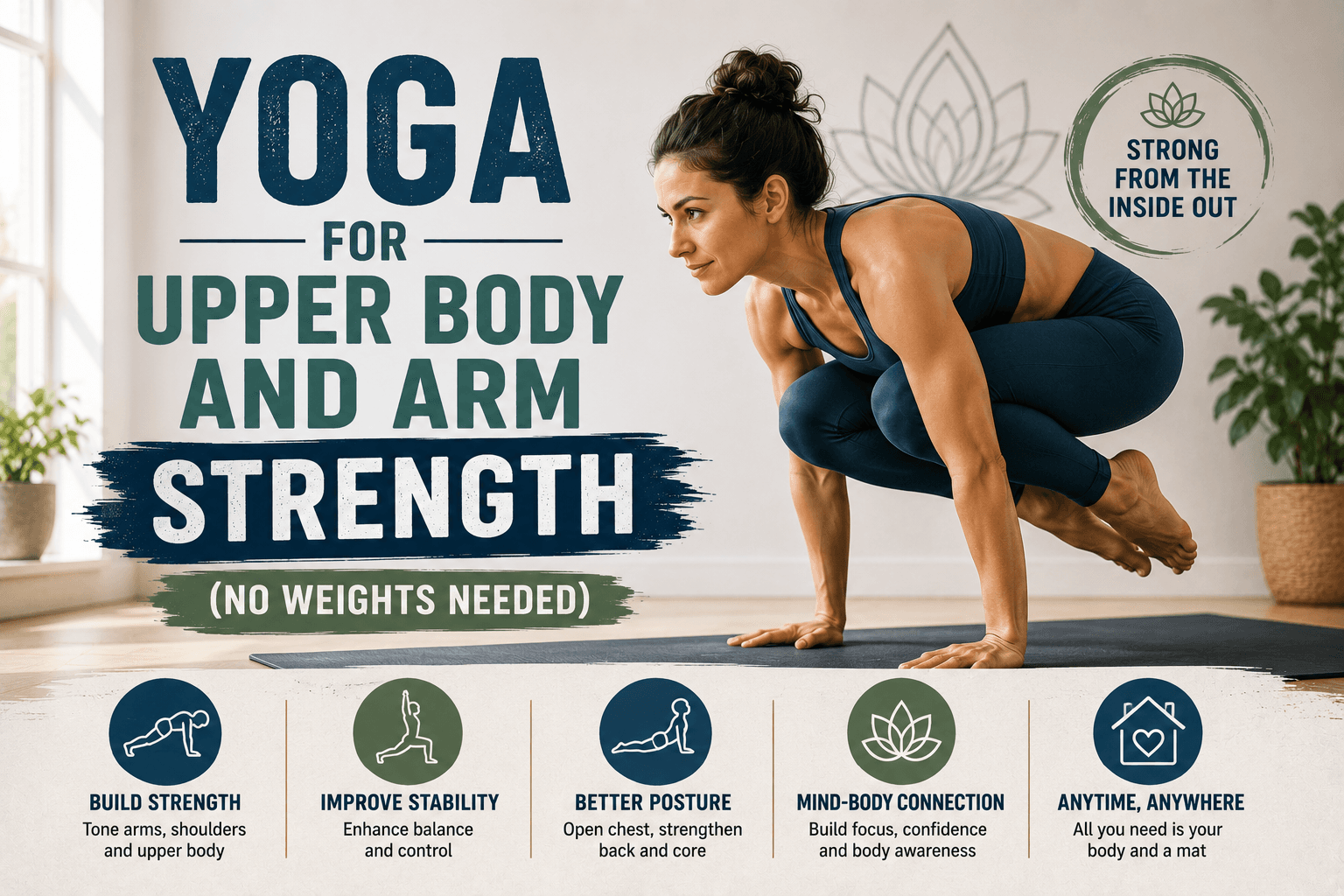
Yoga for upper body and arm strength (no weights needed)
You're probably already doing hundreds of upper-body reps a week and getting almost nothing from them. The pose meant to build your arms is the one nearly everyone gets wrong.
The short answer
Yes, yoga builds upper body strength — through Chaturanga Dandasana (the yoga push-up), plank variations, and arm balances. A twice-weekly practice meets the CDC's muscle-strengthening guideline without touching a dumbbell.
The catch: chaturanga is the most consistently butchered pose in yoga. Elbows flared, shoulders sinking below elbow height, chest collapsing — done that way it builds nothing and is a leading cause of shoulder trouble in regular practitioners.
And the honest limit: bodyweight builds endurance and relative strength well, but you can't progressively overload a plank forever. For real size or maximal strength you'll eventually need load.
Yes it works — but probably not how you're doing it
Here's an uncomfortable observation about yoga for upper body strength. A regular vinyasa practitioner might move through chaturanga forty or fifty times in a single class. Three classes a week and that's well over a hundred repetitions of what is essentially a push-up.
By any reasonable logic, they should have strong arms. Many don't.
The reason isn't that yoga can't build strength — it can, and the CDC counts bodyweight exercise as muscle-strengthening activity alongside weights and resistance bands. The reason is that chaturanga performed badly isn't a strength movement at all. It's a controlled fall.
When the elbows flare wide and the shoulders sink below elbow height, the load transfers off the working muscles and onto the shoulder joint's passive structures. You get the fatigue without the adaptation, plus a slow accumulation of shoulder irritation. It is genuinely the most consistently mis-taught pose in mainstream yoga.
If you've searched how to strengthen arms without weights and landed on yet another pose list, the useful version is different. It's this: learn to do the two or three you're already doing properly, and yoga becomes a real arm workout without weights.
Chaturanga: the pose doing all the work
Chaturanga Dandasana — four-limbed staff pose — is the yoga push up, and it's the single hardest upper-body movement in a standard practice. Everything about your arm and chest development in yoga runs through this one shape.
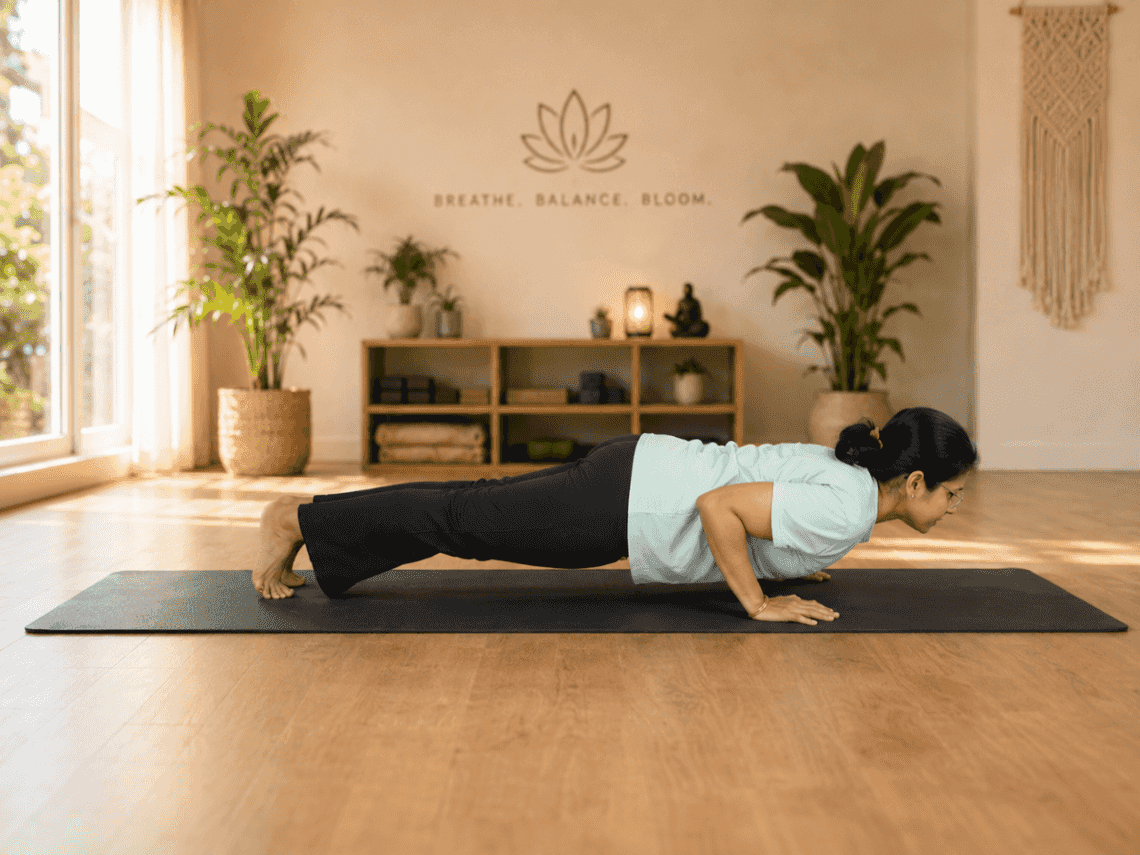
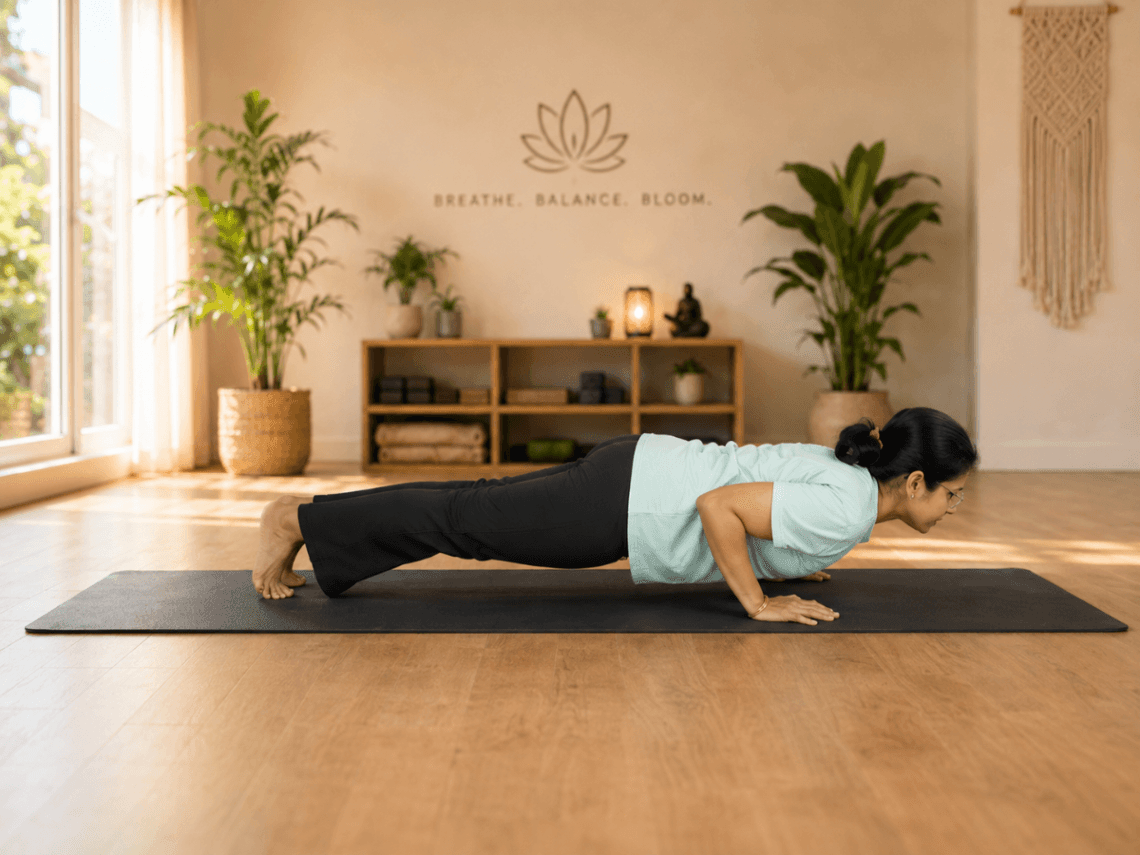
Chaturanga Dandasana
Four-limbed staff pose · the yoga push-up
From a high plank, shift forward slightly on the toes so the shoulders travel past the wrists. Then bend the elbows and lower — but only until the upper arms are roughly parallel to the floor and the shoulders are level with the elbows. Not lower. Elbows stay hugged in toward the ribs, pointing back rather than out. Body holds one line from heel to head.
The whole descent should be controlled and slow enough that you could stop halfway. If you can't stop halfway, you're falling, not lowering.
The three failures: elbows flaring wide to the sides; shoulders dropping below elbow height; hips sagging so the body bends rather than holding a line. Any of the three and the pose stops doing its job.
The knees-down version is not a lesser pose. Dropping the knees while keeping everything else identical — elbows in, shoulders high, one line from knee to head — is the correct version if the full pose collapses your form. Almost everyone would be better served doing it that way for a few months.
Plank, and why holding longer isn't the answer
Plank pose is where most people start, and it's genuinely useful — shoulders, chest, core, and the wrists all working together to hold one position.
But there's a trap. Once you can hold a plank for two minutes, holding it for three doesn't build much more. You've moved from strength work into endurance, and the returns flatten. Harder leverage beats longer holds.
High Plank
Phalakasana · the foundation
Shoulders stacked directly over wrists, heels pressing back, one line from heel to head. Press the floor away so the upper back broadens rather than letting the chest sink between the shoulder blades.
Progress it by: lifting one leg, then one arm, then moving to forearms, then side plank. Not by adding minutes.
Side Plank
Vasisthasana · half the support, twice the demand
From plank, roll onto the outer edge of one foot, stack the shoulders, and reach the top arm skyward. Everything that plank asked of two arms now falls on one, plus significant lateral core work.
Easier: bottom knee down on the floor, which removes most of the load while keeping the shape. Harder: lift the top leg.
Dolphin
Ardha Pincha Mayurasana · shoulder builder
Forearms on the floor parallel, elbows shoulder-width, hips lifted as in downward dog. Deceptively hard, and one of the better shoulder-strengthening positions in yoga because it loads them in flexion without wrist involvement.
Useful if: your wrists complain in plank and chaturanga. Dolphin gives you upper body work without them.
Arm balances: where it gets genuinely hard
Yoga for arm strength stops being gentle here. Any yoga arm balance takes your entire mass onto your hands. These take your entire mass onto your hands, and they are the closest yoga gets to advanced calisthenics.
Crow Pose
Bakasana · the gateway arm balance
From a squat, plant the hands shoulder-width, bend the elbows slightly, rest the knees high on the upper arms near the armpits, then shift weight forward until the feet lift. Gaze forward, not down — looking down is what makes people topple.
Truth about it: it's more about weight shift and courage than raw strength. Most people who "can't" do crow are simply not leaning far enough forward.
Beyond crow: side crow, firefly, eight-angle pose. Yoga arm balance poses scale a long way, and they're the honest answer to "how do I keep progressing without equipment" — you don't add weight, you reduce your base of support and change the leverage.
Learn the Form From Someone Watching
Rabab Bazar's Yoga for Upper Body builds strength in the shoulders, chest, back, arms and core — 60 minutes, $10 group or $30 private, rated 4.9★ from 42 reviews. It's Intermediate level; see the gentler option further down if you're starting out.
Book Yoga for Upper Body — $10 Yoga for Arms Strength — $10Shoulders and upper back
Strength without mobility is a short-lived arrangement, and yoga for shoulders is one of the areas where the practice genuinely outperforms a weights room.
Downward dog is doing more shoulder work than people credit. Held properly — arms straight, upper back broad, weight distributed rather than dumped into the wrists — it's a sustained overhead shoulder position most gym programmes never train.
Backbends open the front of the shoulders and chest, which matters because almost everything else in modern life closes them. Yoga for upper back stiffness generally lives here too — cobra, locust, bridge, and gentle thoracic extension work.
The pairing is the point: pressing strength from chaturanga and plank, opening from backbends. One without the other produces a strong body that can't move well, or a mobile one that can't hold anything.
A short no-weights sequence
Here's an actual upper body session you can do on a mat with nothing else. Fifteen to twenty minutes, twice a week — which, per the CDC's guidelines, meets the adult muscle-strengthening recommendation. If you're building the habit from nothing, the CDC's guidance on adding physical activity as an adult is a sensible starting framework.
Upper body, no equipment
- Cat-cow · 1 minuteWarm the shoulders and thoracic spine before loading anything.
- Downward dog · 5 breaths, 3 roundsArms straight, upper back broad. Feel the shoulders working.
- High plank · 30 seconds, 3 roundsStop when the hips start to sag. That's the set, not the clock.
- Chaturanga · 5 slow reps, 3 roundsKnees down if form breaks. Three seconds down, no faster.
- Side plank · 20 seconds each side, 2 roundsBottom knee down to scale it.
- Dolphin · 30 seconds, 2 roundsWhere the shoulders really earn it. Wrist-free.
- Crow attempts · 5 triesFalling forward onto a cushion is part of learning this.
- Cobra and child's pose · 2 minutesOpen what you just closed.
That's a genuine arm workout without weights. It'll feel harder than it reads.
The honest ceiling: where bodyweight stops
Now the part most yoga content leaves out, and it matters if you're serious.
Bodyweight training has a real limit. Strength gains come from progressive overload — gradually asking for more than last time. With weights that's straightforward: add a kilo. With bodyweight you can only manipulate leverage, and eventually you run out of ways to make a plank harder while still being a plank.
What yoga builds well is muscular endurance, relative strength, joint stability and control. What it builds poorly past a certain point is maximal strength and muscle size. If you can hold chaturanga comfortably for thirty seconds and crow feels easy, you have largely extracted what bodyweight yoga has to offer for your arms, and further progress means either serious arm-balance work or external resistance.
None of that makes yoga a poor choice. It makes it a complete answer for general strength and a partial one for building size. Knowing which you want saves a lot of frustration.
When You Need Actual Load
Younes Eddiki's Home Workout Coach covers structured strength and muscle building — 60 minutes, $17 group or $50 private, rated 4.6★ from 27 reviews. Advanced level, and the honest next step once bodyweight plateaus.
Book strength coaching — $17 Browse strength classesIf you sit at a desk all day
Worth its own section, because it's the most common version of this problem and the instructor herself flags it. Rabab's class notes read simply: "Join this session if you have long desk working job and stiffness in upper back."
Desk posture produces a specific pattern — chest and front shoulders tight and short, upper back weak and overstretched, neck carrying load it shouldn't. The instinct is to stretch the sore bit, which is the upper back. But the upper back usually isn't tight; it's weak and overworked. What's actually short is the front.
So the fix is two-directional: strengthen the upper back and the pressing muscles, and open the chest and front shoulders. That's exactly what a well-built upper body yoga session does, and it's why this kind of class often helps desk stiffness more reliably than stretching alone.
Who should be careful
Worth knowing before you load your shoulders
Existing shoulder injury or impingement. Chaturanga and plank are exactly the positions that aggravate it. Get cleared first, and expect to work with dolphin and knees-down variations rather than the full poses.
Wrist pain or carpal tunnel. Most of these poses load the wrists heavily. Dolphin and forearm work are the way around it; so are fists or wedges under the heels of the hands.
Recent surgery or a diagnosed joint condition. Speak with a doctor or physiotherapist first — the National Institute on Aging's guidance on exercising with chronic conditions is a sensible non-commercial starting point.
And a general rule for this specific article: form failure is your stopping point, not fatigue. When the elbows flare or the hips sag, the set is over regardless of how many reps you'd planned.
Learning it live
One honest note: Rabab Bazar teaches nearly every upper-body yoga class on P2Bridge. This isn't a roster of competing options — it's one instructor who has built out this area, plus a strength coach for when bodyweight isn't enough.
The case for live instruction here is stronger than for most yoga topics, and specific: chaturanga form is invisible to you. You cannot see whether your elbows are flaring or your shoulders have dropped below elbow height. A video certainly can't tell you. Someone watching can, in the moment, before a hundred bad repetitions become a shoulder problem.
Yoga for Upper Body
★★★★★4.9 (42 Reviews)Her own description is unusually precise for a class listing: built to develop muscular endurance, stability and functional strength across the shoulders, chest, back, arms and core, through controlled movement and breathing, with posture and joint mobility as stated outcomes. The most-reviewed host on the platform, at 42 reviews.
Book — $10 group Rabab's profile
Yoga for Arms Strength
★★★★★4.9 (42 Reviews)The narrower companion to the upper body session, concentrated on the arms themselves. Same instructor, same price, and a sensible second session in a week if arm strength is the specific goal. Her backbends and strength and flexibility classes cover the opening side.
Book — $10 group Her Beginner class
Home Workout Coach — Strength & Muscle
★★★★★4.6 (27 Reviews)For the honest ceiling described above. Once chaturanga is comfortable and crow feels easy, structured strength work with actual progressive overload is the next step rather than more repetitions of the same shapes.
Book — $17 group Younes's profileNot Ready for Intermediate? Start Here
Rabab's Gentle Yoga to Stretch and Relax is Beginner level, 60 minutes, $10 group or $30 private — 4.9★ from 42 reviews. Build the base, then come back to the strength classes.
Book Gentle Yoga — $10 See all group classesRelated reading: our guide to sun salutations covers the sequence where most of your chaturangas actually happen, building a weekly practice covers fitting strength and yoga together, and home workout coaching vs. a fitness app covers why live form correction matters. Browse the yoga category, core training, the full host directory, private sessions, or more on the blog.
Questions people ask
Can yoga really build arm strength without weights?
Yes, through chaturanga, plank variations and arm balances, which load the arms, shoulders and chest with your own bodyweight. The CDC counts bodyweight exercise as muscle-strengthening activity, so a twice-weekly practice meets the adult guideline. The caveat is that form determines whether it works — a badly performed chaturanga builds very little.
What is chaturanga and why is it so hard?
Chaturanga Dandasana, or four-limbed staff pose, is the yoga push-up. It's hard because it's a controlled lowering that stops halfway rather than a full descent — you hold the hardest portion of a push-up rather than passing through it. Most people avoid the difficulty unconsciously by dropping too low or flaring the elbows.
Why do my shoulders hurt after yoga?
Most commonly, chaturanga form. If the shoulders drop below elbow height or the elbows flare wide, load transfers off the muscles and onto the shoulder joint. Repeated across dozens of repetitions per class, that's a leading cause of shoulder irritation in regular practitioners. Dropping the knees and keeping the shoulders high fixes it.
How many times a week should I do upper body yoga?
Twice a week meets the CDC's muscle-strengthening recommendation and is enough for real progress, provided the sessions actually load the upper body rather than flowing past it. Leave at least a day between sessions that work the same muscles.
Will yoga build muscle in my arms?
It will build muscular endurance, joint stability and noticeable relative strength. Significant muscle size is a different goal, and bodyweight work hits a ceiling because you can only manipulate leverage rather than add load. For size, yoga is a good foundation rather than a complete answer.
What if I can't do chaturanga properly?
Drop the knees and keep everything else identical — elbows hugged in, shoulders level with or above the elbows, one line from knee to head. This isn't a lesser version; it's the correct version until you can hold the full pose without form breaking. Most people would benefit from working there for months.
What can I do if my wrists hurt in plank?
Move to forearm-based work. Dolphin and forearm plank load the shoulders and upper body without putting weight through the wrist joint. Making fists rather than flat palms, or using a wedge under the heels of the hands, also reduces wrist extension considerably.
Is crow pose about strength or technique?
More technique than most people assume. Crow requires reasonable arm strength, but the usual reason people can't do it is failing to shift enough weight forward, often because they're looking down. Fixing the gaze forward and committing to the lean solves it more often than extra strength work does.
Do arm balances count as strength training?
Genuinely, yes. Supporting your full bodyweight on your hands is demanding upper-body and core work, and arm balances scale a long way — from crow through side crow, firefly and eight-angle pose. They're how bodyweight yoga keeps progressing once basic poses become easy.