








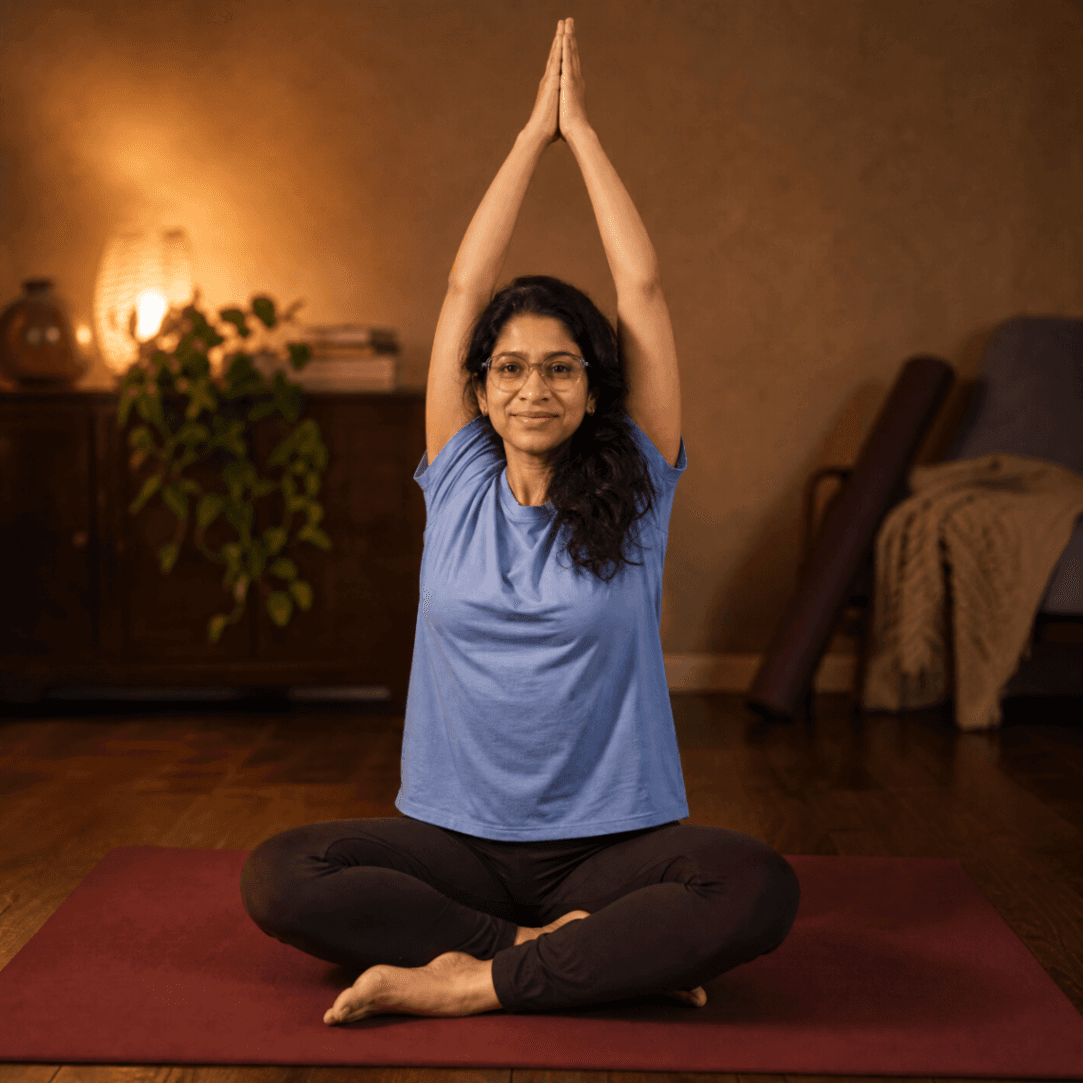


Morning mobility routines: why 10 minutes beats the long workout you skip
A short routine you actually finish beats an ambitious one you abandon by Thursday. Here's the real reason short wins, and three live classes to start with today.
The short answer
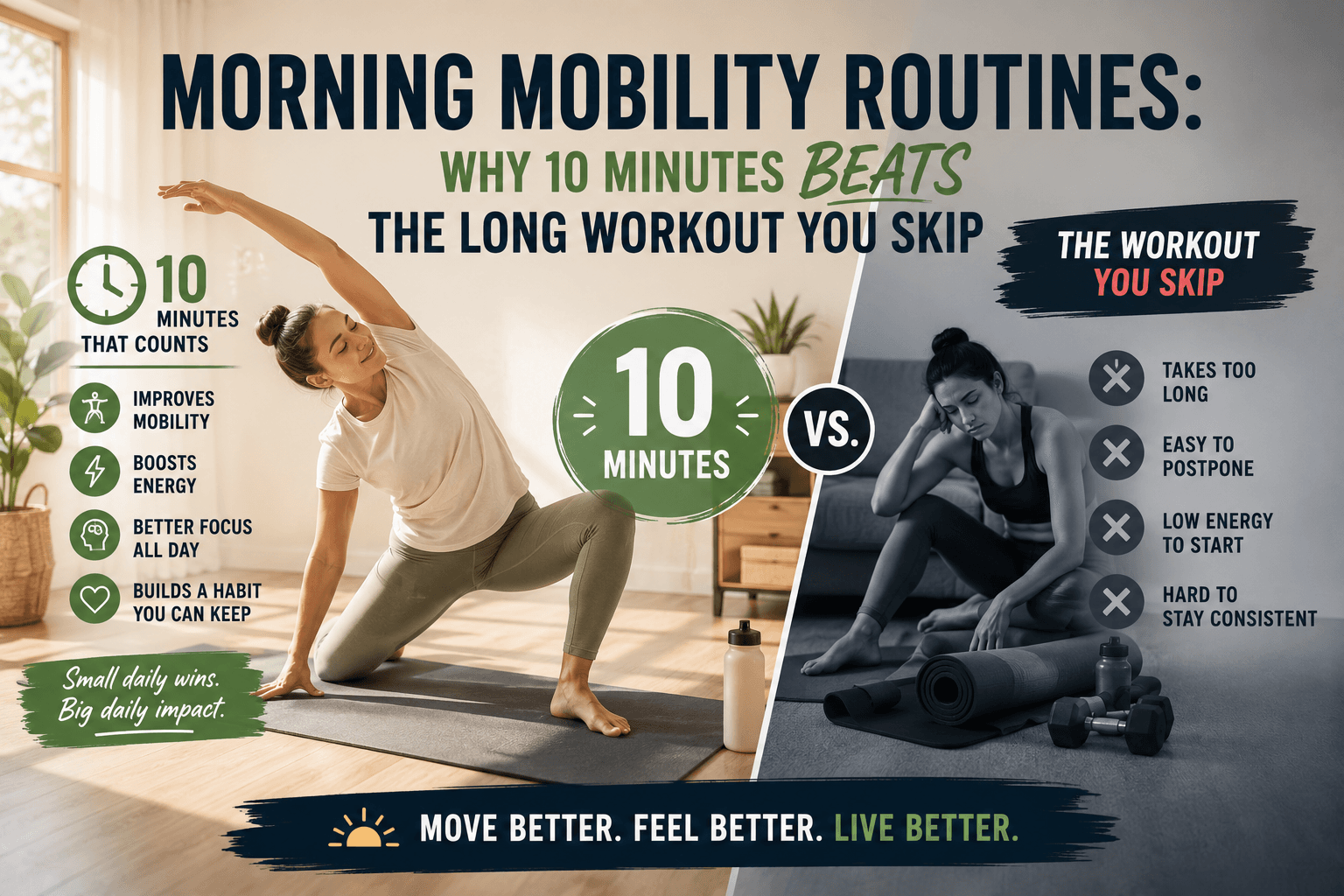
A ten-minute morning mobility routine you actually do beats a forty-five-minute workout you plan to do and skip four days out of five. Mobility work isn't trying to build the same thing strength training builds — it's countering the stiffness that accumulates overnight, and that takes consistency, not duration, to fix.
The habit compounds. The abandoned plan doesn't. That's the whole argument, and it's borne out by how differently short and long routines actually get finished in practice.
Why the ambitious routine fails
Nobody plans to quit their new morning routine. The forty-five-minute full-body plan, the five-day-a-week promise, the alarm set for an hour earlier — all genuinely intended. And then Tuesday happens, or a bad night's sleep happens, and the whole plan gets pushed to tomorrow, and tomorrow becomes next week.
This isn't a willpower problem. It's a math problem. A forty-five-minute session skipped four mornings out of five delivers roughly nine minutes of actual movement, averaged across the week. A ten-minute session done five mornings out of five delivers ten. The smaller, finished commitment produces more real movement than the larger, abandoned one — not sometimes, structurally, every time the abandonment rate is what it usually is for ambitious plans.
What are good morning workouts, then, if not the ambitious ones? Ask what is a good morning workout on any search engine and you'll get the same answer this article is making: whichever one you'll actually do tomorrow, and the one after that. Quick morning workouts win not because intensity doesn't matter, but because a workout that happens beats a better workout that doesn't. Best morning exercise routine advice almost always ends up being some version of this — smaller and finished, not bigger and abandoned.
The same logic holds whether you're looking at an early morning workout, a morning workout routine at home, a morning fitness routine at home, or an at home morning workout routine built around a specific goal. The format matters less than whether it survives contact with a genuinely ordinary Tuesday morning. Good workouts in the morning are, almost by definition, the ones still happening in week six.
What actually happens to your body overnight
Morning stiffness is real and mostly mechanical, not mysterious. Hours of stillness reduce fluid movement in and around your joints, and connective tissue behaves more like a substance that's been sitting than one that's been used. None of this requires a long session to fix — it requires movement, applied consistently, first thing. Best morning stretching for this specific problem tends to be broad rather than deep: moving every major joint through its range once matters more than holding any single stretch for a long time.
This is also the honest answer to why does stretching in the morning feel good, and why do we stretch in the morning at all — you're not building anything new in a ten-minute session, you're restoring range of motion that was already there before eight hours of lying still. That's a genuinely different job than a workout, and it's one a short session is well suited to finish. If you've wondered is it good to stretch in the morning specifically, or is it healthy to workout in the morning versus any other time, the honest answer is that mobility work benefits from morning timing more than general fitness does, precisely because it's undoing something that happened overnight.
A simple wake up stretch sequence — ankles, hips, spine, shoulders, one pass each — covers most of what accumulates overnight. If you'd rather pair the movement with something calmer, several hosts teach breathwork and guided meditation that works well either side of a short mobility session. Stretches to wake you up don't need to be elaborate; morning movement in general is more about breadth than intensity, and even a handful of stretches for energy done consistently outperforms an elaborate routine done rarely.
Three real options: 30, 45, or 60 minutes
Here's the practical version of "start small" — three live, bookable classes, three durations, so the decision is concrete rather than aspirational.

Chair Yoga Break
★★★★★4.9 (25 Reviews)The lowest-commitment entry point on this list. Built around releasing tension from sitting — neck and shoulders especially — using nothing but a sturdy chair. If forty-five minutes still feels like too much to start, this is where to actually start.
Book Chair Yoga Break — $10 Yanina's profile
Morning Mobility
★★★★★5.0 (8 Reviews)The direct subject of this article. Gentle movement for the hips, back, shoulders, and spine — no equipment needed, comfortable clothing and a little space is all the class actually requires. This is the class the whole "why 10 minutes beats a long workout" argument is built around.
Book Morning Mobility — $18 Sarah's profile
Full Body Stretch & Relax
★★★★★4.6 (27 Reviews)Where to graduate to once the habit is real and mornings feel like they have room for more — and if you eventually want to add load rather than just range of motion, our strength classes and core training are the natural next step after mobility. Full-body stretching for flexibility, posture, and recovery — the host's own guidance is simple: move slowly, breathe deeply, never force a stretch.
Book Full Body Stretch — $17 Younes's profileStart With Sarah's Morning Mobility Class
5.0 stars from 8 reviews. $18 for a group class, $60 for private — 45 minutes of guided movement for the hips, back, shoulders, and spine, live with a real instructor.
Book Morning Mobility — $18 Browse all fitness classesBuilding the habit that actually sticks
A few practical mechanics matter more than motivation here. Attach the routine to something that already happens every morning — right after you get out of bed, right before coffee, whatever's already fixed in your day. A routine that depends on remembering to schedule it competes with everything else remembering to do; a routine attached to an existing habit doesn't.
Book the same time slot repeatedly rather than deciding fresh each day. A recurring 7am class removes the daily negotiation with yourself about whether today's the day — private sessions are easier to lock into a fixed weekly slot than group classes, and it's worth checking current offers if you're planning to book several. If none of the listed times work for your timezone, the custom experience request exists for exactly that. Expect it to feel like effort for longer than you'd think, and don't take that as a sign it isn't working. A 2024 systematic review and meta-analysis of 20 studies covering 2,601 people found that health habits typically take two to five months to become genuinely automatic — not the widely repeated 21 days, which the researchers explicitly refute. Quitting in week two is quitting long before the mechanism that makes habits effortless has had a chance to engage.
That same review turned up something directly relevant to this article's argument, and it's worth knowing about. One of the studies it analysed (Fournier et al.) tracked people building a daily stretching habit specifically, and found morning practice produced a habit in a mean of 106 days versus 154 days for evening practice. Morning stretching became automatic roughly seven weeks sooner. The reviewers concluded that morning practices and self-chosen habits consistently show greater habit strength — which is a real, evidence-backed reason to put mobility work first thing rather than "later today."
One more practical note, since it comes up often: stretching in bed in the morning before you've even stood up is a genuinely reasonable way to start, particularly for anyone managing more significant stiffness. Morning stretches for seniors frequently begin exactly this way, still lying down, before progressing to standing work — there's no rule that a mobility routine has to start on your feet. A short pass through upper body mobility exercises — shoulder rolls, gentle neck turns, an overhead reach — while still under the covers is a legitimate first step, not a shortcut.
If you sit at a desk all day
Worth its own section, because a specific and common situation deserves a specific answer rather than generic advice: mobility exercises for people who sit all day aren't the same problem as general morning stiffness, even though they overlap. Hours of sitting compound the overnight stillness rather than resetting it, which is exactly why Yanina's Chair Yoga Break exists as a format — not a lesser version of a real class, a version built for the specific mechanics of a desk-bound body. It's a genuine mobility warm up before the workday starts, not a workout in its own right.
Desk-specific stiffness tends to show up in predictable places. Upper body mobility — neck, shoulders, thoracic spine — takes the worst of it from hunching over a screen. Lower body mobility, especially the hips, tightens from hours of a fixed seated angle. A routine that targets both, even briefly, does more to regain mobility than a longer session that ignores where the actual tightness is. Improved mobility here isn't about flexibility for its own sake — it's about the specific joints a desk job quietly stiffens.
If you've searched flexibility classes near me or mobility training near me hoping to find something for exactly this, or you're a flexibility coach near me search away from booking something local, it's worth knowing that flexibility near me doesn't need to mean local at all. A flexibility coach working with you live over video watches your posture exactly the way an in-person one would. The same goes if you've searched yoga classes for seniors near me on behalf of a parent or yourself — an instructor experienced with gentler pacing doesn't need to be nearby to actually help, and often the right specialist simply isn't the closest one. The wider yoga category covers gentler formats too, and if you teach this kind of work yourself, you can become a host on the platform.
Who should check with a doctor first
Worth a quick check before starting
Mobility work is broadly gentle and low-risk, which is part of why it's a reasonable starting point for almost anyone. That said, if you have a recent injury, a diagnosed joint or spine condition, or you're recovering from surgery, mention it to your instructor before class and check with your doctor or physiotherapist first if you're at all unsure. None of these classes are designed to push through pain, and a live instructor can adapt around almost anything once they know about it. The National Institute on Aging's guidance on exercising with chronic conditions is a solid, non-commercial place to start that conversation with your doctor.
Pick Your Starting Point
30 minutes with Yanina — $10 group, 4.9★. 45 with Sarah — $18 group, 5.0★. 60 with Younes — $17 group, 4.6★. All beginner-friendly, all live.
See group classes Browse all hostsQuestions people ask
Why does stretching in the morning feel good?
Hours of overnight stillness reduce fluid movement in and around your joints, so morning stretching restores range of motion that was already there rather than building something new. That's a big part of why it feels immediately good rather than effortful the way a hard workout does — you're undoing overnight stiffness, not creating fatigue.
Is 10 minutes actually enough for a morning routine?
For mobility specifically, yes — the goal is restoring range of motion and reducing stiffness, not building strength or endurance, which is a job short consistent sessions handle well. Ten minutes done daily also has a dramatically higher real-world completion rate than a 45-minute plan, which matters more than the extra volume a longer session would theoretically provide.
What's the difference between a mobility routine and stretching?
Stretching typically targets a specific muscle held in a fixed position. Mobility work moves a joint actively through its available range, which more closely matches how your body actually needs to move through a day. Most morning mobility routines blend both.
Is it healthy to work out in the morning specifically, or does timing not matter?
Timing matters less than consistency for most goals, but morning has a practical advantage: it's before the day's obligations have had a chance to crowd it out. For mobility specifically, morning also directly addresses overnight stiffness, which gives it a genuine functional reason to happen first thing rather than just a scheduling one.
Do I need any equipment for a morning mobility class?
Generally no. Sarah's Morning Mobility class needs no equipment at all, just comfortable clothing and a little space. Yanina's Chair Yoga Break needs only a sturdy, stable chair without wheels or armrests. Younes's Full Body Stretch & Relax also requires no equipment.
What if I sit at a desk all day — is a general mobility class enough?
A general class helps, but the specific stiffness patterns from prolonged sitting — tight hips, rounded shoulders, a stiff spine — respond well to a format built around that constraint specifically, which is exactly what a chair-based session addresses directly rather than as an afterthought.
How long until a morning mobility habit actually feels automatic?
Considerably longer than most people expect. A 2024 systematic review of 20 studies found health habits typically take two to five months to become genuinely automatic, with wide individual variation — and it explicitly refutes the popular "21 days" claim. Notably, one study of daily stretching specifically found morning practice reached automaticity in a mean of 106 days versus 154 days in the evening, so morning timing appears to help. The practical takeaway: don't judge whether it's working in the first couple of weeks.