


Tom yum vs. panang: the two Thai dishes that teach you everything
One of these isn't a curry. That sounds like pedantry until you understand why — and then it turns out to be the most useful thing anyone can tell you about Thai cooking.
The short answer
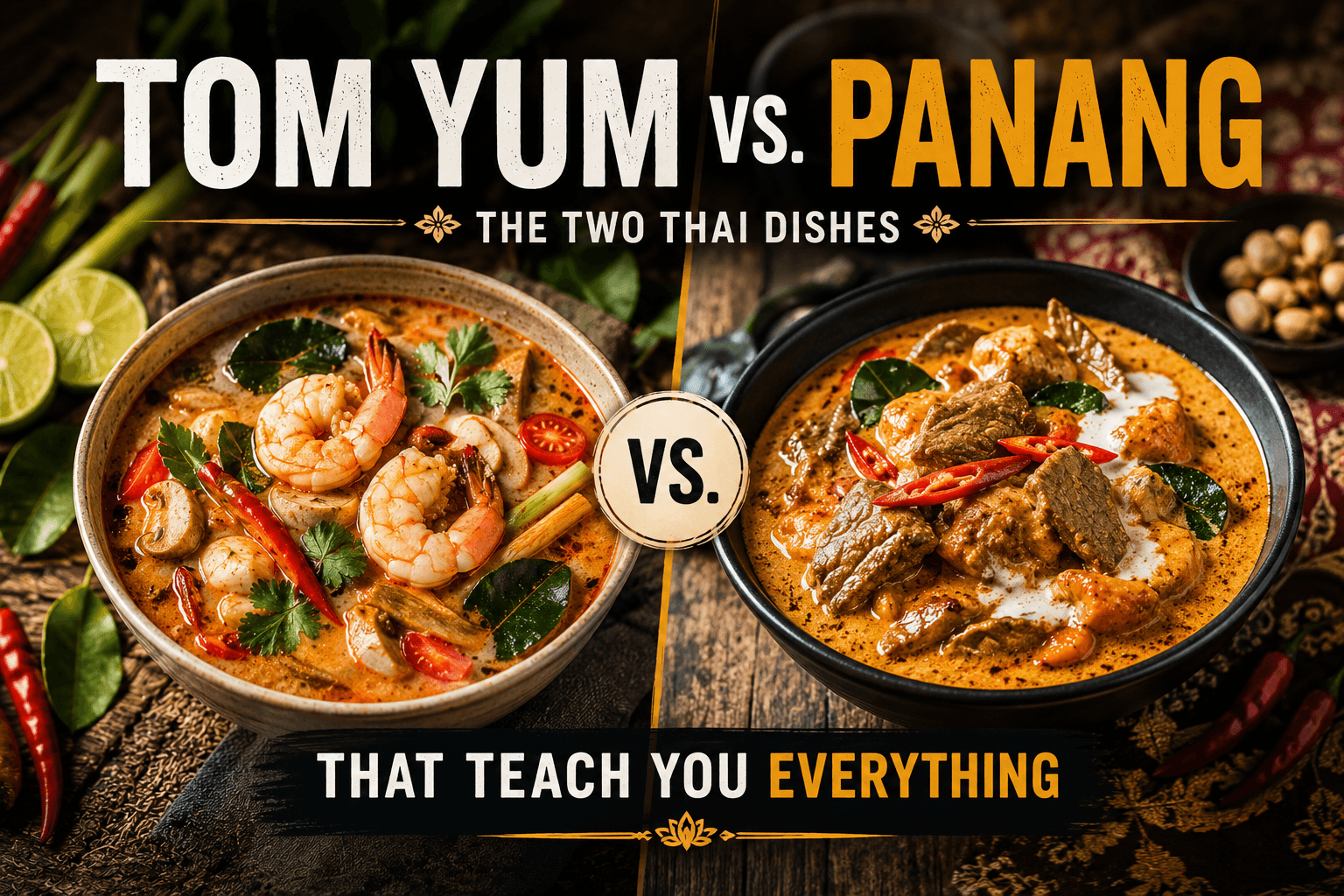
Tom yum is a soup. Panang is a curry. And the difference isn't a label — it's two opposite ways of handling the same aromatics.
Tom yum infuses. Lemongrass, galangal and makrut lime leaves are bruised, left whole, steeped in broth, then pushed aside on the plate. Clear, sharp, sour-led.
Panang pounds. The same aromatics become a paste, fried in coconut cream until the oil splits. Thick, sweet, clinging to the beef rather than pooling under it.
Learn those two structures and most Thai dishes stop being mysterious. Nearly all of them are one or the other.
One of these is not a curry
Tom yum gets called a curry constantly in English. It isn't one. Tom means to boil; yum refers to a spicy-sour style of mixing. It's a soup, and Thai classification treats it as one. Panang, meanwhile, is squarely a curry.
That correction would be trivia if the two dishes were merely different. They're not merely different — they're built by opposite methods, and between them they cover almost the whole technical range of Thai cooking.
Consider what the two dishes actually share: lemongrass, galangal, makrut lime, chilli, garlic, shallot, fish sauce. Nearly the same shopping list. What separates them completely is what you do to those aromatics.
In tom yum you bruise them and leave them whole. They sit in the broth, give up their oils, and get pushed to the side of the bowl. Nobody eats a stalk of lemongrass. In panang you pound them into a paste and fry that paste in split coconut oil until the spices bloom. The aromatics stop being a flavouring and become the body of the sauce.
Infusion versus emulsion. Steep versus pound. Once you can see which one a dish is doing, the rest of Thai cooking opens up — green curry, massaman and choo chee are all doing the panang thing; tom kha, tom saap and most Thai soups are doing the tom yum thing.
Tom yum: the infusion
The classic is tom yum kung, made with prawns. The build is fast — this is a soup you can have on the table in twenty minutes, and length of cooking is not where its flavour comes from.
Lemongrass gets cut into batons and bruised with the flat of a knife to split the fibres. Galangal is sliced into coins. Makrut lime leaves are torn rather than chopped, which releases far more aroma than a knife does. All of it goes into stock and steeps.
Then the things that shouldn't be boiled: prawns for a couple of minutes only, mushrooms, chillies. And at the very end, off the heat, lime juice and fish sauce.
Why lime goes in last
Boiling lime juice dulls it — the bright top notes cook off and what's left tastes flat and slightly bitter. Take the pot off the heat, then add the lime. Same for fish sauce, which turns harsh if you boil it hard.
This is the single most common fixable mistake in home tom yum, and it costs nothing to correct.
Note what you don't do: you don't strain the aromatics out, and you don't chop them small enough to eat. A bowl of tom yum arrives with lemongrass batons and galangal coins in it. They're not garnish and they're not a mistake — you eat around them. Chopping lemongrass fine so it's "easier to eat" produces a bowl of woody splinters, and it's a giveaway that a recipe was written by someone guessing.
Nam sai, nam khon, and the tom kha confusion
There are two legitimate tom yums, and the difference has a date attached.
Nam sai is the clear version — the traditional profile, and the stronger, more intense one. Broth, aromatics, chilli, lime. Nothing to soften it.
Nam khon is the creamy version, thickened with evaporated or coconut milk. It's documented as emerging during the reign of King Vajiravudh, Rama VI, between 1910 and 1925 — recent, as these things go. It's milder, hugely popular in Bangkok, and the version most Western diners have met.
Neither is wrong. But if you've only had the creamy one and found tom yum underwhelming, the clear version is a genuinely different experience and worth seeking out.
Tom kha is not "creamy tom yum"
People swap these names constantly and they're separate dishes. Tom kha is built on coconut milk and is usually made with chicken — tom kha gai. Creamy tom yum uses evaporated milk and usually features seafood. Kha means galangal, which sits much further forward in tom kha than it does in tom yum.
Ordering tom kha expecting tom yum is how people end up thinking Thai soups all taste the same.
Panang: the paste
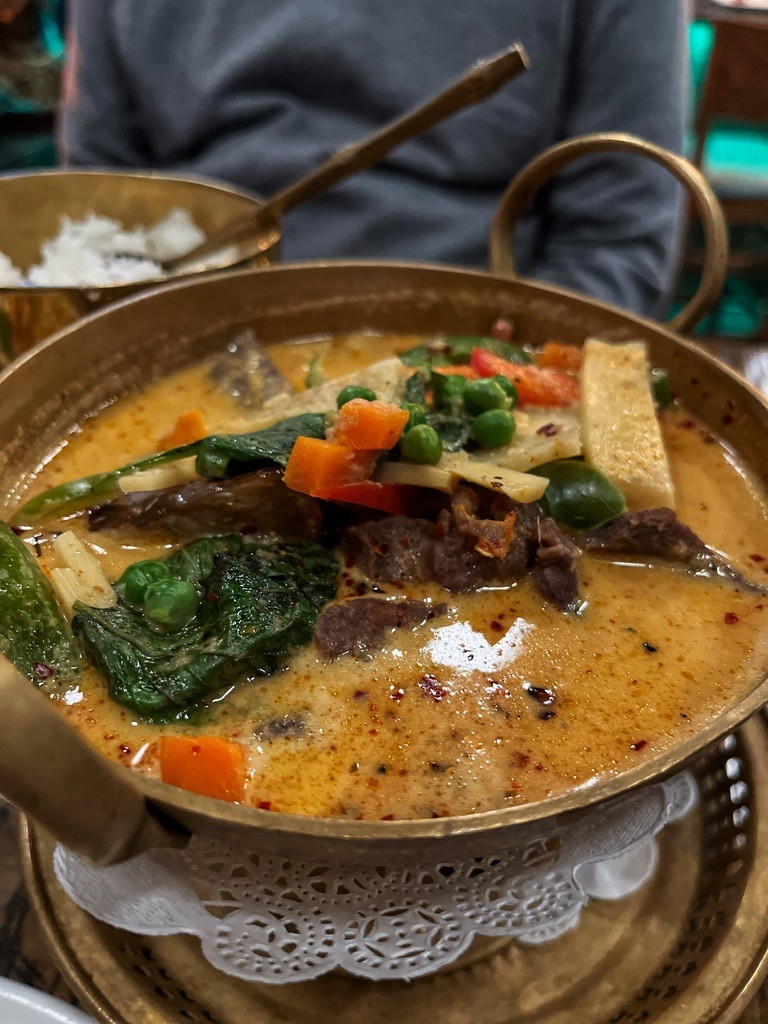
Panang comes from central Thailand, and its paste is a specific thing: dried chillies, galangal, lemongrass, makrut lime zest, coriander root, coriander seeds, cumin seeds, garlic, shallot, shrimp paste, salt — and, crucially, peanuts.
The name has two competing origin stories and I'd not back either too hard. One traces it to an old Khmer word for "cross," from chickens grilled with their legs crossed and basted with a peanut-and-coconut curry paste. The other traces it to the Malay panggang, meaning grilled. Both point at the grill, which is a satisfying coincidence if nothing else.
What matters at the stove is that panang is a "dry" curry. It isn't soupy. The sauce should be thick enough to sit on a spoon and to coat the beef rather than pool beneath it. If your panang comes out looking like a thin red soup with meat in it, something specific went wrong — and it's almost always the next section.
Cracking the coconut cream
Here's the technique that separates panang made properly from the flat, slightly raw-tasting version most people produce at home. Almost no Western recipe explains it, and it takes four minutes.
You don't fry the paste in oil. You fry it in coconut cream that you've broken.
Put thick coconut cream in the pan on its own — no milk, no water added, no paste yet. Simmer it. The water evaporates, the fats and solids separate out, and you get visible oil pooling and shimmering at the edges. That's cracked or split coconut cream. Now the curry paste goes in, and it fries in that coconut oil until it darkens and smells transformed.
Then, and only then, the rest of the coconut milk.
Skip this — tip the paste straight into a pan of coconut milk and simmer — and the paste never fries. Raw garlic and raw shallot dominate. Spices stay closed. The sauce won't thicken properly because you've had no fat phase to build it on. That's the flat panang.
Buy cream that can crack
Coconut cream loaded with guar gum, xanthan gum or emulsifiers will resist splitting — the additives exist specifically to keep it emulsified, which is the opposite of what you want here. Look for coconut and water on the ingredient list, and little else. If yours refuses to crack after several minutes, that's the reason, not your technique.
Cook Both in One Session
Shawnie Kelley teaches Thai Classics: Tom Yum & Panang Curry Beef live — a soup and a curry in one class, which is exactly how you'd want to learn the two methods. She's a Chef Instructor with 18+ years, rated 4.5★.
See Shawnie's classes & pricing All cooking classesPanang vs red curry
Useful to know, because panang paste is essentially red curry paste with two additions: roasted peanuts and nutmeg, plus a heavier hand with cumin and coriander.
That gives you a genuine shortcut. If you can only find red curry paste, pound a couple of tablespoons of roasted unsalted peanuts and a little grated nutmeg into it with a mortar and pestle. It isn't identical to a properly made panang paste, but it's far closer than red curry alone.
| Panang | Red curry | |
|---|---|---|
| Paste additions | Roasted peanuts, nutmeg, more cumin and coriander | None of those |
| Consistency | Thick, nearly dry — coats the meat | Thinner, pools |
| Heat | Milder — peanuts and cream buffer the chilli | Spicier |
| Sweetness | Noticeably sweeter | Sharper, brighter |
| Classic protein | Beef | Chicken, duck, pork |
On the beef: panang is traditionally made with it, and in smaller, more concentrated portions than a Western plate expects. Thick sauce, less of it, more rice. The USDA's safe internal temperature for whole cuts of beef is 145°F with a rest, though a simmered curry takes the meat well past that by design — panang beef is cooked until tender, not until pink.
The substitutions that ruin both
Three swaps appear in English-language recipes constantly, and each one removes something the dish depends on.
- Galangal replaced with ginger. The most damaging one. They look similar and taste nothing alike — galangal is piney, citrusy and slightly medicinal; ginger is warm and pungent. Ginger in tom yum makes a soup that is recognisably not tom yum. Frozen galangal is widely available and works fine.
- Makrut lime leaves replaced with lime zest. Different compound, different aroma. The leaves freeze well — buy a bag and keep them in the freezer indefinitely.
- Lemongrass replaced with lemon. Lemongrass isn't citrus. It's grassy and floral with a citrus edge, and lemon juice contributes sourness the recipe already gets from lime.
If you can only source one of the three properly, make it the galangal. It's the backbone of both dishes.
Balance at the end
This is the part that actually generalises, and it's why these two dishes teach the whole cuisine.
Thai cooking balances four tastes — salty, sour, sweet, spicy — and the balance is struck at the end, by tasting. Fish sauce brings salt. Lime brings sour. Palm sugar brings sweet. Fresh or dried chilli brings heat.
A Thai recipe's quantities are a starting position, not a specification. Limes vary. Fish sauce brands vary enormously in saltiness. Curry pastes vary more than that — a shop-bought paste is often much saltier than a homemade one, which is why adding the full listed amount of fish sauce on top can wreck a curry.
So: taste, then correct. Too flat, add fish sauce. Too salty, add lime and a little sugar. Too sharp, sugar. Too sweet, lime. Too dull overall, more chilli.
Once that habit is automatic you can cook Thai food without a recipe in front of you, which is more or less the definition of knowing a cuisine.

Learning it live
Worth addressing head-on: Shawnie Kelley is American, teaching Thai food. That's a fair thing to notice, and the answer isn't to wave it away.
The answer is in what a student wrote about this exact class in August. They noted that she started by explaining which ingredients they'd be using, why they were using them, and what is traditionally used — then talked through every step and took questions as they went.
That's the right footing for teaching a cuisine you're not from: naming the tradition, explaining the reasoning, and being clear about where a home kitchen departs from it. It's also her consistent signature — her paella class covers socarrat, bomba rice and why you don't stir. She teaches the why, which is precisely what recipe cards can't do.

Thai Classics: Tom Yum & Panang Curry Beef
★★★★☆ 4.5Both dishes in one session — the soup and the curry, the infusion and the paste. Learning them together is genuinely the efficient way in, because the contrast is the lesson. She leads culinary programs at Columbus State and writes about food and travel, and she publishes her cooking publicly, so you can see her teaching style before you book.
The Same Discipline, a Different Cuisine
Her Spanish Paella Mixta runs 90 minutes at $35 either private or group, and her Taste of Cape Cod is $30. Paella and panang share more than they look: both build a fat-and-aromatic base before any liquid, and both punish stirring.
Book Paella — $35 See all group classesMore reading: moqueca covers another dish where layering beats stirring, shrimp and grits traces a cuisine's real origins, and potstickers covers hand technique. Browse the culinary category, the host directory, private sessions, current offers, or the blog. Teams can book via P2Bridge for Teams, and you can become a host.
Questions people ask
Is tom yum a curry or a soup?
A soup. Tom means to boil and yum refers to a spicy-sour mixing style — it's classified as a soup in Thai cooking, while panang is classified as a curry. The distinction matters because the two are built by opposite methods: tom yum infuses whole bruised aromatics into broth, while panang pounds them into a paste that becomes the sauce.
What's the difference between tom yum and tom kha?
They're separate dishes, not versions of each other. Tom kha is built on coconut milk and is usually made with chicken — tom kha gai, with galangal well forward. Creamy tom yum uses evaporated milk and usually features seafood. There's also clear tom yum, called nam sai, which is the traditional and more intense profile.
Why is my panang curry thin and watery?
Almost certainly because the curry paste was never properly fried. The traditional method is to simmer thick coconut cream alone until the fats separate and oil appears, then fry the paste in that split oil before adding any more liquid. Tipping paste straight into coconut milk skips the fat phase, leaves raw garlic and shallot notes dominant, and produces a sauce that won't thicken.
What is cracking coconut cream?
Simmering thick coconut cream on its own until the water evaporates and the fats and solids separate out, leaving visible oil in the pan. That separated oil is what you fry the curry paste in. Coconut cream containing guar gum, xanthan gum or emulsifiers often won't crack, since those additives are there specifically to prevent separation.
What's the difference between panang and red curry?
Panang paste is essentially red curry paste plus roasted peanuts and nutmeg, with more cumin and coriander. The result is thicker, sweeter and milder, and it clings to the meat rather than pooling. Panang is traditionally made with beef. If you only have red curry paste, pounding roasted peanuts and a little nutmeg into it gets you noticeably closer.
Can I use ginger instead of galangal?
Not really — they look alike and taste nothing alike. Galangal is piney, citrusy and slightly medicinal; ginger is warm and pungent. Substituting it produces a soup that isn't recognisably tom yum. Frozen galangal is sold in most Asian grocers and works perfectly well, as do frozen makrut lime leaves.
Are you supposed to eat the lemongrass in tom yum?
No. Lemongrass batons, galangal coins and makrut lime leaves are bruised and left whole so they can infuse the broth, and diners push them to the side of the bowl. Chopping them fine so they can be eaten produces woody splinters and is a reliable sign that a recipe was written by someone unfamiliar with the dish.
When should I add lime juice and fish sauce?
Off the heat, at the very end. Boiling lime juice cooks off its bright top notes and leaves a flat, faintly bitter taste, and hard-boiled fish sauce turns harsh. Take the pan off the heat first, then season and taste. It's the easiest improvement most home cooks can make to tom yum.
How do you balance Thai flavours?
By tasting and correcting at the end rather than trusting the quantities. Fish sauce for salt, lime for sour, palm sugar for sweet, chilli for heat. Limes, fish sauce brands and curry pastes vary a great deal — shop-bought pastes are often much saltier than homemade — so treat written amounts as a starting position and adjust from there.