


Crêpes vs Pancakes vs Galettes: What Actually Differs
It isn't thickness. A pancake is chemically leavened and a crêpe isn't — thickness is what the leavening causes. And a true Breton galette isn't wheat at all. It's buckwheat, which isn't wheat, isn't a grain, and isn't even a grass.

The real difference isn't thickness
Ask most people and you'll get some version of "crêpes are thin, pancakes are fluffy." Which is true, and which explains nothing — it's like saying the difference between a sprinter and a marathon runner is that one finishes sooner.
Two variables do the actual work. Everything else is downstream of them.
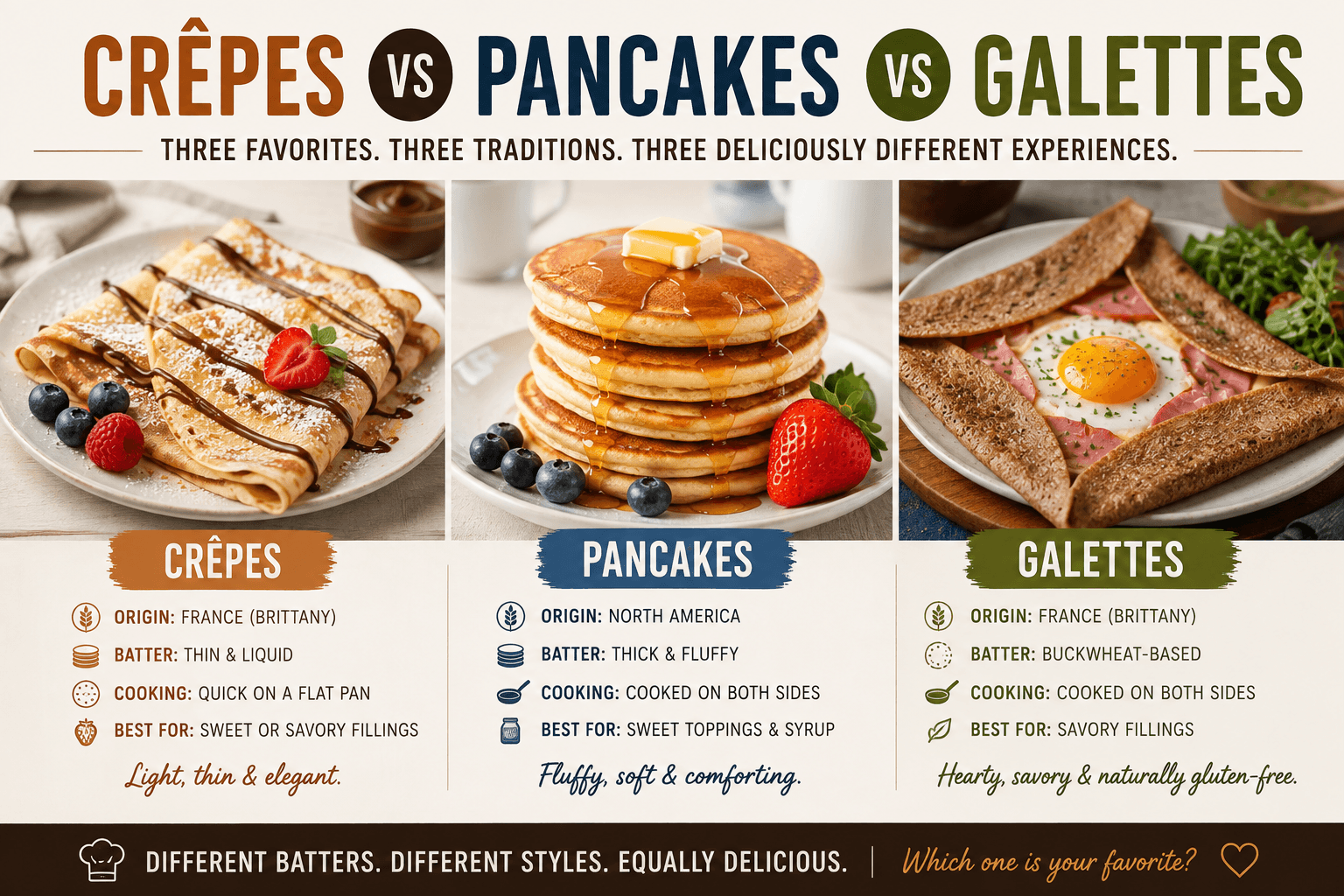
| Crêpe | Pancake | Galette | |
|---|---|---|---|
| Flour | Wheat, fine (Type 45) | Wheat, plain or self-raising | Buckwheat — not wheat |
| Liquid | Milk | Milk or buttermilk | Water |
| Eggs | Yes | Yes | Sometimes, often none |
| Leavening | None | Baking powder or bicarb | None |
| Rest the batter? | Yes — 2 hrs to overnight | No — use it now | Yes — 2 hrs to overnight |
| Thickness | Paper-thin | 1–2 cm, risen | Thin, lacy at the edge |
| Sweet or savoury | Usually sweet | Usually sweet | Savoury by default |
| Gluten | Yes | Yes | Naturally gluten-free |
Leavening is the line that divides them
A pancake rises because something in it produces gas. Baking powder, or bicarbonate of soda meeting an acid like buttermilk, releases carbon dioxide into the batter. Those bubbles get trapped by the gluten network, the heat sets the structure around them, and you get a thick, aerated disc.
A crêpe has none of that. No baking powder, no bicarb, nothing generating gas. It's flour, milk, eggs and a little butter, and it stays thin because there is nothing in it whose job is to make it not thin.
A galette has no leavening either. Buckwheat flour, water, salt, sometimes an egg.
So the family tree runs the other way round from how most people draw it. Crêpes and galettes are siblings — both unleavened, both thin, both poured and spread. The pancake is the outlier, and the thing that makes it an outlier is a tin of baking powder that didn't exist for most of culinary history.
Try this at home if you don't believe it: make your usual pancake batter and leave out the baking powder. You will not get thin pancakes. You'll get something very close to a thick, slightly rubbery crêpe — because that's what a pancake is underneath.
Why crêpe batter rests and pancake batter must not
This is the practical payoff of the whole article, and it's the thing I got wrong for years.
Crêpe batter should rest. Two hours at room temperature, or overnight in the fridge. Two things happen while it sits. The gluten you developed by whisking relaxes, so the batter stops fighting back and the crêpe cooks tender instead of chewy. And the starch granules finish absorbing liquid, which thickens the batter slightly and makes it spread more evenly.
An unrested crêpe batter gives you crêpes that are faintly rubbery and tear when you lift them. It's not a myth and it's not French fussiness — you can taste it side by side.
Pancake batter must not rest. The chemical leavening starts reacting the instant the wet ingredients meet the dry. Those bubbles are on a clock. Leave the bowl on the counter for forty minutes while you make coffee and read the news, and a meaningful share of your lift has already escaped into the kitchen. The batter goes in the pan flat.
Two bowls of pale batter that look nearly identical, and the instructions are opposites. I spent a long time making mediocre versions of both because I was applying one rule to both bowls.
The corollary, since it follows directly: mix pancake batter badly. Lumps are fine. Overmixing develops gluten and knocks gas out, and you want neither. Whisk crêpe batter smooth, then let it sit. Stir pancake batter until it's just combined, then cook it immediately.
The galette is a different grain entirely
Here's where the common explanation — "a galette is just a savoury crêpe" — falls apart.
A true Breton galette is made with buckwheat. In French, sarrasin or blé noir. And buckwheat is not wheat. It isn't a cereal grain at all. It's a pseudocereal, botanically closer to rhubarb and sorrel than to anything in a wheat field, and it is naturally gluten-free.
That single substitution changes everything downstream:
- Colour. Grey-brown rather than pale gold, from the hull fragments in the flour.
- Flavour. Nutty, earthy, faintly bitter — which is why galettes go with ham, cheese and egg rather than sugar and lemon.
- Behaviour. No gluten means no elastic network to develop, so galette batter handles differently and the edges come out lacy and crisp instead of soft.
- Diet. A galette made the traditional way is safe for people avoiding gluten. A crêpe is not.
The naming does get slippery, and it's worth being straight about it. In Brittany these are also called crêpes de blé noir or crêpes de sarrasin — so "crêpe" and "galette" genuinely do overlap in local usage. What's consistent is the split by flour: buckwheat for the savoury version, fine wheat flour for the sweet crêpes de froment.
And one disambiguation, because it trips people constantly: galette des rois, the Epiphany cake, is a completely unrelated thing made of puff pastry and frangipane. Same word, different food. Galette just means "flat cake."
How buckwheat ended up in Brittany
Buckwheat isn't European. It came from Asia during the Middle Ages, and it took hold in exactly the places where nothing better would grow — poor, thin, acidic soil. Brittany above all, and also Limousin and Auvergne.
It arrived around the 14th century and reached its peak by the 19th, first as bread and porridge. The move into thin batter cooked on a griddle came later, roughly the 16th century, and Quimper claims to be where it happened.
So the galette exists because buckwheat grew where wheat wouldn't. It's a poverty food that became a regional identity — which is a pattern you'll find behind an enormous share of the world's most-loved dishes, and one of the reasons food history is more interesting than food writing usually admits.
Brittany even split along its own linguistic line. Savoury buckwheat galettes dominate in Upper Brittany; sweeter wheat crêpes are more the thing in Lower Brittany, tracking the Gallo and Breton language divide. And Normandy claims galettes too, with Normandy cider to go with them. I'm not settling that one.
The galette complète, the billig and the bowl of cider
If you order one thing in a Breton crêperie, it's the galette complète: ham, grated cheese — Gruyère or Emmental — and an egg cracked straight onto the batter, yolk left runny, the four corners folded in to frame it.
Two details worth knowing about how it's actually cooked, because they explain why yours doesn't look like theirs.
It's made on a billig: a rimless cast-iron griddle around 40 cm across. Not a pan. The batter is spread with a rozell, a small wooden T-shaped rake, in one turn of the wrist. And galettes are frequently cooked on one side only, the browned face becoming the outside.
You can't replicate 40 cm of flat cast iron in a domestic kitchen, which is why most home recipes quietly sneak in some plain flour to make the batter easier to handle. That's an adaptation, not a tradition — worth knowing which one you're doing.
It's drunk with cider, from a bolée — a shallow clay bowl rather than a glass. And there's a street-food form too: the galette-saucisse of Upper Brittany, a grilled pork sausage rolled in a cold buckwheat galette, eaten in hand at markets and football matches around Rennes. The galette is served cold on purpose there, so it insulates your hand from the sausage.
The crêpe isn't French. It's a ratio.
France gets the credit, and fairly — the technique was refined there and the vocabulary is French. But the crêpe isn't really a French invention. It's a formula: thin unleavened batter, high liquid-to-flour ratio, thin pan, fast heat. And that formula shows up independently all over the world, because it's the obvious solution to a universal problem.
The clearest example on this site is Indonesian dadar gulung.
It's a thin pandan-green crêpe, rolled around sweetened grated coconut. The batter is flour, egg, water and coconut milk — a crêpe batter with coconut milk standing in for dairy. Same ratio, same technique, different liquid and a different flavouring.
And this isn't my interpretation. Maria Angeline R's live class on P2Bridge tells students to prepare a frying pan of 15 to 18 cm for the crepes (dadar gulung). Her own teaching materials call it a crêpe and specify the pan diameter. When a Le Cordon Bleu-trained food technologist in Jakarta and a crêperie in Quimper are describing the same object, that's not coincidence — it's convergent evolution in a frying pan.

Once you see the crêpe as a ratio rather than a nationality, the map opens up. Learn the technique in one cuisine and you can read it in a dozen others.
Learn the crêpe technique from a food technologist
Maria Angeline R is a Le Cordon Bleu-trained pastry chef with a background in food technology — which, for a topic that comes down to batter chemistry, is about as relevant as credentials get. Her 90-minute class covers rose-shaped dadar gulung and klepon, beginner level, and it's the best-value class in the P2Bridge culinary catalogue.
How to actually make each one
Crêpes
Fine wheat flour, milk, eggs, melted butter, a pinch of salt, sugar if sweet. Whisk to completely smooth — lumps here are a real problem, unlike in pancakes. Rest it, minimum two hours. The batter should be thin enough to coat a spoon and run straight off it; if it clings, add milk. Hot pan, small amount of fat, pour and swirl immediately.
Your first crêpe will be bad. Everyone's first crêpe is bad — it's the pan telling you it isn't at temperature yet. In French kitchens it's traditionally the cook's, eaten standing up.
Pancakes
Plain flour, baking powder, sugar, salt, egg, milk or buttermilk, melted butter. Combine wet and dry and stir just until they meet — lumps are correct. Do not rest. Straight into a medium pan. Flip when bubbles appear on the surface and the edges look set, not before. Medium heat, not high; the inside needs time the outside doesn't have if the pan is too hot.
Galettes
Buckwheat flour, water, salt, optionally one egg. Whisk smooth, rest at least two hours or overnight. The batter should be noticeably more liquid than a crêpe batter. Hot pan, spread thin, and consider cooking one side only. Fill it savoury — ham, cheese, egg — and fold the corners in.
You can buy a domestic billig. I haven't, and a wide flat-bottomed pan gets you most of the way. The honest limit is diameter: a 40 cm galette folds into something a 24 cm pan simply can't produce.
Learn it live with a chef
Batter is one of those things where five minutes of someone watching you beats an hour of reading. Consistency is the whole game, and consistency is almost impossible to describe in writing — "coats the back of a spoon" means something once you've seen it and nothing before that.

★★★★★ 5.07 reviews · 6 experiences
Verified Host · Indonesia · Pastry Chef, Food Stylist, Food Technologist · Le Cordon Bleu trained · 10 years
The technical authority for anything batter-related on this platform. Her dadar gulung is a crêpe by another name — her class notes even specify the 15–18 cm pan — and a food technology background means she can tell you why a batter behaves the way it does, not just what to do next.

★★★★★ 5.03 reviews · 12 experiences
Cuisine Specialist · United States · Chef Instructor, food & travel writer · 18+ years, five published books
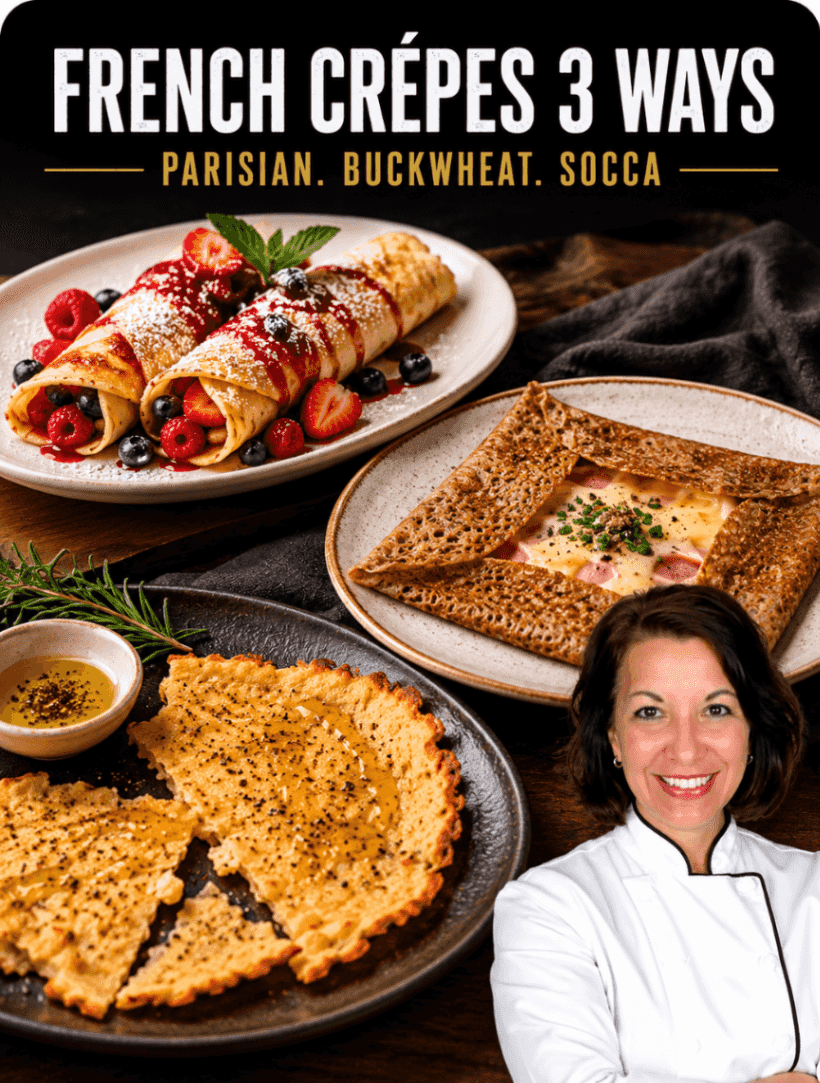
Leads culinary programs for Columbus State in Ohio. French Crêpes Three Ways is the wheat-crêpe side of this article — 90 minutes, beginner level, taught live so someone can tell you whether your batter is actually thin enough.
One gap worth naming: there is no buckwheat galette class on P2Bridge yet. If savoury Breton galettes are what brought you here, that one you'll have to make from the notes above — or request it as a custom experience, which the platform does accommodate.
More on the site: the full culinary catalogue, dessert classes, baking classes, upcoming group sessions, class packages, and every verified host.
Frequently asked questions
What is the difference between a crêpe and a pancake?
Leavening. A pancake contains baking powder or bicarbonate of soda, which releases carbon dioxide and makes it rise. A crêpe contains no leavening at all, so it stays thin. Thickness is the result of that difference, not the definition of it.
Is a galette just a savoury crêpe?
No. A true Breton galette is made with buckwheat flour rather than wheat, which changes its colour, flavour, texture and dietary profile. It is usually made with water instead of milk. Savoury filling is a consequence of the buckwheat's nutty, earthy flavour, not the defining feature.
Should I rest crêpe batter?
Yes. Rest it at least two hours at room temperature, or overnight in the fridge. Resting lets the gluten relax and the starch fully hydrate, which produces a tender crêpe rather than a rubbery one that tears when lifted. The difference is noticeable side by side.
Should I rest pancake batter?
No. Chemical leavening begins releasing gas the moment wet ingredients meet dry ones. Letting the batter stand allows that lift to escape before cooking, giving flatter pancakes. Mix pancake batter until only just combined, leave the lumps, and cook it straight away.
Are galettes gluten-free?
A traditional galette made with 100% buckwheat flour is naturally gluten-free, because buckwheat is a pseudocereal unrelated to wheat. Many home recipes add plain wheat flour to make the batter easier to handle, so check before assuming. Restaurant galettes vary and cross-contamination is possible.
Is buckwheat a type of wheat?
No, despite the name. Buckwheat is a pseudocereal, botanically closer to rhubarb and sorrel than to any true grain, and it is not a grass. It contains no gluten. In French it is called sarrasin or blé noir, meaning black wheat, which adds to the confusion.
What is a galette complète?
The classic Breton galette filling: ham, grated cheese such as Gruyère or Emmental, and an egg cracked onto the batter with the yolk left runny. The four sides are folded in to frame the egg. It is traditionally eaten with cider served in a shallow clay bowl called a bolée.
Is dadar gulung a crêpe?
Functionally, yes. Dadar gulung is an Indonesian rolled crêpe made from a thin unleavened batter of flour, egg and coconut milk, coloured green with pandan and filled with sweetened grated coconut. It follows the same ratio and technique as a French crêpe with coconut milk replacing dairy.
Related reading: Korean banchan and the twelve-dish table, turning fond into a pan sauce, and what actually changes in vegan and vegetarian cooking.
How we sourced this
History and terminology come from French and Breton culinary sources listed below, covering buckwheat's arrival in Europe, the sarrasin and froment distinction, and the galette-saucisse tradition of Upper Brittany. French terms are given on first use.
Class details, prices and ratings were verified directly against the live P2Bridge listings on 24 August 2026. Maria Angeline R's pan-size instruction and ingredient list were read from her class page that day. Ratings appear with their review counts so you can weigh them — see the P2Bridge reviews page for the underlying feedback. Prices change; check the class page before booking.
What this article does not claim. We have not described the contents of the French Crêpes Three Ways class, because that page was not readable at the time of writing — only its verified name, price, level and rating are stated. No P2Bridge class currently teaches buckwheat galettes, and we have not implied otherwise.