







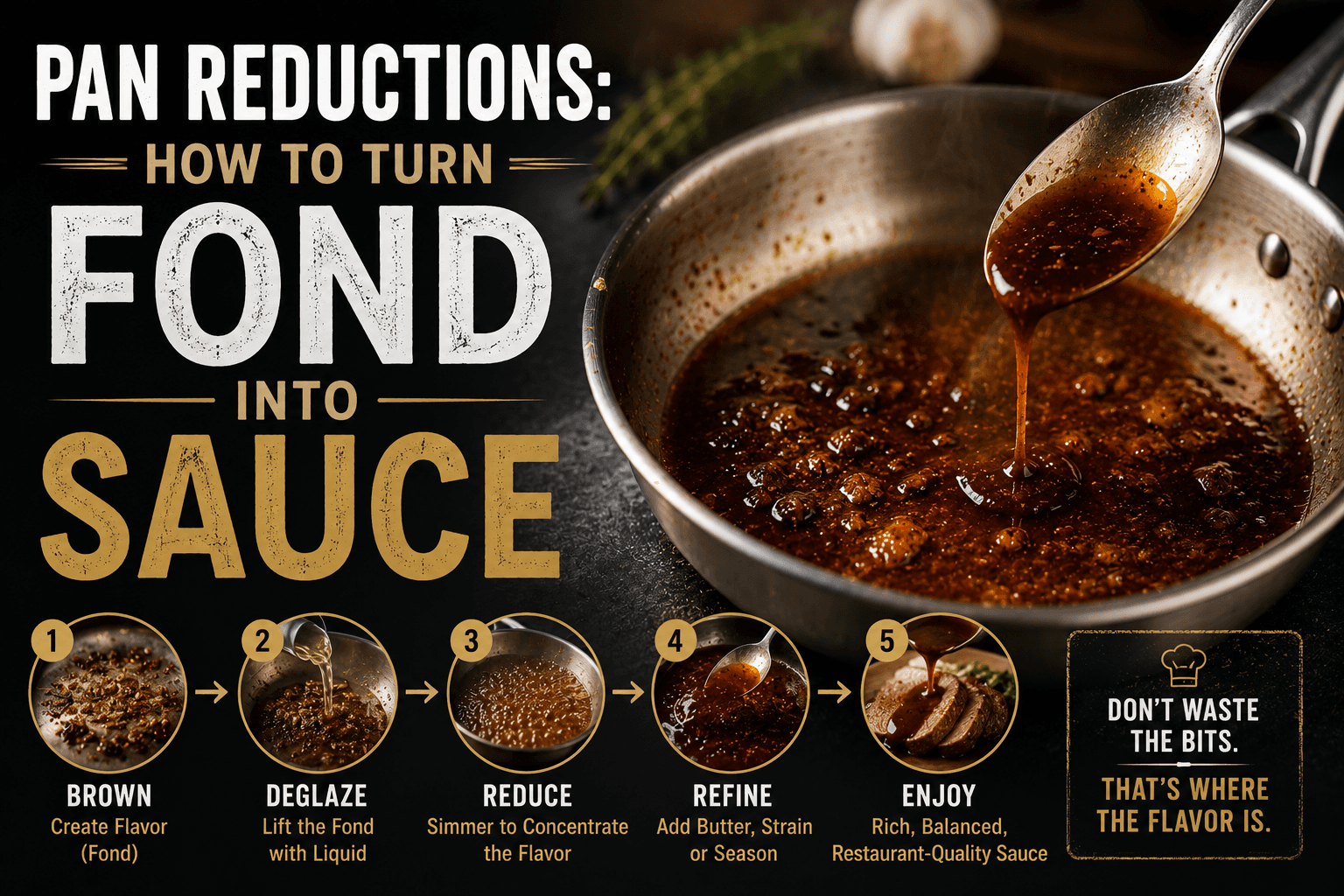
Pan Reductions: How to Turn Fond Into Sauce
Fond is the browned layer welded to your pan after searing — amino acids and sugars that reacted under high heat. It is water-soluble. Add liquid, scrape, reduce by half, then swirl in cold butter off the heat, and you have a sauce in four minutes from something most cooks put in the sink.

What fond actually is, and why it's stuck
Pull a seared piece of meat out of a hot pan and look at what's left. A patchy brown-to-mahogany crust, bonded to the metal, that looks like something you'll need steel wool for.
That's fond. French, and it means base or foundation, which tells you how the people who named it were thinking about it.
Chemically it's the residue of the Maillard reaction — amino acids from the protein reacting with reducing sugars under heat, producing hundreds of new aromatic compounds that didn't exist in the raw ingredient. Dr Emma Davies, a food chemist writing for BBC Science Focus, puts the useful working range between about 110°C and 170°C, and notes that pushing past it develops bitterness rather than more flavour. Most of that reaction happens on the surface of your meat. But the most concentrated portion — the part where juices ran out, pooled, and cooked down to almost nothing — ends up bonded to the pan.
So the flavour isn't evenly split between meat and pan. The pan gets the intense fraction. Escoffier describes the saucier's routine plainly: deglaze the searing pan, scrape up the browned bits, reduce, and you have the base of the sauce that goes out with the dish.
And here's the part that makes the whole technique work. Those compounds are water-soluble. They're not burnt onto the metal in any permanent sense — they're a concentrated, dried-out glaze waiting for liquid. Which is why deglazing feels almost like a trick the first time you do it. You add half a cup of wine to a pan you were dreading scrubbing, and thirty seconds later the pan is clean and the wine is brown.
The one-line version: the best-tasting thing in the pan is the part most people run under the tap.
Stage 1 — Build the fond
You cannot deglaze a pan that has nothing in it, and the number of ways to end up with an empty pan is larger than people expect.
Water is the whole story. It boils at 100°C and refuses to go higher, and the Maillard reaction needs roughly 140°C to run at any useful speed. So as long as there's moisture sitting on the surface of your protein, that surface is capped at boiling point and physically cannot brown. It steams. It goes grey. It weeps liquid into the pan, which then has to evaporate before anything else can begin — by which time the inside is overcooked.
Four things fix this, and they all reduce to the same principle:
- Dry the meat. Paper towels, both sides, right before it goes in. Salting it and leaving it uncovered in the fridge for an hour is better.
- Preheat properly. Longer than you think — a cast iron pan wants five to seven minutes over medium-high. A drop of water should vanish on contact, not skitter and sit.
- Don't crowd the pan. Four pieces in a pan sized for two means the moisture they release can't escape fast enough, and you've built a steamer. Cook in batches.
- Use steel or cast iron. Nonstick works exactly as advertised: nothing sticks, so no fond forms. It's the wrong tool for this entire technique.
What you want at the end of this stage is a pan that looks slightly alarming. Deep brown, patchy, bonded on. If the pan looks clean when the meat comes out, there's no sauce coming.
| Stage | What you're doing | The mechanism | How it goes wrong |
|---|---|---|---|
| 1. Build | Sear dry protein in a hot steel or cast iron pan | Maillard reaction, 140–165°C | Wet meat or a crowded pan caps the surface at 100°C — it steams instead of browning |
| 2. Deglaze | Add liquid, scrape with wood or silicone | Fond is water-soluble; liquid also drops the pan below reaction temperature | Waiting too long and the fond scorches; going in with metal gouges the pan |
| 3. Reduce | Simmer in a wide pan until roughly halved | Evaporation concentrates what's left | Reducing salted stock — salt doesn't evaporate, so you concentrate it into brine |
| 4. Mount | Swirl in cold butter off the heat, one piece at a time | Emulsion — gloss and body with no flour | Butter into a boiling pan splits into oil and solids |
Stage 2 — Deglaze, and stop the reaction
Two things happen the moment liquid hits the pan, and only one of them is obvious.
The obvious one: the fond dissolves. Water-soluble compounds go into solution, the pan releases them, and a bit of scraping finishes the job.
The one nobody mentions: the pan temperature crashes. It drops from searing heat to boiling point almost instantly, and that halts the Maillard reaction. Khymos makes this point directly — adding water lowers the temperature and stops the browning, which is precisely what you want at that moment. Left alone, fond doesn't plateau at delicious. It keeps going, past browning, into scorching, and the peer-reviewed literature on controlling Maillard reactions in food is clear that overrunning the reaction produces bitter and burnt notes rather than richer ones.
So deglazing isn't only extraction. It's a brake.
On liquid: wine and stock are the defaults, but acidity helps, and spirits work beautifully with sweet-savoury profiles — rum with pork and apple is a genuinely great pairing, not a novelty. Plain water is fine. Not ideal, but fine, and infinitely better than washing the pan.
Scrape with wood or silicone. A metal spatula on steel gets you fond plus a small amount of your pan.
Timing is the part people get wrong. Deglaze immediately after the protein comes out, while the pan is still hot. Every extra thirty seconds of dry heat is thirty seconds of fond moving from brown to black.
Stage 3 — Reduce (and the salt mistake)
Reduction is subtraction. You aren't adding anything — you're removing water so that what remains is more concentrated. Sugars concentrate. Acids concentrate. Gelatin concentrates and starts giving the sauce body.
Use a wide pan, not a deep one. Evaporation happens at the surface, so surface area sets the pace. A wide skillet reduces in three minutes what a saucepan takes ten to do.
Reduce by roughly half for a wine-based sauce. You'll see it: the bubbles get bigger and lazier as viscosity climbs, and the sauce starts coating the back of a spoon instead of running off it.
Now the mistake, and it's the one that ruined more of my sauces than any other. Salt does not evaporate.
Reduce a salted stock by half and you haven't made it half as salty — you've made it twice as salty. Same salt, half the water. I once reduced a properly seasoned chicken stock down to a beautiful glossy quarter-cup and served something closer to a bouillon cube than a sauce. It looked perfect. It was inedible.
Use unsalted or low-sodium stock. Season at the very end, after the reduction is where you want it. Always in that order.
Stage 4 — Mount with cold butter
French kitchens call this monter au beurre, and it's the step that turns a thin brown liquid into something that looks like it came from a restaurant.
Take the pan off the heat. Add cold butter, cubed, one or two pieces at a time, swirling the pan rather than stirring. Each piece should disappear before the next goes in.
The mechanism is emulsion. Butter is roughly 80% fat, 16% water, and the milk solids act as an emulsifier, suspending fat droplets through the sauce. That suspension is what produces gloss and a coating texture — not thickness in the flour sense, but a weight on the tongue that flour can't imitate.
Emulsions are temperature-sensitive, which is the whole reason for taking the pan off the heat. Add butter to a boiling sauce and it breaks: the fat separates out and floats, and you get an oil slick over a watery base. Once broken it's hard to bring back. Cold butter, off the heat, patience.

Finish with acid. A squeeze of lemon, a splash of vinegar, a little of the wine you deglazed with held back for the end. Reduction concentrates sweetness and richness, and acid is what stops the whole thing sitting heavily. Skip it and the sauce tastes muddy without anyone being able to say why.
You can thicken a pan sauce with a cornflour slurry instead. It'll work. It'll also taste like it — slightly dull, slightly gluey, with none of the shine. Butter is doing something starch can't.
When the fond is burnt, start again
Dark brown fond is flavour. Black fond is bitter, and no amount of reducing, seasoning, sweetening or cream will fix it.
Bitterness from pyrolysis — the stage past caramelisation where compounds break down and turn acrid — doesn't dilute out. Reduction makes it worse, because reduction concentrates everything, including the thing you're trying to escape.
So: wash the pan. Sear something else, or serve the meat without a sauce. Most articles won't say this because it reads as a failure. It isn't. Recognising ruined fond in three seconds and cutting your losses is a skill, and it's cheaper than a bitter sauce over a good piece of meat.
The tell is smell. Good fond smells roasted, nutty, faintly sweet. Burnt fond smells like an ashtray, and you'll know before you look.
Roux vs reduction: two different tools
These get lumped together as "thickening a sauce," which obscures how differently they work.
A roux thickens with starch. Flour cooked in fat, then liquid whisked in; the starch granules swell and hold the liquid. You can make a roux with no browning at all — a white roux for a béchamel never goes past pale. It doesn't need fond. It doesn't need a seared protein. It's independent.
A reduction thickens by removing water, and it depends entirely on what you started with. No fond, no sauce.
The classic New Orleans kitchen is where this gets interesting, because a dark Cajun roux is cooked so long it browns deeply — and that browning is Maillard chemistry again, just happening in flour and fat rather than on meat. Same reaction, different substrate, completely different technique.

Learn the roux side of the family
Shawnie Kelley's Taste of New Orleans is a 90-minute live class built on the technique a reduction can't do — slow-cooked roux, browned in the pan until it's the colour of an old penny. She's been teaching for fifteen years and leads culinary programs for Columbus State in Ohio.
A worked example, start to finish
Here's the whole thing on a pork tenderloin, which is a good cut to learn on: it's lean enough that it genuinely needs a sauce, and it sears fast.
- Dry the tenderloin thoroughly, salt it, leave it 15 minutes.
- Heat a heavy steel or cast iron skillet until a drop of water vanishes on contact. Oil in.
- Sear on all sides, two to three minutes a face, until deeply coloured. Pull it at 138°F and rest it — carryover heat takes it to 145°F. The pan should now look burnt-on and slightly frightening. Good.
- Drop the heat. Soften a diced onion and two diced apples in the fat that's left, three or four minutes, scraping as you go.
- Deglaze with a quarter cup of rum or white wine. Scrape hard with wood. Everything comes up.
- Add aromatics — a couple of cinnamon sticks, two tablespoons of brown sugar.
- Reduce by half. Three to four minutes in a wide pan. It should coat a spoon.
- Off the heat, mount with cold butter, a cube at a time, swirling.
- Season now, and only now. Taste. Add acid if it's sitting heavy.
- Spoon over the rested, sliced pork.
That is not a recipe I invented for this article. It's the sequence in Mackaeda Mc Kenzie's live class on P2Bridge, and it's a good illustration of why the technique generalises — the apples and rum are a Caribbean choice, but swap in shallots and red wine and the four stages don't move an inch.
Cook this exact sauce with the chef watching
Mackaeda Mc Kenzie teaches the pork tenderloin and spiced rum apple reduction live in 60 minutes — sear, deglaze, reduce, mount, in real time on your own stove. Beginner level. She can see whether your pan is hot enough, which is the one thing a recipe will never tell you.
Learn it live with a chef
The gap between reading this and doing it is judgement. Is the pan hot enough. Is that fond brown or is it going black. Has the reduction gone one minute too far. Those are all real-time calls, and a recipe can't make them for you. Someone watching your pan can.

Three P2Bridge hosts who teach this technique live

★★★★★ 4.914 reviews
Verified Host · Trinidad and Tobago · 6 years experience · Caribbean and African home cooking
The clearest worked example of a pan reduction on the platform. Sear, deglaze with rum, reduce with apple and cinnamon, mount with cold butter — the full four-stage sequence inside an hour, with her watching your pan.

★★★★★ 5.03 reviews · 12 experiences
Cuisine Specialist · United States · Chef Instructor, food & travel writer · 18+ years
Leads culinary programs for Columbus State in Ohio and has taught for fifteen years. Ninety minutes on sauce-building specifically — the closest thing on P2Bridge to a dedicated course in this technique.
★★★★★ 5.03 reviews · with Shawnie Kelley
Cuisine Specialist · United States · 90 minutes · beginner
The roux side of the family — the technique a reduction cannot do. Flour and fat browned slowly until it is the colour of an old penny, which is the same Maillard chemistry running in a different substrate.
More on the site: live online pork cooking classes, the full culinary catalogue, upcoming group sessions, class packages, and every verified host.
Frequently asked questions
What exactly is fond?
Fond is the browned residue bonded to the pan after searing. It forms through the Maillard reaction between amino acids and reducing sugars under high heat, and it is the most concentrated flavour in the dish. The word is French for base or foundation. Critically, it is water-soluble, which is what makes deglazing work.
What liquid should I deglaze with?
Wine and stock are the defaults, and acidity helps dissolve the fond. Spirits work well with sweet-savoury profiles, such as rum with pork and apple. Beer, cider, vinegar and citrus juice all work. Plain water works too. Use unsalted stock, because salt concentrates during reduction.
Why did my pan sauce turn out too salty?
Because salt does not evaporate. Reducing a salted liquid by half removes water but leaves all the salt behind, doubling the concentration. Always deglaze and reduce with unsalted or low-sodium liquid, then season at the very end once the reduction has reached the consistency you want.
Why did my butter split when I added it to the sauce?
The pan was too hot. Mounting with butter creates an emulsion, and emulsions break at high temperature — the fat separates and floats as an oil slick. Take the pan off the heat first, then add cold cubed butter one or two pieces at a time, swirling the pan rather than stirring.
Can I make a pan sauce in a nonstick pan?
Not really. Nonstick coatings are designed to prevent food bonding to the surface, so little or no fond forms — and without fond there is nothing to deglaze. Use stainless steel or cast iron for any dish where you intend to build a sauce from the pan.
My fond went black. Can I save it?
No. Black fond has passed browning into pyrolysis, which produces genuinely bitter compounds. Reduction concentrates that bitterness rather than diluting it, and no amount of sweetening, cream or seasoning masks it. Wash the pan and serve the protein without a sauce, or sear something else and start over.
What is the difference between a roux and a reduction?
A roux thickens with starch — flour cooked in fat, then liquid whisked in — and needs no browning or fond at all. A reduction thickens by evaporating water, concentrating what is already there, and depends entirely on the fond you started with. They are different tools, not alternatives.
How long does a pan reduction take?
About four minutes once the protein is out of the pan. Deglazing takes under a minute, reducing by half takes three to four minutes in a wide skillet, and mounting with butter takes thirty seconds. Using a wide pan rather than a deep one roughly halves the reduction time.
Related reading: why your pork tenderloin comes out dry, why pork is safe at 145°F, and pork tenderloin and pork loin are not the same cut.
Sources
- Escoffier — The Science of Cooking: What Every Chef Should Understand about Chemistry
- Journal of Agricultural and Food Chemistry (ACS) — Control of Maillard Reactions in Foods
- BBC Science Focus — What is the Maillard reaction? (Dr Emma Davies)
- Khymos — Maximizing Food Flavor by Speeding Up the Maillard Reaction