


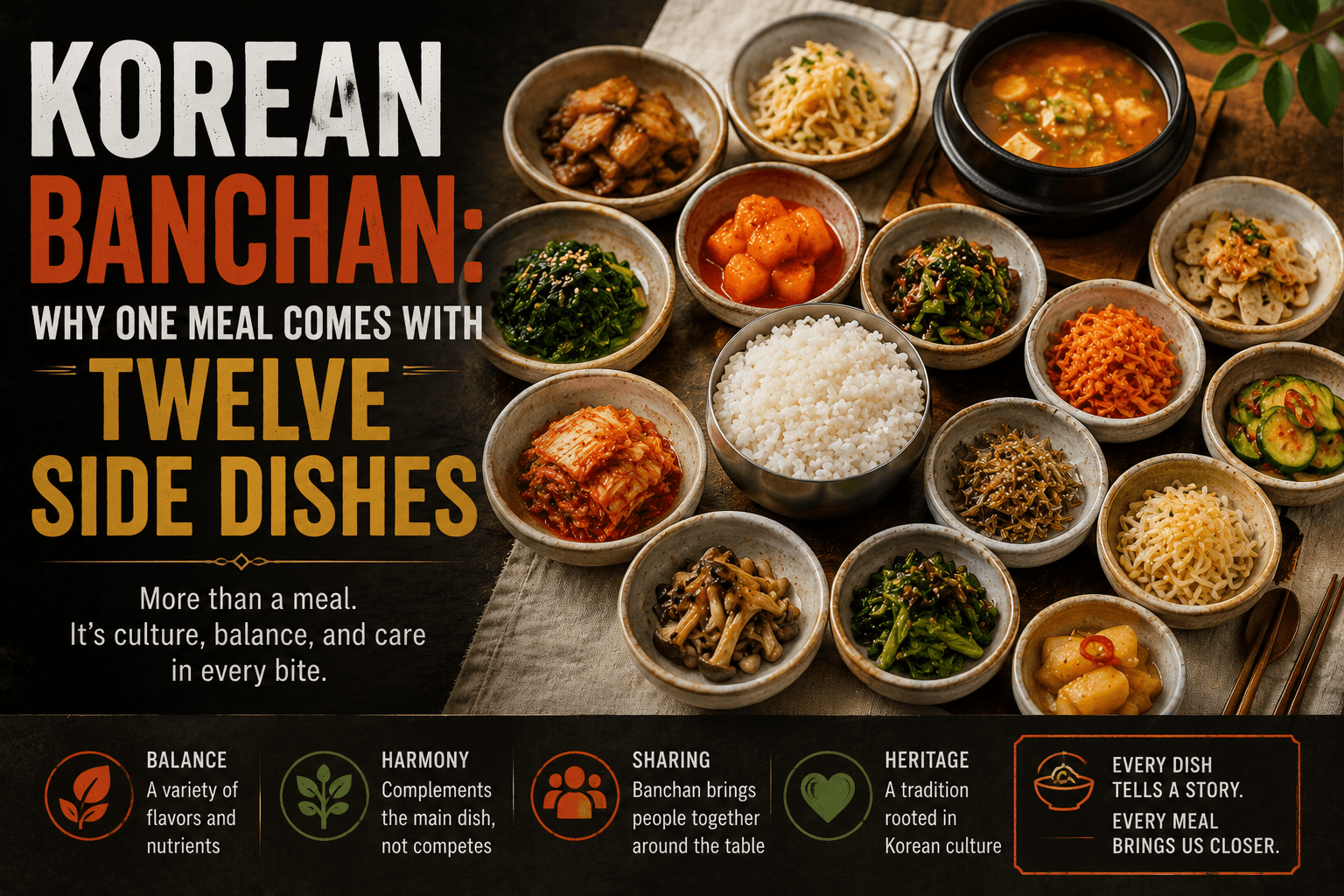
Korean Banchan: Why One Meal Comes With Twelve Side Dishes
Banchan (반찬) are the small shared dishes that arrive with a Korean meal. The number was never decorative — under the Joseon cheop system it marked rank. Commoners ate at three to five. Nobility were capped at nine. Twelve belonged to the king, and it was the only even number in the whole scheme.

Twelve isn't abundance. It's a rank.
The formal Korean table setting has a name: bansang (반상). And the number of banchan sitting on it has a name too — the cheop (첩) count.
During the Joseon Dynasty, which ran from 1392 to 1897, that count was codified. Not as etiquette advice. As a hierarchy.
| Setting | Banchan | Who ate this way |
|---|---|---|
| 3-cheop — 삼첩 | 3 | Ordinary households, everyday meals |
| 5-cheop — 오첩 | 5 | Ordinary households on better days |
| 7-cheop — 칠첩 | 7 | Yangban — the scholar-official class |
| 9-cheop — 구첩 | 9 | Nobility. The ceiling for anyone not royal |
| 12-cheop — 십이첩 | 12 | The king. The surasang (수라상), served twice daily |
So when you read that a Korean royal meal came with twelve side dishes, that isn't a chef showing off. It's the top rung of a ladder everybody else was standing lower on.
There's a detail here that gets missed. Twelve is the only even number in the system. Three, five, seven, nine — odd all the way up, because odd counts were considered auspicious. The royal table broke the pattern, which is its own quiet statement about who the rules applied to.
What actually counts as banchan
Here's the rule almost every English-language explainer skips, and it changes the whole picture.
Rice, soup, stew, the fermented pastes and kimchi are not counted.
Bap (밥, rice). Guk or tang (soup). Jjigae (stew). Ganjang and gochujang. And kimchi — kimchi above all. None of it enters the cheop number, because none of it was ever optional. Those things were assumed to be on the table whether you were a farmer or a king.
Which means a 12-cheop royal setting wasn't twelve dishes. It was twelve dishes plus rice, plus soup, plus stew, plus the pastes, plus kimchi. Seventeen-ish vessels, and the count only tracked the part that varied by rank.
Kimchi sitting outside the system is the most telling part. It wasn't excluded because it didn't matter. It was excluded because it was too fundamental to be a variable.
Quick translation: the cheop number counts the dishes that signalled your status. Everything a Korean meal needs to be a Korean meal was never in the count at all.
Why Korea built a vegetable cuisine
Banchan is usually traced back to the mid-Three Kingdoms period, and the cause was religious rather than culinary.
Buddhist influence led the monarchies of the period to proscribe eating meat. That removed the centrepiece from the table — and vegetables moved into the space it left. Court kitchens spent generations developing ways to cook, season and present them, because they had to. Less affluent households did smaller versions of the same thing.
Then the Mongol invasions ended the prohibition. Meat came back.
But roughly six centuries of vegetable-centred cooking had already set the shape of the cuisine, and it didn't unwind. The technique culture outlived the rule that created it. That's the actual causal chain, and it's more interesting than "Koreans like vegetables" — a religious ban produced a body of technique so developed that it survived its own repeal by several hundred years.
You can see the residue in any banchan spread today. The meat dish is at the centre. Almost everything around it is a vegetable that somebody figured out how to make delicious under constraint.
Winter is the other reason
Korea gets cold winters and humid summers, and before refrigeration that combination is a storage problem.
Fermentation and pickling solved it. Lacto-fermentation let a household take autumn's harvest and carry it through to spring — nutrients intact, flavour improved rather than merely preserved. Kimchi is the famous case, but the same logic runs through soy-braised roots, salted greens and the jang pastes that season nearly everything else.
So banchan is partly a storage system that turned into a cuisine. The variety on the table isn't there because someone wanted twelve flavours. It's there because twelve different things were put up at twelve different points in the year, and they all keep.
That's also why banchan is typically served cool or at room temperature rather than hot. These are dishes made in advance, in quantity, and brought out as needed.
The six ways a vegetable becomes banchan
Banchan isn't a list of dishes so much as a set of methods applied to whatever's in season. Learn the six and you can read any spread on sight.
| Method | What happens | Typical examples |
|---|---|---|
| Namul — 나물 | Blanched briefly, squeezed dry, dressed while still warm with sesame oil, garlic, salt | Spinach, soybean sprouts, fernbrake |
| Muchim — 무침 | Dressed raw or lightly blanched, no cooking in the dressing | Cucumber, seasoned radish, dried squid |
| Bokkeum — 볶음 | Stir-fried quickly in a seasoned sauce | Anchovies, lotus root, small dried fish |
| Jorim — 조림 | Simmered slowly in seasoned liquid until it reduces and glazes | Soy-braised potato, tofu, black beans |
| Jjim — 찜 | Steamed, sometimes finished in its own liquid | Egg, short rib, stuffed vegetables |
| Jeon — 전 | Coated in batter or egg and pan-fried flat | Courgette, potato, fish, scallion |
The distinction people most often miss is namul versus muchim. Both end up as a seasoned vegetable in a small bowl. The difference is that namul is blanched first and dressed warm — which matters, because warm leaves absorb sesame oil and garlic in a way cold ones don't. Dress blanched spinach after it's chilled and you get a coating. Dress it warm and you get a seasoning that's gone all the way through.
And squeeze the spinach harder than feels reasonable. Water in the leaf is water diluting the dressing.
The king's table was a report on his provinces
This is the fact that reframes everything else.
During Joseon, regional specialities from Korea's eight provinces were sent to the palace on a monthly cycle. Each region's contribution went onto the royal table. So the surasang wasn't only a meal — it was a rolling status report on the agricultural health of the kingdom, delivered in edible form twice a day.
A province having a bad year showed up as a thinner or absent contribution. The king could read the state of his territory off his own lunch.
Once you know that, the twelve stops looking like indulgence. It looks like a dashboard. The variety was the point — twelve dishes meant twelve data streams, and a table that pulled from everywhere meant a kingdom that was, at least that month, holding together.
The scholarship on Joseon court cuisine and its aesthetics is worth reading directly if this interests you — Chung and colleagues, writing in the Journal of Ethnic Foods, cover the recovery and reconstruction of royal-court cooking in detail, and Kim and colleagues in the same journal set out the historical background of the Korean diet more broadly. Royal dishes were largely served in bangjja, hand-forged bronzeware, which is its own rabbit hole.
Why the refills are free
Walk into a Korean restaurant, order one thing, and four to eight small plates arrive before your food does. Nobody charges you. Ask for more kimchi and more kimchi comes, also free.
Western diners tend to read this as unusual generosity. It isn't, quite. It's structural.
Banchan is classified as part of the meal, not as an addition to it. Rice without banchan isn't a cheaper meal — it's an incomplete one. Charging for it would be like charging separately for the plate.
There's a cultural layer underneath that too: jeong (정), which covers warmth, attachment and the obligation that builds up between people who share things. Refilling banchan without being asked is a small, routine expression of it. The gesture is doing something the price of the meal isn't.
One practical note, since it comes up: you're expected to finish what you take, and taking more than you'll eat is the actual bad manners here — not asking for a refill.
Mandu, kimchi and the salt principle
Korean mandu, Chinese pot stickers and Japanese gyoza are close relatives, and the technique that makes all three work is the same one that makes kimchi work.
Salt the cabbage. Wait. Squeeze the water out.
In a dumpling, skipping that step gives you a filling that leaks during cooking and a wrapper that tears. In kimchi, the same salting step is what draws out enough water for lacto-fermentation to take hold in the brine that's left. Different outcome, identical physics — salt pulls water across a cell membrane by osmosis, and what you do with the drier vegetable afterwards is the only thing that differs.

If you want to understand banchan through your hands rather than through history, this is a good side door. We went deeper on the folding and filling mechanics in our guide to pot stickers and dumplings.
Learn the salt-and-squeeze step properly
Denise Fan teaches pork and cabbage pot stickers live in 60 minutes. The cabbage handling is the transferable skill — get it right and your dumplings stop leaking and your kimchi starts fermenting the way it should.
What a real Korean table looks like on a Tuesday
Nobody is making twelve dishes on a weeknight. It's worth saying plainly, because articles about banchan have a habit of leaving readers with the impression that Korean households run a small restaurant every evening.
A normal home meal is rice, a soup or stew, kimchi, and three to five banchan. Most of those banchan were made days ago and live in the fridge in stacked containers. Dinner is largely an assembly job.
That's the genius of the format, actually. The variety comes from storage, not from labour on the night. Cook four banchan on a Sunday and you've seasoned six meals.
If you're building toward this at home, start with two: a namul you like and a jorim that keeps. Add a third when the first two are automatic. Twelve is a museum piece — three is a practice.
Learn it live — and a word about who's teaching
Something worth putting on the table before the booking links, because you'd notice anyway.
P2Bridge doesn't currently have a Korean host. The Korean Classics class is taught by Shawnie Kelley, who is American — a career chef instructor who leads culinary programs for Columbus State in Ohio, has taught for fifteen years, and lists Korean among the cuisines she teaches alongside Thai, Vietnamese, Indian and European.
Is that the same as learning from someone who grew up eating banchan out of their family's fridge? No. It isn't, and pretending otherwise would be silly.
What it is: a well-structured route into the techniques. A reviewer of her Thai class noted that she opens by explaining which ingredients are being used, why they're being used, and what's traditionally used — then walks through every step and takes questions throughout. That's a teacher being explicit about the line between the traditional version and the adapted one, which is exactly the disclosure you want from someone teaching outside their own heritage.
Use it for what it's good for. If you also have access to a Korean home cook, a Korean grocery, or a Korean neighbour who'll let you watch a kimjang, take that too. The two aren't in competition.
Cook a Korean spread live, start to finish
Korean Classics runs 90 minutes at beginner level — the methods behind the table rather than a single recipe, taught in real time with questions welcome throughout. It is the only Korean class on P2Bridge and the highest-rated in the culinary catalogue.

Hosts teaching these techniques live

★★★★★ 5.03 reviews · 12 experiences
Cuisine Specialist · United States · Chef Instructor, food & travel writer · 18+ years, five published books
Leads culinary programs for Columbus State in Ohio. Korean Classics is 90 minutes, beginner level, and the only Korean class on the platform — a structured route into the methods rather than a claim of heritage.
★★★★★ 5.03 reviews
Verified Host · South Africa · English + Afrikaans · 10 years experience
The dumpling route in. Pot stickers are mandu's close cousin, and the cabbage salting step she teaches is the same water-removal principle that starts a batch of kimchi.

★★★★★ 4.9Premier Host · Sweden
Slavic and Eastern European cooking
The fermentation counterpart. Kimchi and sauerkraut are both lacto-fermented cabbage solving the same winter storage problem at opposite ends of the continent — worth cooking if the preservation angle is what drew you here.
More on the site: Shawnie also teaches Vietnamese at Home, Indian at Home and Thai Classics — we unpacked that last one in tom yum vs panang. Browse the full culinary catalogue, upcoming group sessions, class packages, team sessions, or meet every verified host.
Frequently asked questions
What is banchan?
Banchan (반찬) are the small shared side dishes served alongside rice in a Korean meal. They sit in the middle of the table for everyone, while rice and soup are served individually. Most are vegetable-based, served cool or at room temperature, and prepared in advance rather than cooked to order.
Why do Korean meals come with twelve side dishes?
Twelve was the royal count. Under the Joseon cheop system the number of banchan marked rank: three to five for ordinary households, seven for the scholar-official class, nine as the ceiling for nobility, and twelve for the king alone. Twelve was also the only even number in the system.
Is kimchi counted as banchan?
It is a banchan, but it is not counted in the cheop number. Rice, soup, stew, the fermented jang pastes and kimchi were all excluded from the count because they were assumed to be present at every meal regardless of rank. Only the dishes that varied by status were counted.
Why is banchan free at Korean restaurants?
Because it is classified as part of the meal rather than an addition to it. Rice without banchan is considered incomplete, so charging separately would make little sense. Refills are free too. The custom also reflects jeong (정), the Korean idea of warmth and mutual attachment expressed through small gestures.
How many banchan does a Korean family actually make at home?
Usually three to five, and most are made days ahead and kept in the fridge. A weeknight meal is largely assembly: rice, a soup or stew, kimchi, and whatever banchan are already prepared. Twelve-dish tables belong to royal court cuisine and special occasions, not ordinary evenings.
What is the difference between namul and muchim?
Namul (나물) is blanched first, squeezed dry, then dressed while still warm so the sesame oil and garlic penetrate the leaf. Muchim (무침) is dressed raw or only lightly blanched, with no cooking in the dressing. Both end up as seasoned vegetables, but namul is seasoned through and muchim is seasoned on the surface.
Why is Korean cuisine so vegetable-heavy?
Buddhist influence around the mid-Three Kingdoms period led monarchies to proscribe eating meat, pushing vegetables to the centre of the cuisine. Court kitchens spent centuries developing preparation methods. The Mongol invasions later ended the ban, but roughly six hundred years of vegetable-centred technique had already set the pattern.
Can you eat banchan as an appetiser?
They arrive first, so it is tempting, but they are designed to be eaten alongside rice throughout the meal rather than before it. Each bite of banchan is meant to pair with a mouthful of plain rice, which is why the seasoning is concentrated and the portions are small.
Related reading: tom yum vs panang, pot stickers and dumplings, and what actually changes in vegan and vegetarian cooking.
Sources
- Chung, Shin, Chung, Choi & Woo (2017) — Recovering the royal cuisine in Chosun Dynasty and its esthetics, Journal of Ethnic Foods 4(4)
- Kim et al. (2016) — Korean diet: characteristics and historical background, Journal of Ethnic Foods 3(1)
- Korean royal court cuisine — the surasang and bangjja bronzeware