


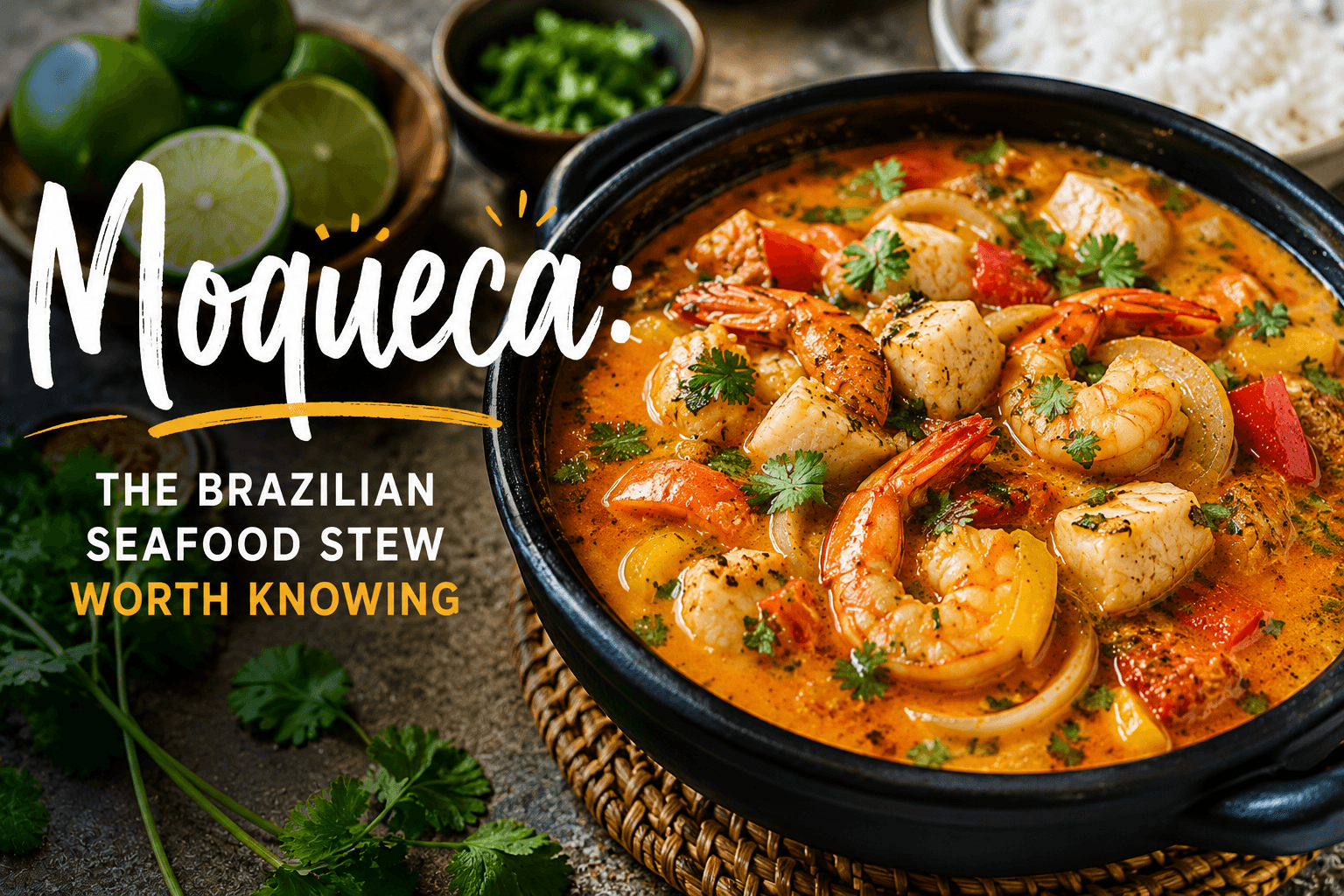
Moqueca: the Brazilian seafood stew worth knowing
There is no single moqueca. Two Brazilian states make genuinely different dishes under the same name and argue about it with real heat — and most English recipes quietly blend the two into something nobody there would recognise.
The short answer
Moqueca is a Brazilian seafood stew cooked slowly in layers, traditionally in a clay pot. There are two distinct versions. Baiana (from Bahia) uses dendê palm oil and coconut milk — rich and orange-red. Capixaba (from Espírito Santo) uses neither: colour comes from urucum, liquid from fish broth. Lighter, fish-forward.
The rule that matters most in either version: layer the ingredients and don't stir. Stirring breaks the fish apart. Fifteen minutes, lid on, leave it alone.
There is no single moqueca
Search for a moqueca recipe in English and you'll mostly find one dish: fish, coconut milk, palm oil, peppers, coriander. Reasonable enough. It is also, in Brazilian terms, a partisan choice presented as neutral — and quite often a hybrid that belongs to neither tradition.
Two states claim moqueca. Bahia, on the northeast coast, and Espírito Santo, just south of it. Their versions differ in the two things that define a stew — the fat and the liquid — and Brazilians argue about which is the real one with a seriousness that surprises outsiders.
The capixaba position has a slogan, and it's a good one: "Moqueca é capixaba, o resto é peixada." Moqueca is capixaba; the rest is just fish stew. The line is attributed to the journalist and writer Cacau Monjardim, and it has long since escaped food criticism into ordinary speech — repeated in restaurants, at festivals, and in arguments at New Year's parties.
Bahians disagree, at volume.
The chef-educator Alexandre Bressaneli draws the distinction more diplomatically: the baiana prizes the combination of ingredients; the capixaba wants the flavour of the fish. That's the cleanest summary of the split anyone has managed.

Baiana vs capixaba, compared
| Moqueca Baiana | Moqueca Capixaba | |
|---|---|---|
| From | Bahia | Espírito Santo |
| The fat | Azeite de dendê (red palm oil) | Olive oil with urucum (annatto) |
| The liquid | Coconut milk | Seasoned fish broth |
| Colour from | Dendê | Urucum |
| Peppers | Bell peppers common | Not traditional |
| Character | Rich, earthy, intense | Lighter, delicate, fish-forward |
| Lineage | Strong West African influence | Indigenous and Portuguese |
Note what isn't on that list: neither version contains cream, neither is thickened with flour, and neither is a curry. The body comes from the fat and the reduction, not from a thickener.
A word on dendê. It isn't interchangeable with other palm oils and it isn't a colouring agent. It has a distinct, slightly musky, unmistakably West African flavour, and a baiana without it is not a baiana. If you can't find it, make the capixaba — that's a better answer than substituting.
The name, and where the dish comes from
The word itself points somewhere most descriptions of moqueca don't go.
The historian Luís da Câmara Cascudo, in História da Alimentação no Brasil, associates "moqueca" with the Tupi word pokeka — meaning fish wrapped and cooked, roasted in leaves. That's an Indigenous root beneath a dish usually filed under Afro-Brazilian cooking.
Both readings are right, and neither is complete. Moqueca developed over roughly four centuries along Brazil's Atlantic coast out of three traditions at once: Indigenous technique and ingredients, West African ingredients and cooking arriving with enslaved people, and Portuguese influence. The two regional versions essentially preserve different weightings of that same inheritance — Bahia leaning African, Espírito Santo leaning Indigenous and Portuguese.
Which is why the rivalry is more interesting than a simple recipe argument. It's two communities each holding on to a different part of the same history.
A connection worth following
Bahia is the centre of Afro-Brazilian cooking, shaped by the West African diaspora. So is the Lowcountry of coastal South Carolina and Georgia, where the Gullah Geechee created shrimp and grits. Two coastlines, two hemispheres, one culinary lineage — and both dishes built on seafood, slow cooking and technique carried across the Atlantic. Cooking both is a genuinely interesting way to see it.
The clay pot, and why it's heritage
Traditional moqueca is cooked and served in a panela de barro — a handmade black clay pot. In Espírito Santo this isn't optional, it's most of the argument.
The pots made by the paneleiras de Goiabeiras, in a neighbourhood of Vitória, are registered by IPHAN — Brazil's national historic and artistic heritage institute — as intangible cultural heritage. The craft itself is protected, not just the object.
And it does real work. Clay holds and distributes heat gently, so the stew cooks without a rolling boil — which is precisely what keeps the fish in one piece. The pot also stays hot long after it leaves the flame, so a moqueca arrives at the table still bubbling.
If you don't have one
A heavy Dutch oven or a sturdy ceramic casserole is a perfectly good substitute — cooking time and flavour barely change. What you lose is thermal mass and a piece of tradition, not the dish.
If you do buy a clay pot, it needs cura before first use: seasoning with oil, gently heated, to stop it cracking. Skip that and it will split.
Choosing the fish
This decides the dish more than any seasoning does. You need firm, white-fleshed fish that holds together through a simmer.
Traditional choices in Brazil: garoupa (grouper), robalo (snook), pescada amarela, cação. Elsewhere: monkfish, halibut, cod loin, or any firm white fish cut into thick steaks or chunks rather than thin fillets.
What fails: tilapia, sole, plaice, basa — anything delicate. They disintegrate, and once the fish has broken up you have a soup with fragments in it.
Prawns are common in both versions, added near the end for the two or three minutes they need. The USDA's safe temperature for seafood is 145°F, which prawns reach almost instantly — the far greater risk is overcooking them into rubber.
Layer, don't stir
Here's the technique that separates a moqueca from a fish stew, and the rule most home cooks break within the first two minutes.
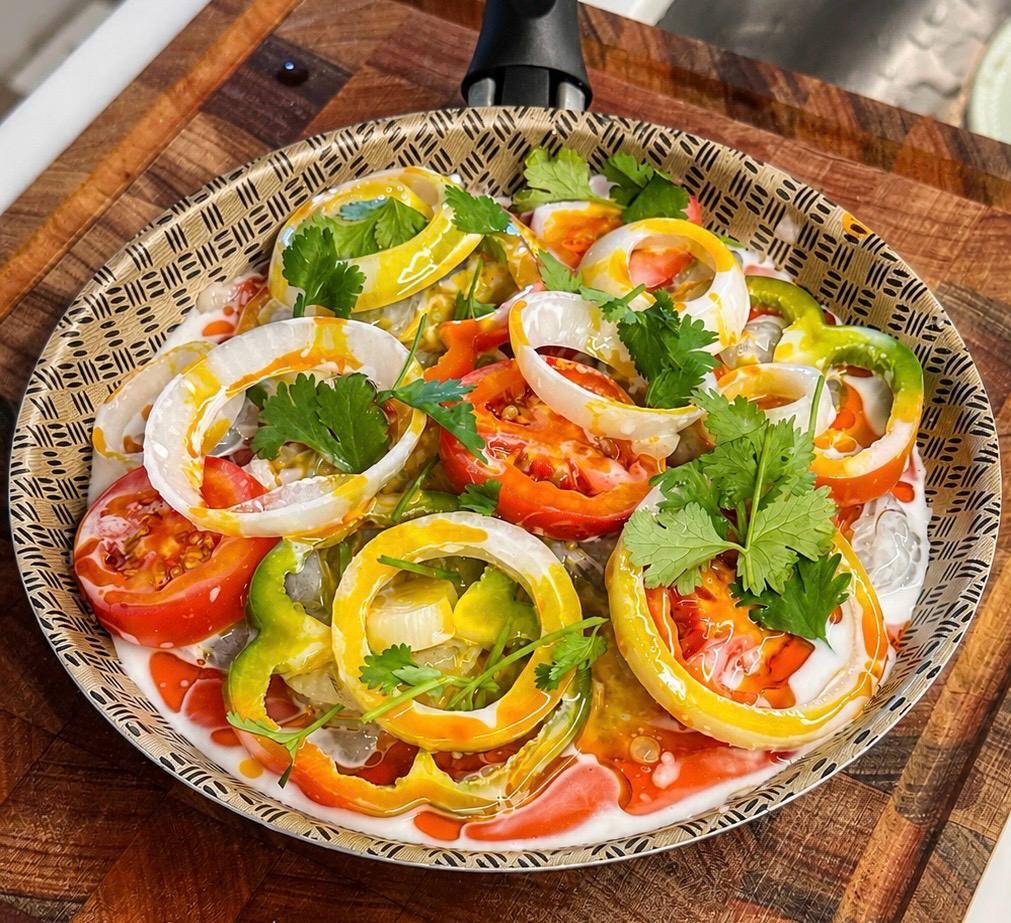
The ingredients go into the pot in layers. A bed of sliced onion, tomato and coriander stems on the bottom. Seasoned fish pieces arranged over it. More onion, tomato and pepper on top. Then the liquid — coconut milk for a baiana, fish broth for a capixaba — poured around rather than stirred through.
Lid on. Medium heat. Roughly fifteen minutes. Do not stir. If you need to check it, tilt the pot and spoon broth over the top rather than moving anything.
The layering does two jobs at once: it protects the fish from direct contact with the pot base, and it lets the vegetables release their liquid downward through the fish. Stir it and you get the same ingredients in a completely different, much worse dish.
Cook It With a Brazilian Chef
Suelen Santiago's Brazilian Moqueca runs 45 minutes — $25 in a group or $60 private, rated 4.8★ from 29 reviews. She's a professional chef working across Brazil and the United States, and this is the cheapest class in her catalogue.
Book Moqueca — $25 group All cooking classesPirão, and what goes alongside
A moqueca served alone is an incomplete meal in Brazil. Three things come with it.
Rice — plain white, to soak up broth.
Pirão — and this is the one outsiders skip. Take some of the moqueca's broth near the end, whisk cassava flour into it over low heat, and you get a smooth, savoury porridge that carries the whole flavour of the stew. It's the reason you want more broth than the fish strictly needs. Skipping pirão is like making a roast and throwing away the pan juices.
Farofa — toasted cassava flour, for texture against all that softness.
Why yours went wrong
- The fish fell apart. Either you stirred it, or you used a delicate fish. Both are fixable and neither is recoverable mid-cook.
- It tasted flat. Under-seasoned fish. Season the fish itself with salt, lime and garlic before it goes in — not just the broth around it.
- Greasy rather than rich. Too much dendê. It's assertive; a couple of tablespoons at the end is plenty, and it goes in late rather than at the start.
- Watery. Too much liquid for the pot, or the lid trapped condensation into it. Moqueca makes its own liquid from the vegetables — add less than feels right.
- Rubbery prawns. In too early. Two or three minutes at the end.
Learning it live
One note for clarity: Suelen Santiago teaches the only moqueca class on P2Bridge. Unlike most single-host topics on this site, that's not much of a limitation here — a Brazilian chef teaching a Brazilian national dish is the person you'd want anyway.
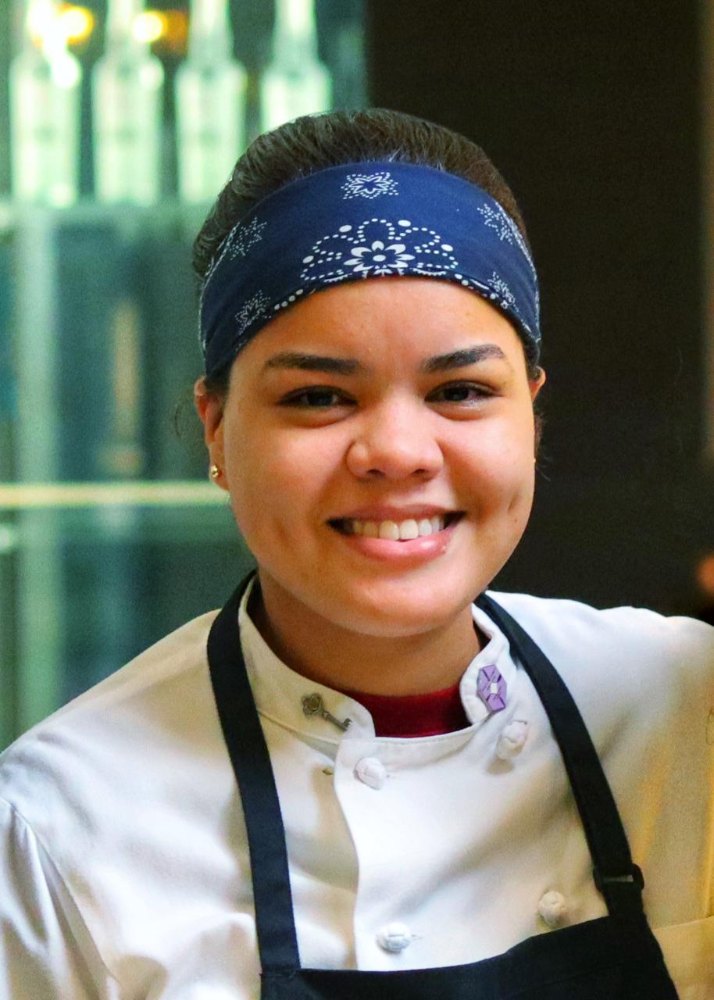
Rich & Flavorful Brazilian Moqueca
★★★★★ 4.8 (29 Reviews)A professional chef with ten years of international experience between Brazil and the United States, specialising in hot kitchen, pastry, bakery and high-volume hospitality. She also publishes as The Sue Chef, describing herself there as a private and host chef working across Brazil and the US — worth a look before booking, since you can see how she teaches.
▶ Watch her cook on YouTube — The Sue ChefMake It a Full Brazilian Meal
Her Brazilian Cheese Bread is also $25 in a group (4.8★, 29 reviews) — pão de queijo alongside moqueca is a genuinely Brazilian table. Or follow the Atlantic lineage to her Southern Shrimp and Grits at $30.
Brazilian Cheese Bread — $25 Shrimp and Grits — $30More reading: shrimp and grits traces the same West African lineage on the other side of the Atlantic, potstickers covers dumpling technique, and no-churn ice cream covers dessert. Browse the culinary category, the host directory, private sessions, group classes, current offers, or the blog. Teams can book via P2Bridge for Teams, and you can become a host.
Questions people ask
What is moqueca?
A Brazilian seafood stew, cooked slowly in layers and traditionally served in a clay pot. It developed over roughly four centuries along Brazil's Atlantic coast from Indigenous, West African and Portuguese traditions. There are two distinct regional versions — baiana from Bahia and capixaba from Espírito Santo — and Brazilians debate which is the true one.
What's the difference between moqueca baiana and capixaba?
The fat and the liquid. Baiana uses dendê palm oil and coconut milk, giving a rich, earthy, orange-red stew with strong West African influence. Capixaba uses neither — colour comes from urucum (annatto), liquid from seasoned fish broth, with olive oil. It's lighter and more fish-forward, with Indigenous and Portuguese lineage. Both are legitimate.
Why shouldn't you stir moqueca?
Because it breaks the fish apart. The ingredients are built in layers — aromatics on the bottom, fish in the middle, more vegetables on top — and the layering protects the fish while letting the vegetables release liquid downward. Stirring destroys that structure. If you need to baste, tilt the pot and spoon broth over the top.
What fish is best for moqueca?
Firm, white-fleshed fish in thick pieces. In Brazil that means garoupa, robalo, pescada amarela or cação. Elsewhere, monkfish, halibut or cod loin work well. Avoid delicate fish like tilapia, sole or basa — they disintegrate during the simmer and leave you with fragments rather than pieces.
Can I make moqueca without dendê oil?
Yes — make the capixaba version, which never uses it. Dendê has a distinctive, slightly musky flavour that other oils don't replicate, so substituting produces something that's neither version. Making capixaba deliberately is a better answer than making a compromised baiana.
Do I need a clay pot?
No, though it's traditional and does real work — clay distributes heat gently so the stew never boils hard, which keeps the fish intact. A heavy Dutch oven or ceramic casserole is a good substitute. If you do buy a panela de barro, season it with oil before first use or it may crack.
What is pirão and do I need it?
Pirão is the moqueca's own broth thickened with cassava flour into a smooth savoury porridge, served alongside. In Brazil it's essentially standard, and it's the reason you want more broth than the fish alone requires. Skipping it is like making a roast and discarding the pan juices.
How long does moqueca take to cook?
About fifteen minutes once assembled, covered, over medium heat. It's a quick dish rather than a long braise — the fish only needs enough time to cook through, and longer makes it worse rather than better. Prawns go in for the last two or three minutes only.