


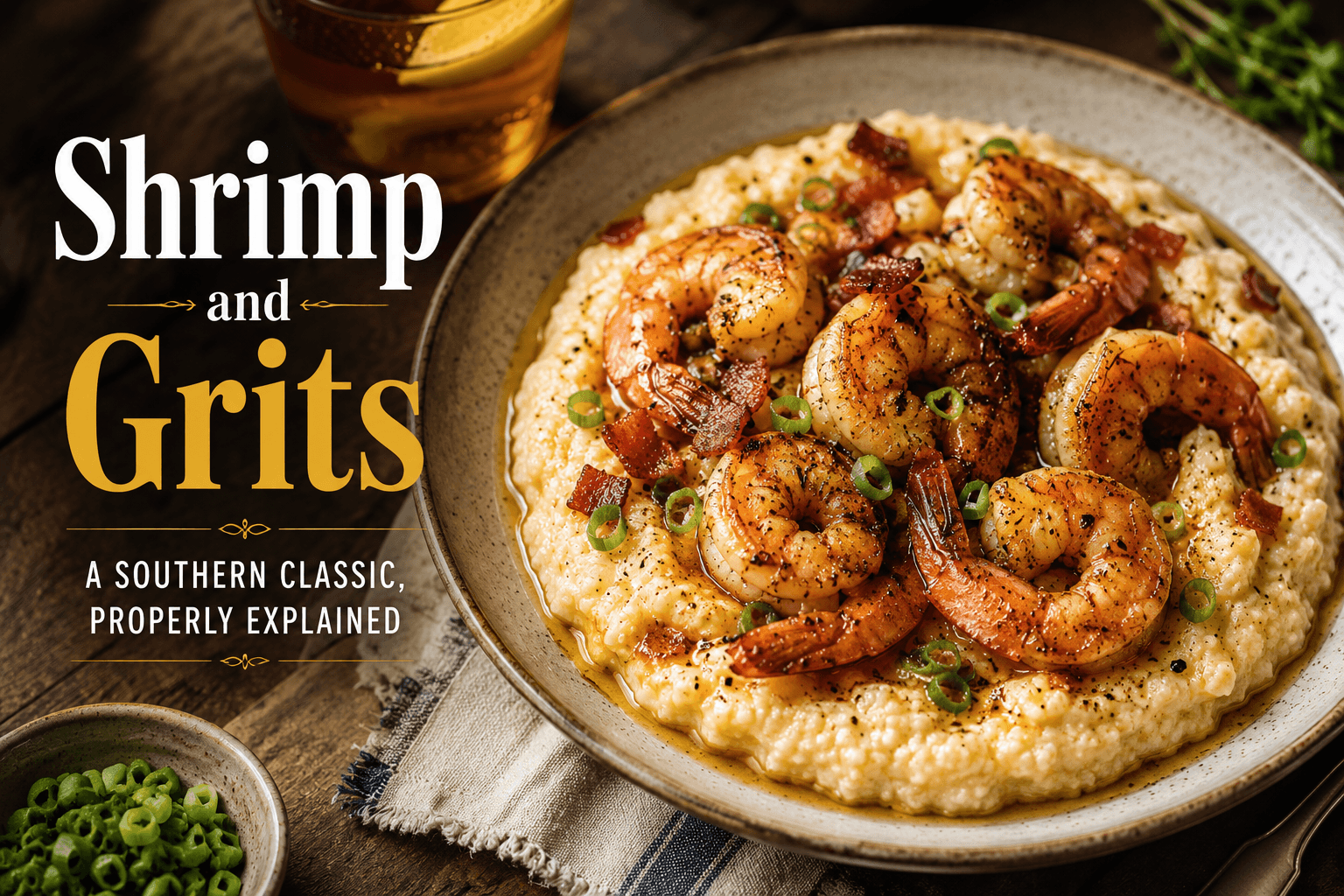
Shrimp and grits: a Southern classic, properly explained
It was a fisherman's breakfast on the Carolina Sea Islands long before it was a restaurant dish. Here's where it actually comes from, and the two mistakes that ruin it at home.
The short answer
Shrimp and grits is a Gullah Geechee dish from the Lowcountry of coastal South Carolina and Georgia — a fisherman's breakfast made by descendants of enslaved West and Central Africans, eaten during shrimp season long before any restaurant put it on a menu.
Grits: stone-ground, roughly 4 parts liquid to 1 part grits, 30–45 minutes, stirred often, cooked in stock or milk rather than water.
Shrimp: pull them the moment they curl into a loose C. A tight O means overcooked and rubbery. That single tell fixes most of what goes wrong.
Where the dish actually comes from
Most articles call shrimp and grits "a Southern classic" and move straight to the recipe. That skips the part worth knowing.
The dish belongs to the Gullah Geechee — descendants of West and Central Africans enslaved on the Sea Islands of coastal South Carolina and Georgia. They were brought there specifically for their rice-growing expertise, and the isolation of the islands meant their language, foodways and culture survived in a way they did not elsewhere in the American South.
The dish they made was assembled from three traditions at once. Grits came from Indigenous North America — the Muskogee ground corn in stone mills, and the word "hominy" descends from the Algonquin uskatahomen, meaning treated corn. Shrimp came from the creeks, catchable with a cast net for free. And the technique — the roux, the gravy, the seasoning — came from West Africa, where grain porridges were already eaten alongside shrimp.
Here's the detail that reframes it. Shrimp was considered undesirable. Enslavers fed it to the enslaved precisely because nobody else wanted it. What the Gullah Geechee did with that was turn a throwaway protein into a dish that now sells for twenty-eight dollars in Charleston restaurants.
What they called it
"Shrimp and grits" is the restaurant name. In the Lowcountry it was "breakfast shrimp" — eaten in the morning during shrimp season, which peaks around November. Among the Gullah Geechee it was also known as "shrimp gravy" and "smuttered shrimp."
A recipe appears in 200 Years of Charleston Cooking (1931) under the name "shrimp and hominy," with credit for its creation given to Black cooks. Charleston Receipts followed in 1950, published by the Junior League of Charleston as "Breakfast Shrimp." That book is still in print with its original text intact — a Jim Crow–era artifact in which Gullah verses were transcribed by white authors.
National fame arrived only in the mid-1990s, when Crook's Corner in Chapel Hill and a New York Times piece pushed it onto menus across the country. By then the Gullah Geechee had been cooking it for roughly two centuries.
Worth stating plainly: this is not humble food that chefs improved. It was a complete, skilled dish that the rest of the country took a very long time to notice. The Levine Museum of the New South traces the lineage in more detail, and it's worth twenty minutes.

What grits actually are
Ground dried corn. That's the whole answer, and the confusion is mostly American regional vocabulary colliding with Italian.
Grits vs. polenta: broadly the same idea, different corn. Grits are traditionally made from dent corn, often hominy — corn treated with an alkaline solution, which changes both flavour and nutrition. Polenta usually uses flint corn and is finer. They are not interchangeable, though people substitute constantly.
Grits vs. cornmeal: grind size. Grits are coarser.
The type you buy matters more than any other decision in this dish.
The grits: ratio, time, liquid
Three numbers and one habit.
Ratio: roughly 4:1 liquid to grits. Stone-ground absorb more than the packet usually suggests. Keep hot liquid nearby and add more if they tighten before they're tender — thin grits can be reduced, but under-hydrated grits stay gritty no matter how long you cook them.
Time: 30 to 45 minutes. There is no shortcut. The starch needs time to hydrate and release, and that release is what makes them creamy rather than merely soft.
Liquid: not water. Chicken stock, milk, or a mix. Water gives you plain corn porridge. Traditional Lowcountry cooking used whatever was available, which frequently meant milk.
The habit: stir often, and season early. Salt at the start, not the end — grains season from the inside as they hydrate, and salt added late sits on the surface tasting harsh.
Cheese, incidentally, is a modern addition. Very good, and now near-universal in restaurant versions, but not part of the original dish. Add it if you like it; don't assume you're being traditional.
The shrimp: the C-shape rule
Here is the single most useful thing in this article, and it takes one sentence.
A shrimp curled into a loose C is cooked. A shrimp curled tight into an O is overcooked.
Shrimp go from perfect to rubbery in well under a minute, and they keep cooking in a hot pan after the heat goes off. Two to three minutes total is usually the whole job — a minute or so per side for medium shrimp. The USDA's safe temperature for seafood is 145°F, which shrimp reach very quickly.
The C-to-O test exists because timing alone doesn't work. Shrimp size varies, pan temperature varies, and by the time you've checked a thermometer on something that small you've overcooked it. The shape is instant and it's reliable.
Cook It With a Professional Chef Watching
Suelen Santiago's Southern Shrimp and Grits runs 45 minutes — $30 in a group or $60 private, rated 4.8★ from 29 reviews. She's a professional chef with ten years across Brazil and the United States.
Book Shrimp and Grits — $30 All cooking classesShrimp gravy, and what came later
The original dish isn't shrimp sitting on grits. It's shrimp in a gravy, spooned over — which is why one Gullah Geechee name for it was simply "shrimp gravy."
The classic build: render bacon or salt pork, cook aromatics in the fat, make a roux with a spoonful of flour, then loosen it with stock or the liquid from the shrimp shells. Some Charleston versions add tomato. The shrimp go in at the very end, for the two minutes they need.
Don't throw the shells away. Simmered for fifteen minutes in water or stock they produce a shrimp broth that transforms the gravy. This is the step that separates a good home version from a flat one, and it costs nothing but a pan.
What came later: cheese in the grits, andouille sausage, Cajun and Creole seasoning blends, and the various barbecue-sauce and cream-heavy restaurant versions. All legitimate, none original.

Regional variations, honestly
| Version | What changes | Where from |
|---|---|---|
| Lowcountry original | Shrimp gravy with bacon or salt pork, plain grits, no cheese | Gullah Geechee, coastal SC and GA |
| Charleston | Tomato in the gravy | Charleston kitchens |
| Cajun / Creole | Andouille sausage, Creole seasoning, more heat | Louisiana influence |
| Modern restaurant | Cheese grits, cream, sometimes barbecue sauce | Post-1990s, nationwide |
None of these is wrong. But it's worth knowing which one you're making, and worth not calling a cheese-grits-and-andouille version "traditional."
Why yours went wrong
- Rubbery shrimp. Overcooked. Watch for the loose C and pull them then.
- Gritty grits. Not enough liquid, or not enough time. Add hot liquid and keep going.
- Bland grits. Cooked in water, or salted at the end. Use stock or milk, salt at the start.
- Thin, watery gravy. No roux, or no shell stock. Both are quick fixes.
- Grits set solid while you finished the shrimp. They firm as they cool. Keep them over the lowest heat with a splash of extra liquid, and stir before serving.
Learning it live
One honest note: Suelen Santiago teaches the only shrimp and grits class on P2Bridge, and the only classes on the platform cooking anything adjacent. This isn't a comparison of options.
What a live session helps with here is specific: the shrimp window is short enough that a photo can't teach it, and grits need judgement about consistency that a recipe can't put a number on. Both are the kind of thing someone watching can call in the moment.

Southern Shrimp and Grits
★★★★★ 4.8 (29 Reviews)A professional chef with ten years of international culinary experience between Brazil and the United States, specialising in hot kitchen, pastry, bakery and high-volume hospitality. Forty-five minutes, beginner level, and one of the better-value group classes in the catalogue.
Book — $30 group Suelen's profileThe Same Lineage, the Other Hemisphere
Her Brazilian Moqueca is $25 in a group (4.8★, 29 reviews) — a Bahian seafood stew from the heart of Afro-Brazilian cooking. Same West African diaspora that shaped Gullah Geechee cuisine, different coastline. Two dishes, one lineage, one chef who cooks both.
Book Moqueca — $25 Her fish taco class — $30More reading: our guide to potstickers and dumpling folding covers another hand-skill topic, and homemade ice cream without a machine covers dessert technique. Browse the culinary category, the host directory, private sessions, group classes, current offers, or the blog. Teams can book via P2Bridge for Teams, and you can become a host.
Questions people ask
Where does shrimp and grits come from?
The Gullah Geechee people of the Lowcountry — coastal South Carolina and Georgia. They were descendants of West and Central Africans enslaved on the Sea Islands, brought largely for rice-growing expertise. The dish combined Indigenous North American grits, shrimp caught free from local creeks, and West African cooking technique. It was a fisherman's breakfast, eaten during shrimp season.
How do I know when shrimp are cooked?
Watch the shape. A shrimp curled into a loose C is cooked; curled tight into an O it's overcooked and rubbery. They go from perfect to ruined in under a minute and keep cooking off the heat, so pull them at the C. Two to three minutes total is usually all they need.
What kind of grits should I use?
Stone-ground. They take 30 to 45 minutes and roughly four parts liquid to one part grits, but they're the only type that gives real corn flavour and a creamy texture with some body. Quick grits are an acceptable weeknight compromise at around ten minutes. Instant grits are the reason many people believe they dislike grits.
Why are my grits gritty?
Not enough liquid, not enough time, or both. Stone-ground grits absorb more than packet instructions usually suggest. Keep hot liquid to hand and add it as they tighten — thin grits can be reduced, but under-hydrated grits stay gritty however long you cook them.
Should grits be cooked in water or milk?
Not water, if you can help it. Chicken stock, milk, or a mix of both. This is the single largest flavour improvement available in the dish, and traditional Lowcountry cooking often used milk. Salt at the start rather than the end, so the grains season as they hydrate.
Is cheese traditional in shrimp and grits?
No. Cheese grits are a modern addition, now near-universal in restaurant versions but not part of the original dish. Add cheese if you enjoy it — just don't assume it makes the dish more authentic.
What is shrimp gravy?
It's the original form of the dish and one of its Gullah Geechee names. Rather than shrimp sitting on grits, the shrimp are served in a gravy built from rendered bacon or salt pork, aromatics, a flour roux, and stock — often stock made from the shrimp shells. The shells are worth simmering for fifteen minutes; it transforms the result.
Can I make shrimp and grits ahead of time?
Partly. The gravy base holds well and reheats fine. Grits firm up considerably as they cool, but loosen again over low heat with a splash of extra liquid and a good stir. The shrimp should always be cooked at the last moment — reheated shrimp are rubbery shrimp.