














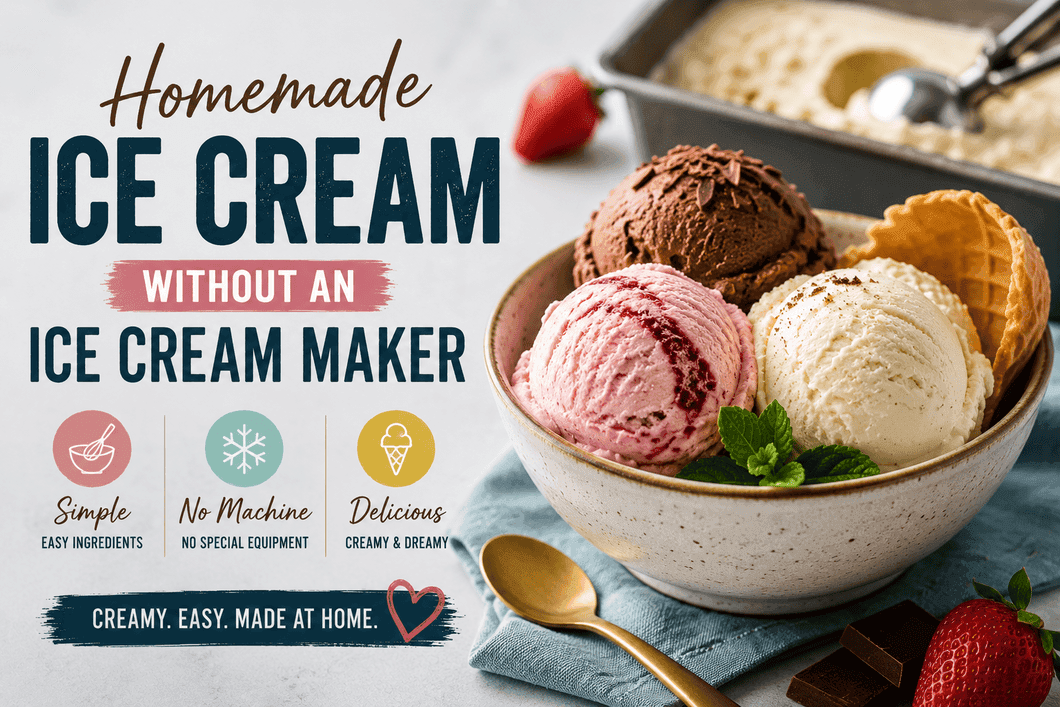
Homemade ice cream without an ice cream maker
Skipping the machine usually means skipping the raw eggs too — which removes the one genuine safety risk in homemade ice cream. The easy route and the safe route turn out to be the same route.
The short answer
The reliable no-churn method: whip 500ml double cream to soft peaks, fold in one tin of sweetened condensed milk plus flavouring, freeze for 6 hours or overnight. No machine, no custard, no eggs.
And the part most guides skip: traditional custard ice cream uses raw or lightly cooked egg yolks, which is where every recorded outbreak of illness from homemade ice cream has come from. No-churn sidesteps it entirely.
Skipping the machine is safer, not just easier
Almost every article on no-churn ice cream frames it as the compromise option. The thing you do because you don't own the equipment. That framing misses something worth knowing.
Traditional ice cream is built on a custard base — egg yolks, cooked gently into milk and cream. It's a lovely technique and it produces a genuinely superior texture. It's also the source of essentially every recorded case of people getting ill from homemade ice cream.
The CDC recorded 17 outbreaks and more than 500 illnesses in the US traced to homemade ice cream over a five-year period. In each case the cause was the same: raw or undercooked eggs carrying salmonella. Church picnics, family reunions, large batches made ahead — the pattern repeats.
The FDA names homemade ice cream specifically in its egg safety guidance, alongside Caesar dressing, as a dish where eggs often end up raw or undercooked on the plate. Its advice is to use pasteurised eggs, or cook the base properly.
The standard no-churn base contains no eggs at all. Cream and sweetened condensed milk, both already pasteurised, folded together and frozen. Nothing needs cooking because there's nothing raw to cook.
So the method people reach for out of convenience happens to be the one that removes the risk. That's a genuinely nice piece of luck, and nobody seems to mention it.
If you do want to make a custard base
It's a perfectly good technique, done properly. The USDA's guidance is specific: heat the egg mixture over low heat, stirring constantly, until it reaches 160°F (71°C), measured with a thermometer rather than guessed. Chill it thoroughly before freezing. And resist tasting the mixture before it's fully cooked — that's how people get caught out.
Pasteurised shell eggs are the other route, and they behave identically to ordinary eggs in a recipe.
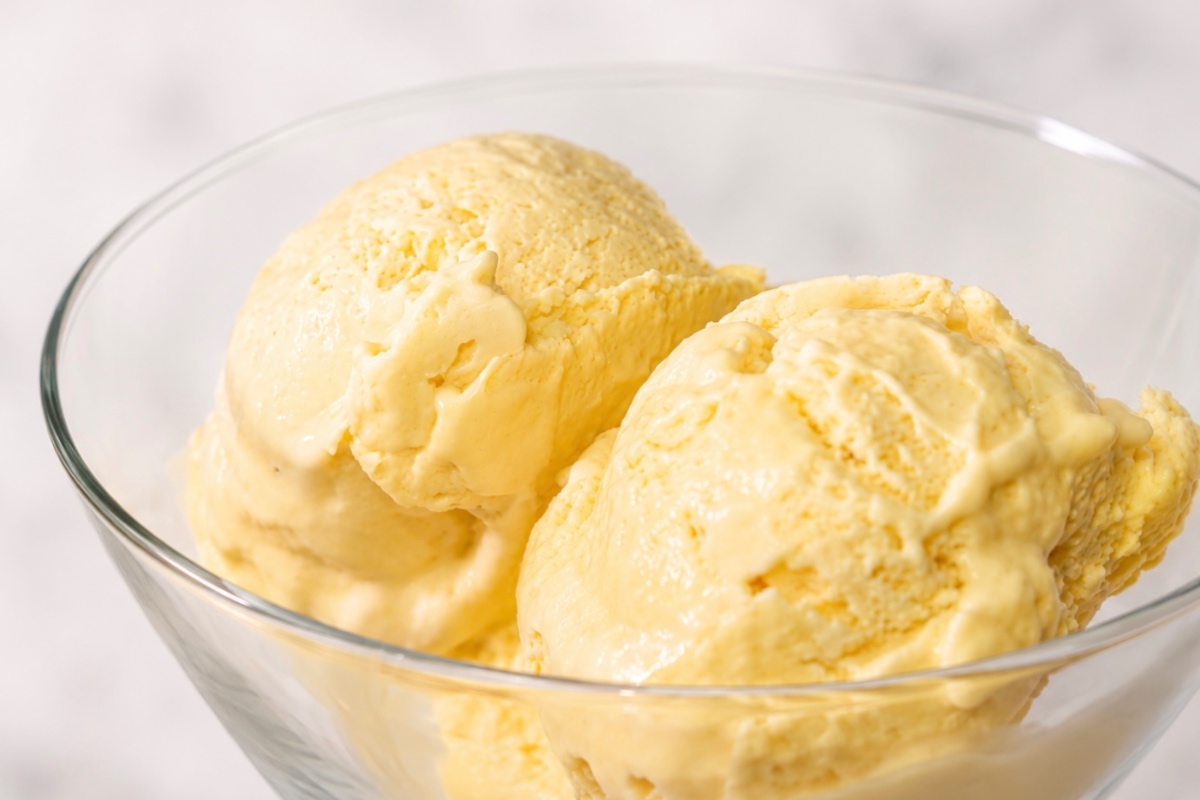
What a machine actually does
Understanding this is what separates good no-churn from a tub of sweet ice. A churner does exactly two jobs, and you have to replace both.
It churns. As the mixture freezes, water forms ice crystals. Constant paddling breaks them up while they're still microscopic. Crystal size is texture — small crystals read as creamy, large ones as icy.
It aerates. The paddle whips air into the base as it freezes. That air, called overrun in the trade, is roughly half the volume of commercial ice cream and most of why it feels light rather than dense.
No-churn replaces both, in a slightly clever way: you add the air up front by whipping the cream, and you prevent large crystals chemically rather than mechanically. Sugar lowers the freezing point so less water freezes solid; fat physically gets in the way of crystals joining up. Sweetened condensed milk delivers a great deal of both, which is precisely why it became the backbone of the method.
Method one: condensed milk no-churn
The reliable one
10 minutes active · 6 hours freezing
Whip 500ml of cold double cream to soft peaks — stop when it holds a shape but still slumps. Overwhipping to stiff peaks makes the fold difficult and the texture grainy.
In a separate bowl, mix one 400g tin of sweetened condensed milk with your flavouring — vanilla, cocoa, fruit purée, coffee. Fold a third of the whipped cream in first to loosen it, then fold the rest through gently in two additions. You're protecting the air you just spent five minutes creating.
Into a container, cling film pressed against the surface, freeze at least six hours.
Verdict: the most consistent result and the one worth learning first. Genuinely close to shop-bought.
One optional addition worth knowing: a tablespoon of vodka or a matching liqueur stirred into the base. Alcohol doesn't freeze at domestic freezer temperatures, so it lowers the overall freezing point and keeps the result scoopable straight from the freezer rather than rock hard. A tablespoon in a full batch is undetectable in flavour.
Method two: freeze and stir
The one that mimics churning
5 minutes active, repeated · 4 hours total
Pour your base into a shallow metal tray — shallow and metal both matter, because you want it freezing fast. After 45 minutes, when the edges have set, beat it hard with a fork or whisk to break the crystals and redistribute. Repeat every 30 to 45 minutes, three or four times.
You are manually doing what the paddle does, just less often.
Verdict: works with any base, including custard. Requires you to be in the house and paying attention, which is its real cost.
Method three: ice cream in a bag
The one to do with kids
10 minutes start to finish
Put 120ml cream, a tablespoon of sugar and a splash of vanilla into a small sealed freezer bag. Put that bag inside a larger one, half filled with ice and a generous handful of salt. Shake for five to ten minutes.
Salt drops the ice's melting point well below zero, so the ice bath gets far colder than ice alone. The shaking is your churn.
Verdict: a single portion, slightly icy, and completely worth it. Kids will remember it. Wear gloves — the bag gets genuinely painful to hold.
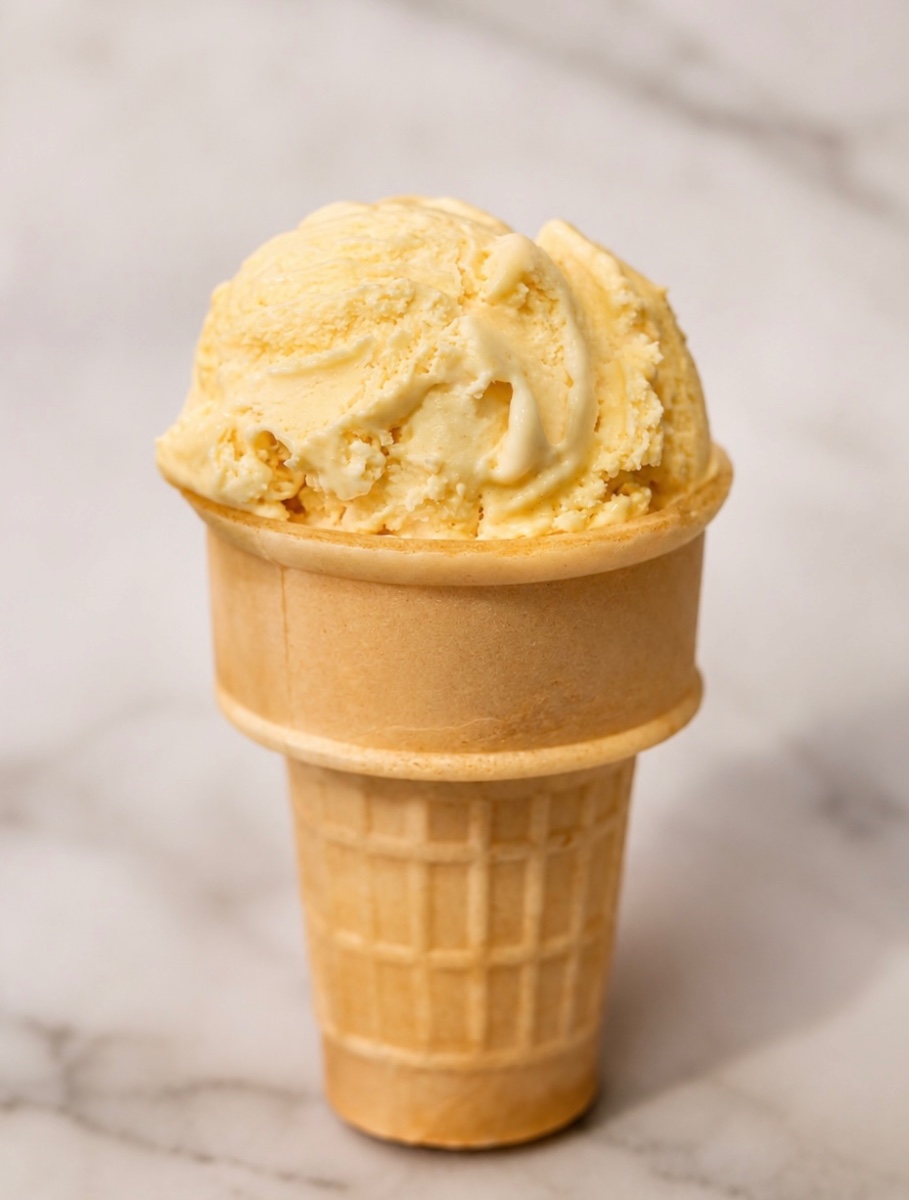
Make It With Someone Watching
Suelen Santiago teaches both Fresh Fruit and Cookie n' Cream ice cream live — 45 minutes, beginner level, rated 4.8★ from 29 reviews. She's a professional chef with a pastry background. These run as one-to-one private sessions at $60, so you get her full attention on your batch.
Fresh Fruit Ice Cream — $60 Cookie n' Cream — $60Why yours turns out icy
Four causes, in the order they're most likely.
- Not enough fat. Single cream, half-fat milk, or a low-fat substitute won't hold a creamy structure. Double cream is doing structural work, not just adding richness.
- Not enough sugar. Cutting the condensed milk to reduce sweetness removes the freezing-point depression along with it. If you want it less sweet, use a bitter flavouring — dark cocoa, espresso, tart fruit — rather than less condensed milk.
- The base wasn't cold enough going in. A room-temperature mixture spends its first hour in the freezer forming exactly the large crystals you're trying to avoid. Chill the base first.
- Watery add-ins. Fresh fruit is mostly water, and water freezes into ice. That's the specific problem the next section is about.
Fruit vs. cookies — two different problems
These two flavours fail in opposite ways, which is why they're worth treating separately.
Fresh fruit ice cream fights water. Strawberries are roughly 90% water, and stirring chopped fresh berries into a base gives you sweet cream studded with small ice cubes. The fixes: cook the fruit down into a thick purée first, or macerate it in sugar and drain, or roast it. Concentrate the flavour and remove the water — that's the whole technique.
Cookies and cream fights sogginess. Biscuits absorb moisture from the base and turn to sludge if they go in too early or too finely crushed. Fold them in at the last moment, keep the pieces reasonably large, and accept that the ones on the outside will soften. Some people coat the pieces in melted chocolate first, which genuinely works.
| Fresh fruit | Cookies & cream | |
|---|---|---|
| The enemy | Water content | Moisture absorption |
| Failure mode | Icy shards through the base | Soggy, disintegrating biscuit |
| The fix | Cook down, macerate or roast first | Fold in last, keep pieces large |
| Difficulty | Moderate — needs prep | Easy — needs timing |
What a machine still does better
Worth being straight about, because a guide that claims no downside isn't worth trusting.
A churner produces smaller and more uniform ice crystals, because it's breaking them continuously rather than preventing them chemically. Side by side, a good custard-based churned ice cream has a denser, silkier quality that no-churn doesn't quite reach.
It also gives you control over overrun. No-churn's air content is whatever your whipping produced, which varies. A machine lets you dial density deliberately.
None of which makes no-churn a poor result. It's genuinely very good, it takes ten minutes of work, it costs nothing extra, and it skips the food safety question entirely. For most people making dessert at home on a Tuesday, that's a better trade than an appliance that lives in a cupboard.
Learning it live
The honest case for a live class here is narrower than for, say, knife skills — but it's real. Whipping cream to the right stage is a judgement call that's much easier to learn from someone saying "stop, that's it" than from a photo. So is knowing when a fruit purée is reduced enough.

Fresh Fruit & Cookie n' Cream Ice Cream
★★★★★ 4.8 (29 Reviews)Suelen is a professional chef with ten years of international experience across Brazil and the United States, specialising in hot kitchen, pastry and bakery work. That pastry background matters here — the judgement calls in this article are exactly the ones a trained pastry chef makes without thinking. Two separate 45-minute classes covering the two flavours that fail in opposite ways. Both run as private one-to-one sessions rather than group classes, so the whole session is spent on your batch — useful for the whipping and reduction judgement calls, which are the parts that go wrong unsupervised.
Fresh Fruit — $60 Suelen's profile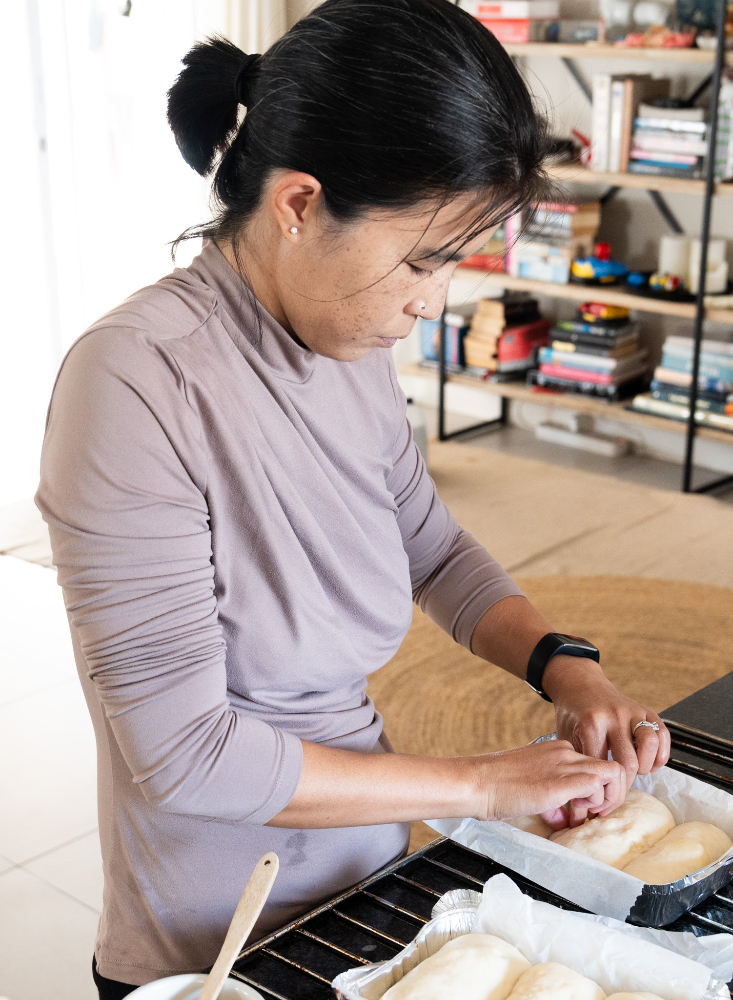
Mochi for Beginners
★★★★★ 5.0Here's the natural pairing: mochi ice cream is glutinous rice dough wrapped around ice cream. Learn the ice cream, then learn the wrapper. At $30 either privately or in a group it's also half the price of the ice cream sessions, which makes it a sensible place to start if you're new to the platform.
Book Mochi — $30 Denise's profileCheaper Ways Into the Dessert Classes
If $60 is more than you want to spend on a first session: Denise's Mochi and Chinese Chiffon Cake are $30 (5.0★), and Suelen's Gluten/Dairy Free Fudge Cookies run $25 in a group (4.8★, 29 reviews).
Chiffon Cake — $30 All cooking classesBrowse the full culinary category, the host directory, private sessions, group classes, current offers, or more writing on the blog. Teams can book together through P2Bridge for Teams, and if you'd like to teach, you can become a host.
Questions people ask
Can you really make ice cream without an ice cream maker?
Yes, and the results are genuinely good. The reliable method is whipping double cream to soft peaks and folding in sweetened condensed milk, then freezing for six hours. You replace the machine's two functions — aeration and crystal control — by adding air up front and relying on the sugar and fat in the condensed milk to keep crystals small.
Is homemade ice cream safe to eat?
No-churn ice cream made with cream and condensed milk is very safe, since both are pasteurised and no eggs are involved. The risk in homemade ice cream comes specifically from raw or undercooked eggs in custard bases — the CDC traced 17 outbreaks and over 500 illnesses to exactly that. If you make a custard base, cook it to 160°F measured with a thermometer, or use pasteurised eggs.
Why is my homemade ice cream icy instead of creamy?
Usually too little fat or too little sugar — both are structural, not just flavour. Other common causes: putting a warm base into the freezer, which forms large crystals in the first hour, and adding fresh fruit, which is mostly water. Use double cream rather than single, don't reduce the condensed milk, and chill the base before freezing.
Do I need to add alcohol to no-churn ice cream?
Not required, but a tablespoon of vodka or a matching liqueur genuinely helps. Alcohol doesn't freeze at domestic freezer temperatures, so it lowers the overall freezing point and keeps the ice cream scoopable rather than rock solid. At that quantity it's undetectable in flavour.
How long does homemade ice cream take to freeze?
Six hours minimum for the no-churn method, and overnight is better. The freeze-and-stir method takes around four hours but needs you to beat it every 30 to 45 minutes. Ice cream in a bag takes about ten minutes, though it makes a single portion and comes out slightly icier.
Can I use fresh fruit in no-churn ice cream?
Yes, but not raw and chopped — fruit is mostly water, and water becomes ice. Cook it down into a thick purée, macerate it in sugar and drain the liquid, or roast it first. You're concentrating flavour and removing water, which is the whole technique behind good fruit ice cream.
How do I stop cookies going soggy in cookies and cream?
Fold them in at the very last moment before freezing, keep the pieces reasonably large rather than finely crushed, and expect the outer edges to soften regardless. Coating the pieces in melted chocolate first creates a moisture barrier and works well.
Is no-churn as good as machine-made ice cream?
Close, but not identical. A machine produces smaller, more uniform ice crystals and lets you control density deliberately, so a well-made churned custard has a silkier quality. No-churn is genuinely very good, takes ten minutes of work, needs no equipment, and avoids the raw egg question entirely.