


Palm Sugar vs Brown Sugar vs Coconut Sugar: The Real Differences
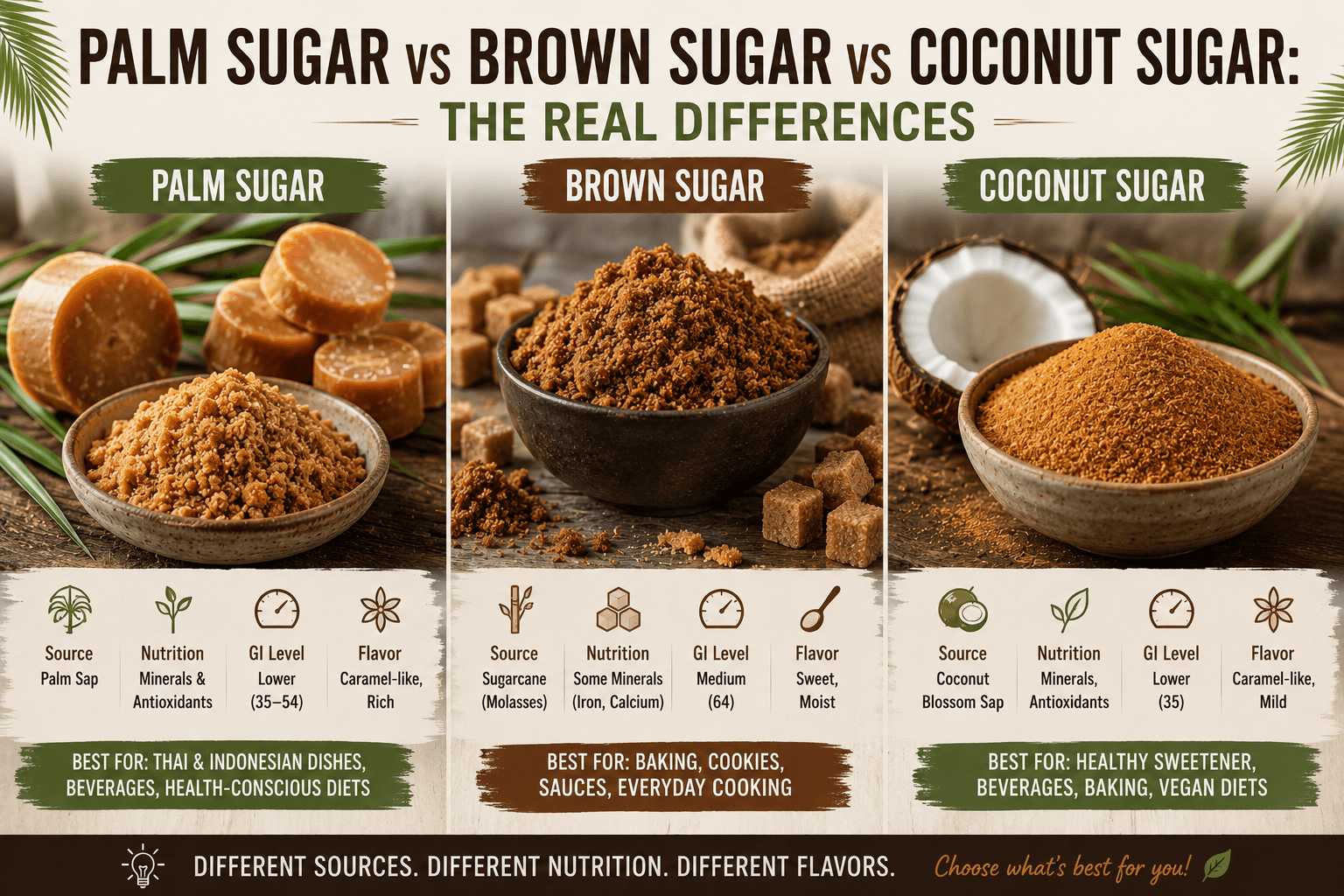
Two of these are evaporated tree sap. The third is refined white sugar with molasses stirred back in — which makes brown sugar the most processed of the three, not the least. Coconut sugar is also a palm sugar, since the coconut palm is a palm. And on health: all three are sugar, and the gap is smaller than the labels suggest.

Two are sap. One is assembled.
Start here, because it reorders everything else.
Palm sugar and coconut sugar are boiled-down sap. Someone taps a tree, collects the liquid, and reduces it over heat until it thickens and sets. There's no refining step. What you buy is essentially concentrated sap.
Brown sugar is manufactured. Most commercial brown sugar is white cane sugar — already fully refined, molasses stripped out — with molasses added back in. Roughly 3.5% of it for light brown, around 6.5% for dark. It's an assembly.
Which means the health-food-shelf intuition is upside down. Brown sugar looks rustic and reads as "less processed than white," and it is in fact white sugar that has been through an extra step. The unrefined ones are the two with the tropical names.
I'm not building a health argument on that — hold that thought until the GI section, where it gets less flattering. But as a matter of what's physically in the bag, it's worth knowing which of these was made and which was merely reduced.
Untangling the names
The single most common confusion on this topic, and it's a fair one: coconut sugar is a palm sugar. The coconut palm is a palm. So the categories overlap rather than sit side by side.
What separates them in practice is which tree, and which part of it.
- "Palm sugar" on an Asian grocery shelf usually means sap from the palmyra, date or sugar (aren) palm. It's sold in hard discs, cylinders or blocks, ranges from pale gold to near-black, and tastes smoky and deeply caramelised.
- Coconut sugar is made from the sap of coconut palm flower buds. Not the flesh. Not the water. It's granulated, free-flowing, mid-brown, and tastes of caramel.
And the thing that catches everyone: coconut sugar does not taste of coconut. Not faintly, not at all. If you've been avoiding it in a recipe because you didn't want a coconut note, you can stop.
Indonesian gula jawa or gula merah sits right on the overlap, which is part of why the labelling is such a mess — it's often made from the aren palm, sometimes from coconut palm, and gets translated as either.
Jaggery is a cousin, not a synonym. It's South Asian, usually cane but sometimes palm, and worth its own article rather than a footnote in this one.
| Palm sugar | Brown sugar | Coconut sugar | |
|---|---|---|---|
| Source | Sap of palmyra, date or aren palm | Refined white cane sugar + molasses added back | Sap of coconut palm flower buds |
| Processing | Boiled down. Not refined | Fully refined, then recombined | Boiled down. Not refined |
| Form | Hard discs, blocks, cylinders | Soft, damp, clumping granules | Dry, free-flowing granules |
| Flavour | Smoky, deep caramel, faintly savoury | Molasses, toffee | Caramel. Not coconut |
| Glycemic index | Varies widely | ~65 | ~54 measured (35 claimed) |
| Sucrose | High | ~97% | ~70–80% |
| Best at | Thai and Indonesian savoury cooking; sweets | Baking where moisture matters | Drop-in for brown sugar; drinks |
Is coconut sugar actually healthier?
Modestly lower on the glycemic index. Otherwise, no. And the number on the packet is probably wrong.
Coconut sugar is marketed on a glycemic index of 35. That figure gets repeated everywhere — product labels, wellness blogs, shop shelf-talkers. It's worth knowing where it came from.
It traces to a single study by the Philippine Food and Nutrition Research Institute, conducted on roughly ten people, in a country with a substantial coconut sugar export industry. It has never been independently replicated in a peer-reviewed journal.
When the University of Sydney — which runs the world's reference GI database — measured it, they got 54. Independent measurements generally land in the 50s. The reported range across studies runs from 35 to 54, and table sugar sits around 65.
So the honest comparison isn't 35 versus 65. It's roughly 54 versus 65. Lower, genuinely — but not the different-category difference the marketing implies.
Two more things worth holding onto:
- Coconut sugar is about 70–80% sucrose — the identical molecule to table sugar — and has essentially the same calories per teaspoon. Nothing about it is low-calorie.
- The trace minerals are real but irrelevant at the doses anyone uses. Iron, zinc, calcium, potassium are all present. You'd have to eat a genuinely alarming quantity to match what a banana gives you, and at that point the sugar has undone the argument.
Credit where it's due, though: there is a real mechanism behind some of the spread. Coconut sugar contains inulin, a prebiotic fibre, at somewhere between 1 and 3% of its carbohydrate, and inulin slows glucose absorption. Its level varies with growing region, season and how hot and long the sap was boiled. So batch-to-batch variation in the GI figures isn't only sloppy testing — the product itself genuinely differs.
One thing I'd flag about the sources on this topic. A lot of the pages ranking for "coconut sugar glycemic index" are published by companies that sell coconut sugar wholesale. They aren't lying, but they have an obvious interest in which number gets repeated, and it shows in which study they cite.
Not medical advice. If you're managing diabetes, prediabetes or insulin resistance, the useful step is reducing total added sugar across all sources rather than swapping one sweetener for another — and that's a conversation for your doctor or a dietitian, not a food blog.
Why brown sugar behaves differently in baking
This is where the choice stops being philosophical and starts affecting what comes out of the oven.
Molasses is hygroscopic — it pulls water out of the air and holds onto it. That's why brown sugar clumps in the cupboard, and it's why cookies made with brown sugar stay chewy while the same recipe with white sugar goes crisp. The molasses is doing moisture management inside your bake.
Swap brown sugar for coconut sugar and you lose some of that. Coconut sugar is drier and less hygroscopic, so the result comes out a touch drier and crisper. Not ruined. Different.
Now the part that catches people out, and I've never seen it flagged on a sweetener comparison page.
Molasses is acidic. In recipes leavened with bicarbonate of soda, the brown sugar isn't only sweetening and moistening — it's supplying acid for the bicarb to react with. Take the brown sugar out and put coconut sugar in, and you may have quietly removed part of your leavening system. Flat cookies, and no obvious culprit.
If you're making that swap in a bicarb-leavened recipe, add a small acidic component to compensate — a teaspoon of lemon juice, or a spoon of yoghurt or buttermilk in place of some of the liquid. Or use baking powder, which brings its own acid.
The short version: brown sugar is doing three jobs in a bake — sweetening, holding moisture, and supplying acid. Any substitute needs to be judged on all three, not just the first.
Palm sugar is a savoury ingredient
Western cooks file all three of these under "baking." Across Southeast Asia, palm sugar spends most of its life in savoury pans.
Thai cooking builds on a four-way balance — salty, sour, spicy, sweet — and palm sugar is what holds the fourth corner. It isn't there to make the dish sweet. It's there to round the fish sauce and the lime so neither one dominates. White sugar can do the arithmetic but tastes one-dimensional doing it; palm sugar brings a smoky caramel depth that reads as part of the dish rather than an addition to it.
You can see it in real quantities. Shawnie Kelley's live Thai class on P2Bridge lists 1 tsp palm sugar in the tom yum and 2 tsp in the panang curry. A teaspoon, in a soup for four. That's seasoning, not sweetening.

Practical note, because palm sugar's physical form defeats people the first time: it comes as a rock-hard disc or cylinder, not as granules. Don't attack it with a knife. Grate it on the coarse side of a box grater, shave it with a vegetable peeler, or drop the whole piece into whatever liquid is already in the pan and let it dissolve. It melts at a lower temperature than granulated sugar, so it goes faster than you'd expect.
See palm sugar used as seasoning, not sweetener
Shawnie Kelley's 90-minute Thai class covers tom yum and panang curry with beef — and the palm sugar in both is there to balance fish sauce and lime. She's a chef instructor leading culinary programs for Columbus State in Ohio, with 18 years of teaching behind her.
We went deeper on the balance those two dishes teach in tom yum vs panang.
Brown sugar does savoury work too
The same logic runs the other way. Brown sugar earns its place in savoury cooking wherever something needs to be balanced rather than sweetened — acid, chilli heat, the sharpness of vinegar or rum.
Mackaeda Mc Kenzie's pork tenderloin class uses 2 tablespoons of brown sugar in an apple and rum pan reduction. The sugar isn't making a dessert sauce. It's balancing the acidity of the apples and the alcohol's bite, and it helps the sauce reduce to something that coats.

Could you use palm sugar there instead? Yes, and it would be good — smokier, a little more complex against the rum. That's a flavour decision, not a right-or-wrong one, and it's the honest answer to most substitution questions on this page.
How to substitute one for another
All three swap at roughly 1:1 by weight. What changes is texture, colour and depth — and in one case, your leavening.
| Swap | Ratio | What to expect |
|---|---|---|
| Brown → coconut | 1:1 | Slightly drier, crisper bake. If the recipe uses bicarbonate of soda, add a teaspoon of lemon juice or swap some liquid for yoghurt — you've removed acid |
| Coconut → brown | 1:1 | Moister and softer. Stronger molasses flavour. No leavening problem |
| Palm → brown | 1:1 by weight | Fine in sweets. In Thai or Indonesian savoury dishes you lose the smoky note and it tastes noticeably flatter |
| Brown → palm (savoury) | 1:1 by weight | Works well and adds depth. Grate it first, or melt it into the pan liquid |
| Palm → coconut | 1:1 | Closest match of any pairing — both are reduced sap. Coconut is milder and less smoky |
| Any → white sugar | 1:1 | Sweetness holds, everything else goes. Expect paler colour, less moisture, no depth |
Weight, not volume, wherever you can. Brown sugar is damp and compacts — a packed cup weighs meaningfully more than a loose one — while coconut sugar is dry and pours level. Measure both by cup and you're not swapping like for like.
You'll notice the "palm (or light brown) sugar" construction in Shawnie's panang curry ingredient list. That's a working chef treating the two as interchangeable at a stated quantity, which is about as direct an answer to the substitution question as you'll get.
Learn it live with a chef
Sugar is one of those ingredients where reading gets you the theory and ten minutes at a stove gets you the judgement — how much palm sugar a curry actually wants, what a reduction looks like when the sugar has done its job.

★★★★★ 5.07 reviews · 6 experiences
Verified Host · Indonesia · Pastry Chef, Food Stylist, Food Technologist · Le Cordon Bleu trained · 10 years
For a subject that comes down to sugar chemistry, a food technologist is the most relevant credential on this platform. Her klepon are built around a molten palm sugar centre, and Indonesian gula jawa sits exactly on the palm-versus-coconut line this article untangles.

★★★★★ 5.03 reviews · 12 experiences
Cuisine Specialist · United States · Chef Instructor, food & travel writer · 18+ years, five published books
Palm sugar as seasoning rather than sweetener. Her Thai class ingredient list is also where the substitution question gets answered by a practitioner — she specifies palm or light brown sugar, at a stated quantity, for the panang curry.

★★★★★ 4.914 reviews
Verified Host · Trinidad and Tobago · 6 years · Caribbean and African home cooking
Brown sugar doing savoury work. Two tablespoons in an apple and rum pan reduction, balancing acid and alcohol rather than sweetening — and the most-reviewed culinary class on the platform.
One gap worth naming: no P2Bridge class currently uses coconut sugar. If that's specifically what brought you here, you can request it as a custom experience — the platform accommodates those.
More on the site: the full culinary catalogue, dessert classes, baking classes, upcoming group sessions, class packages, and every verified host.
Frequently asked questions
Is coconut sugar the same as palm sugar?
Coconut sugar is a type of palm sugar, since the coconut palm is a palm. But what is sold as palm sugar usually comes from the palmyra, date or aren palm and arrives as hard discs or blocks, while coconut sugar comes from coconut palm flower sap and is granulated. They overlap rather than being identical.
Does coconut sugar taste like coconut?
No. It is made from the sap of coconut palm flower buds, not from coconut flesh or coconut water, and carries no coconut flavour at all. It tastes of caramel, similar to a mild brown sugar. This surprises most people using it for the first time.
Is coconut sugar healthier than brown sugar?
Only marginally. Coconut sugar is roughly 70 to 80 percent sucrose with essentially the same calories as table sugar. Its glycemic index measures around 54 against table sugar's 65 — lower, but not the dramatic gap the widely marketed figure of 35 implies. Treat all three as sugar.
Where does coconut sugar's glycemic index of 35 come from?
From a single study by the Philippine Food and Nutrition Research Institute, conducted on around ten people in a country with a large coconut sugar export industry, and never independently replicated in a peer-reviewed journal. The University of Sydney, which maintains the reference glycemic index database, measured 54.
Can I substitute coconut sugar for brown sugar in baking?
Yes, at a 1:1 ratio by weight, but expect a slightly drier and crisper result because coconut sugar holds less moisture. If the recipe is leavened with bicarbonate of soda, add a teaspoon of lemon juice or swap some liquid for yoghurt, since brown sugar's molasses was supplying acid for the reaction.
Why does brown sugar keep baked goods moist?
Because molasses is hygroscopic, meaning it attracts and holds water. That is why brown sugar clumps in the cupboard and why cookies made with it stay chewy while the same recipe with white sugar bakes crisp. The molasses is actively managing moisture inside the bake.
Is brown sugar less processed than white sugar?
No, the opposite. Most commercial brown sugar is fully refined white cane sugar with molasses added back afterwards — roughly 3.5 percent for light brown and about 6.5 percent for dark. Palm and coconut sugar are reduced sap and are genuinely unrefined.
How do you use a hard block of palm sugar?
Grate it on the coarse side of a box grater, shave it with a vegetable peeler, or drop the piece straight into whatever liquid is already in the pan and let it dissolve. Do not try to cut it with a knife. Palm sugar melts at a lower temperature than granulated sugar, so it goes faster than expected.
Related reading: crêpes vs pancakes vs galettes, Korean banchan and the twelve-dish table, and turning fond into a pan sauce.
How we sourced this
Glycemic index figures come from the University of Sydney's reference database as reported by SBS, Australia's public broadcaster, and from medically reviewed nutrition reporting. We deliberately did not cite coconut sugar manufacturers or wholesalers, several of which rank well for this query and all of which have a commercial interest in which figure gets repeated.
Class details, prices, ratings and ingredient lists were read directly from the live P2Bridge class pages on 24 August 2026. Every sugar attributed to a host in this article appears in that class's published ingredient list. Ratings are shown with review counts — see the P2Bridge reviews page for the underlying feedback. Prices change; check before booking.
What this article does not claim. It is not medical or dietary advice, and it does not present coconut sugar as a health food. No P2Bridge class currently uses coconut sugar, and we have not implied otherwise. We have not stated which sugars are used in classes whose ingredient lists we could not read.