



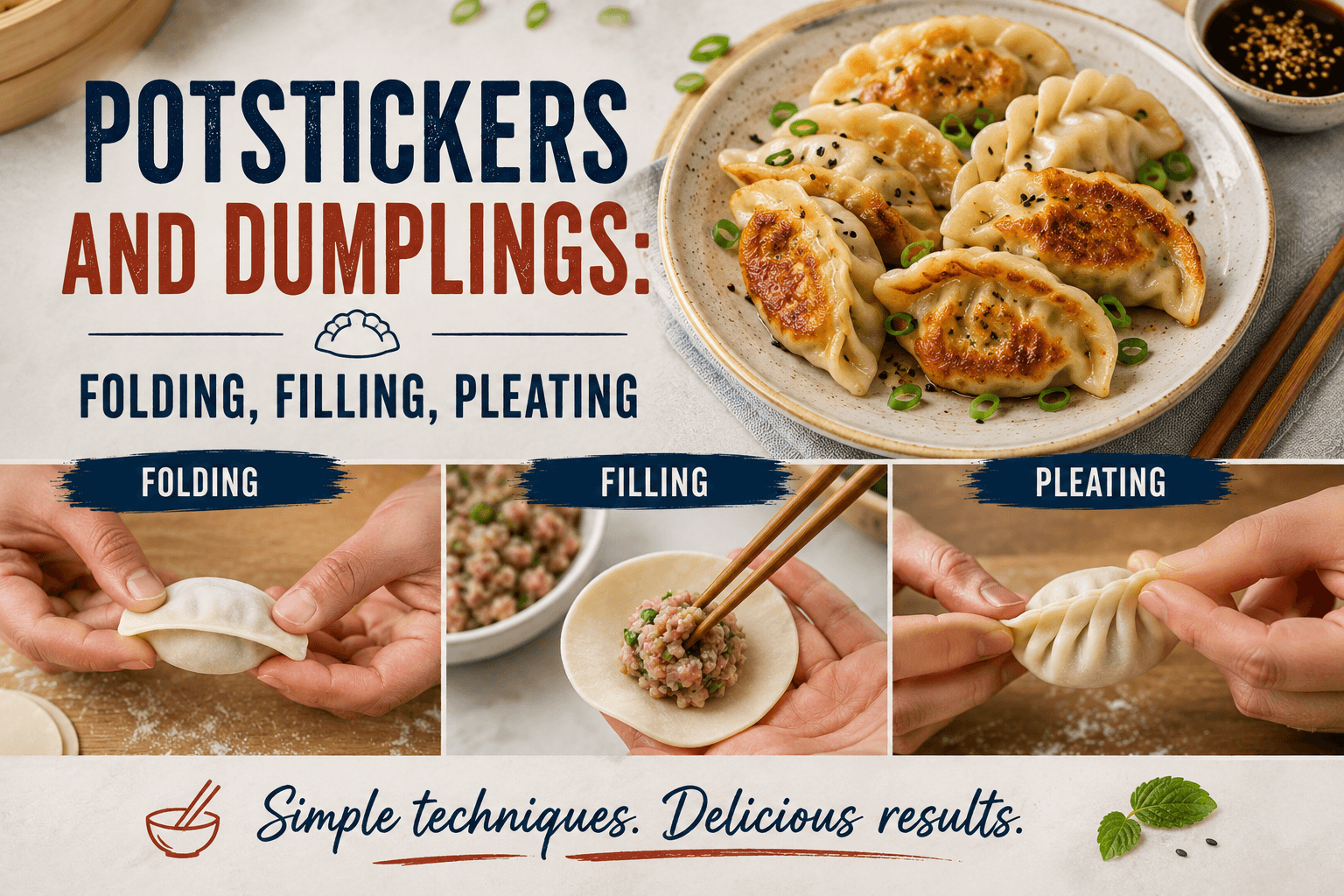
Potstickers and dumplings: folding, filling, pleating
Pleating is the part everyone frets about and the part that matters least. Dumplings fail because of what's inside them — and because you cannot see whether they're cooked.
The short answer
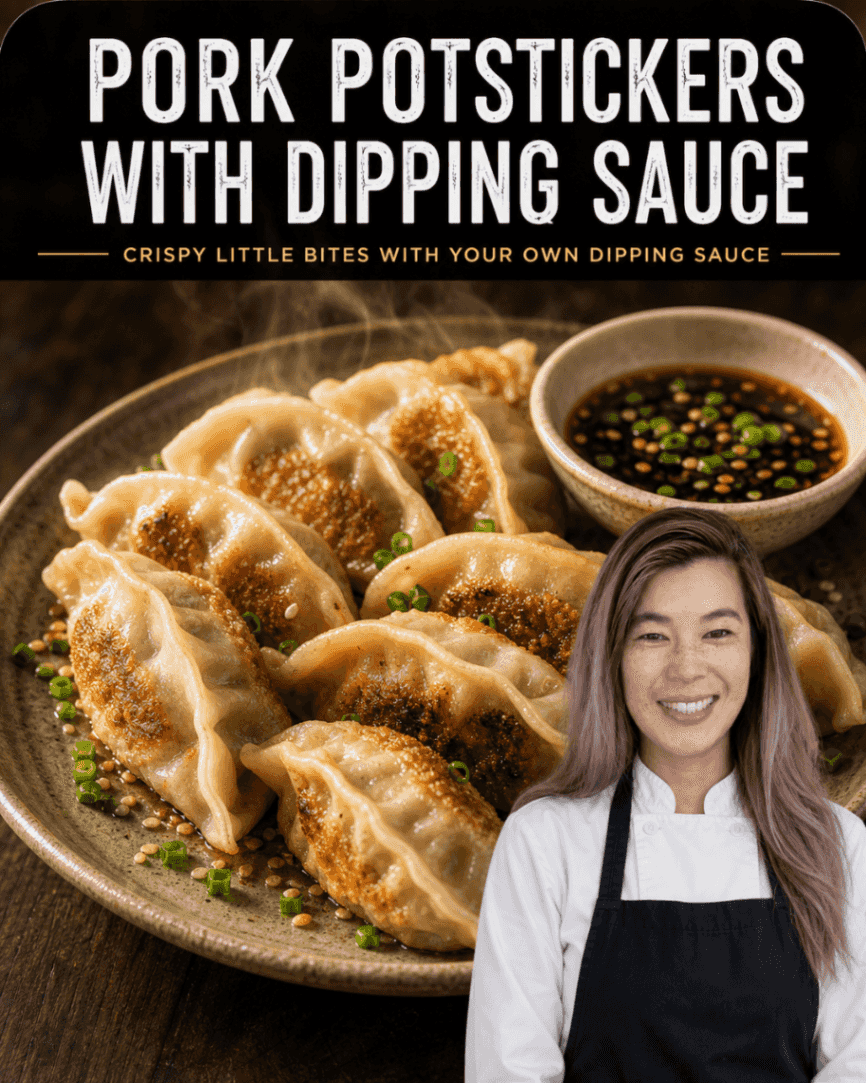
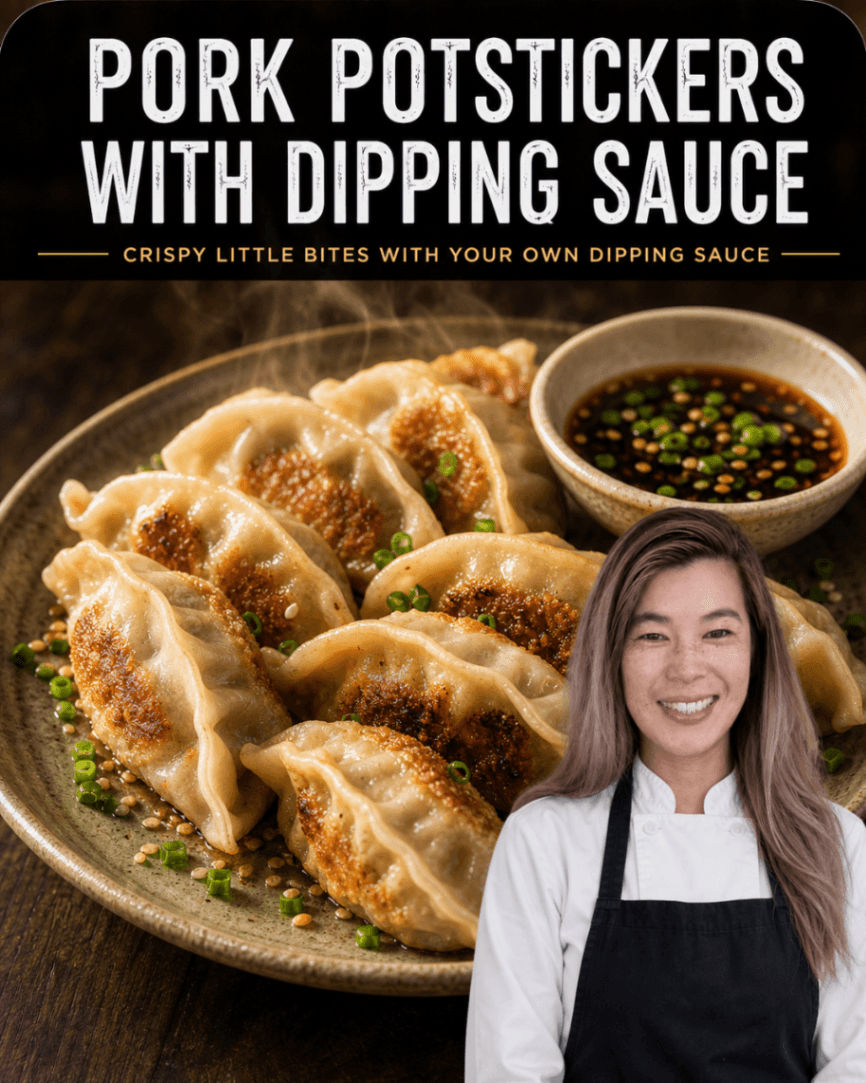
A potsticker is a dumpling cooked in three stages in one pan: fry the base until golden, add water and cover to steam the filling through, then uncover and let the water go so the bottom re-crisps. Crisp underneath, tender on top.
Use about one tablespoon of filling per wrapper — less than looks right — and salt and drain your cabbage first. Wet filling and overfilling cause more failures than bad pleating ever will.
And the bit nobody mentions: a pork dumpling is ground meat sealed inside opaque dough. You cannot judge doneness by looking. USDA guidance is 160°F for ground pork, and colour is not a reliable indicator.
The filling is where it goes wrong
Search for dumpling advice and you'll drown in pleating tutorials. Eighteen folds. Rose shapes. Someone's hands moving impossibly fast.
Almost none of it addresses why your dumplings actually failed, which is nearly always one of two things happening inside the wrapper.
Problem one: the filling is wet
Chinese cabbage is around 95% water. Chop it, mix it with pork, and it sits there quietly leaking. By the time the dumplings hit the pan the seams have softened from the inside, and the moment steam builds they burst.
The fix takes fifteen minutes and is not optional. Finely chop the cabbage, toss it with a good pinch of salt, leave it in a colander for fifteen minutes, then squeeze it out — properly, in a clean tea towel, until you're surprised how much comes out. You'll lose maybe a third of the volume in water. That water is what would have destroyed your dumplings.
Problem two: too much filling
A tablespoon of filling looks stingy sitting in the middle of a wrapper. It looks like you're being mean. Use a tablespoon anyway.
Overfilling causes two failures at once: you can't get a clean seal because the edges won't meet properly, and the filling expands as it heats and splits the seam. The dumplings that look best in photographs are usually underfilled by instinct rather than overfilled.

Wrappers: shop-bought vs homemade
Let's be direct about this, because a lot of content is precious about it. Shop-bought wrappers are fine. Most home cooks should use them, most of the time. They're consistent, they're cheap, and they let you spend your attention on filling and folding rather than on dough.
Look for round wrappers labelled for gyoza or jiaozi — thinner and more delicate than wonton wrappers, which are square and made for soup. Keep the stack under a damp tea towel while you work. A wrapper that dries out for even a few minutes will not seal, and you'll blame your pleating.
Homemade dough is better, and it's a genuinely different thing. Potsticker dough is a hot-water dough — boiling water into the flour rather than cold. That partially gelatinises the starch and denatures some of the gluten, giving a dough that's softer, more pliable, and much easier to pleat without springing back. It's why homemade potsticker wrappers feel silkier than anything in a packet.
It's also a skill in its own right, and trying to learn dough and folding in the same session is how people give up. Learn the folds on shop-bought wrappers first.
The folds, easiest to hardest
Four folds, in the order you should actually learn them. All of them start the same way: filling in the centre, a wet fingertip run along half the rim.
1. The half-moon
No pleats · start here
Fold the wrapper in half over the filling and press the edges together firmly, working from the centre outward so air escapes rather than getting trapped. That's it. No pleats at all.
Don't skip this: it seals as well as any pleated fold and cooks identically. If you're making dumplings for dinner rather than for a photograph, this is a perfectly good answer.
2. The basic pleat
Three to five pleats · the workhorse
Hold the half-folded dumpling in your non-dominant hand. Pinch the centre closed. Then, working from the centre out to one side, use your thumb and forefinger to push a small fold of the front edge toward the centre and press it against the flat back edge. Repeat two or three times, then do the same on the other side.
The key: only the front edge pleats. The back stays flat. That asymmetry is what makes the dumpling curve into a crescent and sit upright.
3. The one-sided pleat
Five to seven pleats · directional
Same technique, but every pleat runs in the same direction from one end to the other rather than out from the centre. Produces a fan-like effect along the top seam and a pronounced curve.
Why bother: it's faster once learned, because your hands aren't switching direction halfway.
4. The standing crescent
Seven or more pleats · for looks
A deeply pleated version with enough curve that the dumpling stands on its own base. This is the shape that photographs well and the one people mean when they say they can't fold dumplings.
Honest assessment: makes no difference to how it tastes. Learn it because it's satisfying, not because your dinner needs it.
Learn the Fold With Someone Watching Your Hands
Denise Fan's Pork and Cabbage Pot Stickers class runs 60 minutes — $30 in a group or $60 private, rated 5.0★. Pleating is a hand skill, and hand skills are what live instruction is genuinely better at.
Book Pot Stickers — $30 group All cooking classesThe three-stage cook
This is what makes a potsticker a potsticker rather than a boiled or steamed dumpling. Three stages, one pan, no lifting anything out.
| Stage | What you do | What's happening |
|---|---|---|
| 1 · Sear | Medium-high heat, oil, dumplings flat side down. 2–3 minutes, undisturbed. | The base browns and sets. Don't move them — that's where the sticking (and the name) comes from. |
| 2 · Steam | Add water to about 1cm, cover immediately, drop to medium. 6–8 minutes. | Steam cooks the filling through and softens the top of the wrapper. This is the stage that actually cooks the pork. |
| 3 · Crisp | Uncover, let the remaining water boil off. 1–2 minutes. | The base re-crisps. You'll hear the sound change from bubbling to frying — that's your cue. |
Two practical notes. Stand back when you add the water — hot oil and water spit, and the lid should go on fast. And don't crowd the pan. Dumplings touching each other steam rather than fry, and they fuse together. Cook in batches.
Why you can't judge doneness by eye
Here's the thing almost no dumpling guide says, and it's the reason the steam stage has a time attached rather than "until they look done."
A pork dumpling is ground meat sealed inside opaque dough. Every visual cue you'd use on a burger or a chop — colour, firmness, juices — is hidden behind a wrapper. You are, quite literally, cooking blind.
The USDA's guidance on fresh pork is specific: ground pork and ground pork mixtures should reach 160°F (71°C). That's higher than the 145°F for whole cuts like chops, because grinding distributes any surface bacteria throughout the meat.
And colour won't tell you. USDA research found that only 55% of people use a food thermometer, despite 88% owning one — most rely on visual cues instead. For dumplings there aren't any visual cues to rely on.
The practical version
You don't need to thermometer every dumpling. Do it once, on the first batch, and learn what a properly cooked one feels and looks like from the outside — how the wrapper goes translucent, how it firms up. Probe through the top into the centre of the filling.
After that, trust the timing: 6 to 8 minutes covered, with actual steam, cooks a tablespoon of filling through reliably. The risk isn't in a properly steamed dumpling — it's in cutting the steam stage short because the bottoms already look brown.
Why yours fall apart
Five causes, roughly in order of how often they're the culprit.
- Wet filling. Cabbage wasn't salted and squeezed. The seam softened from the inside before it ever hit heat.
- Overfilled. Filling expands as it heats and forces the seam apart. A tablespoon.
- Dry wrapper edges. The stack sat uncovered while you worked. Damp tea towel, always.
- Air trapped inside. Press from the centre outward when sealing so air escapes. Trapped air expands and pops the dumpling open.
- Crowded pan. Touching dumplings fuse, then tear apart when you separate them.
Notice that four of the five have nothing to do with pleating.
The dipping sauce
Simpler than people expect, and the ratio matters more than the ingredient list. Start with three parts soy sauce to one part black vinegar — Chinkiang if you can get it, which is maltier and less sharp than most Western vinegars.
From there: a few drops of sesame oil, finely sliced spring onion, grated ginger, chilli oil to taste. Some people add a pinch of sugar to round it off, which is worth trying if the vinegar feels aggressive.
Make it while the dumplings steam. It needs no cooking and improves from sitting for a few minutes.
Learning it live
One honest note: Denise Fan teaches the only dumpling class on P2Bridge, and she's the platform's only Chinese-cuisine host. This isn't a comparison of options — it's the one person doing this, and her classes are rated 5.0.
The case for learning folding live is stronger than for most cooking topics, and it's specific: pleating fails silently from a video. You can watch someone fold forty dumplings and still not know why yours splits, leaks, or won't stand. The problem is usually something small in how you're holding it — thumb position, how much you're pushing, which edge you're moving. Someone watching your hands catches that in one session. A recording never will.

Pork and Cabbage Pot Stickers
★★★★★ 5.0Sixty minutes covering filling, folding and the three-stage cook, with the dipping sauce included. Tagged Intermediate, which is fair — there's a lot happening at once the first time. If you'd rather build up to it, her mochi class below is Beginner level and teaches a closely related skill.
Book — $30 group Denise's profileThe Same Skill, an Easier Class
Denise's Mochi for Beginners is $30 either privately or in a group, rated 5.0★. Different flour, identical hand skill — wrapping a filling in a dough you made, sealing it without trapping air, keeping the wrapper from tearing. If potstickers feel like a lot, start here.
Book Mochi — $30 Her chiffon cake class — $30More reading: our guide to homemade ice cream without a machine covers another technique where a live eye helps. Browse the full culinary category, the host directory, private sessions, group classes, current offers, or the blog. Teams can book together via P2Bridge for Teams, and if you'd like to teach, you can become a host.
Questions people ask
Why do my dumplings fall apart when cooking?
Almost always the filling rather than the fold. Wet filling — usually cabbage that wasn't salted and squeezed — softens the seam from the inside. Overfilling forces the seam apart as the filling expands with heat. Dry wrapper edges won't seal at all, and trapped air pops the dumpling open. Only one common cause, a crowded pan, happens after the folding.
How much filling goes in each dumpling?
About one tablespoon. It looks stingy in the middle of the wrapper, which is exactly why people overfill. Too much filling prevents a clean seal and splits the seam as it heats and expands.
Do I need to pleat dumplings, or is a simple fold fine?
A plain half-moon fold seals as well as any pleated version and cooks identically. Pleating is about appearance and tradition rather than function. Learn the half-moon first, get the filling and cooking right, and add pleats when you feel like it.
How do I know when potstickers are cooked through?
You can't tell by looking, which is the honest answer — the filling is sealed inside opaque dough. USDA guidance for ground pork is 160°F, and colour is not a reliable indicator for any ground meat. Use a thermometer on the first batch to learn what done looks and feels like from outside, then trust the timing: six to eight minutes covered with real steam.
Are shop-bought dumpling wrappers acceptable?
Yes, genuinely. They're consistent, inexpensive, and let you focus on filling and folding. Look for round wrappers labelled gyoza or jiaozi rather than square wonton wrappers. Keep the stack under a damp tea towel — wrappers that dry out will not seal.
What makes potsticker dough different from other dough?
It's a hot-water dough — boiling water goes into the flour rather than cold. That partially gelatinises the starch and denatures some gluten, producing a softer, more pliable dough that pleats without springing back. It's why homemade wrappers feel silkier than packet ones.
Why are they called potstickers?
From the Chinese guotie, literally "pot stick." The first stage of cooking sears the base directly against the pan without moving them, so they stick and form a crisp golden bottom. The sticking is the point, not a mistake.
Can I freeze dumplings before cooking?
Yes, and they freeze very well. Arrange them on a tray so they aren't touching, freeze until solid, then bag them. Cook from frozen using the same three stages, adding two or three minutes to the covered steaming time. Don't thaw first — they'll go soggy and stick to each other.