





Why Your Pork Tenderloin Comes Out Dry (And How to Fix It)
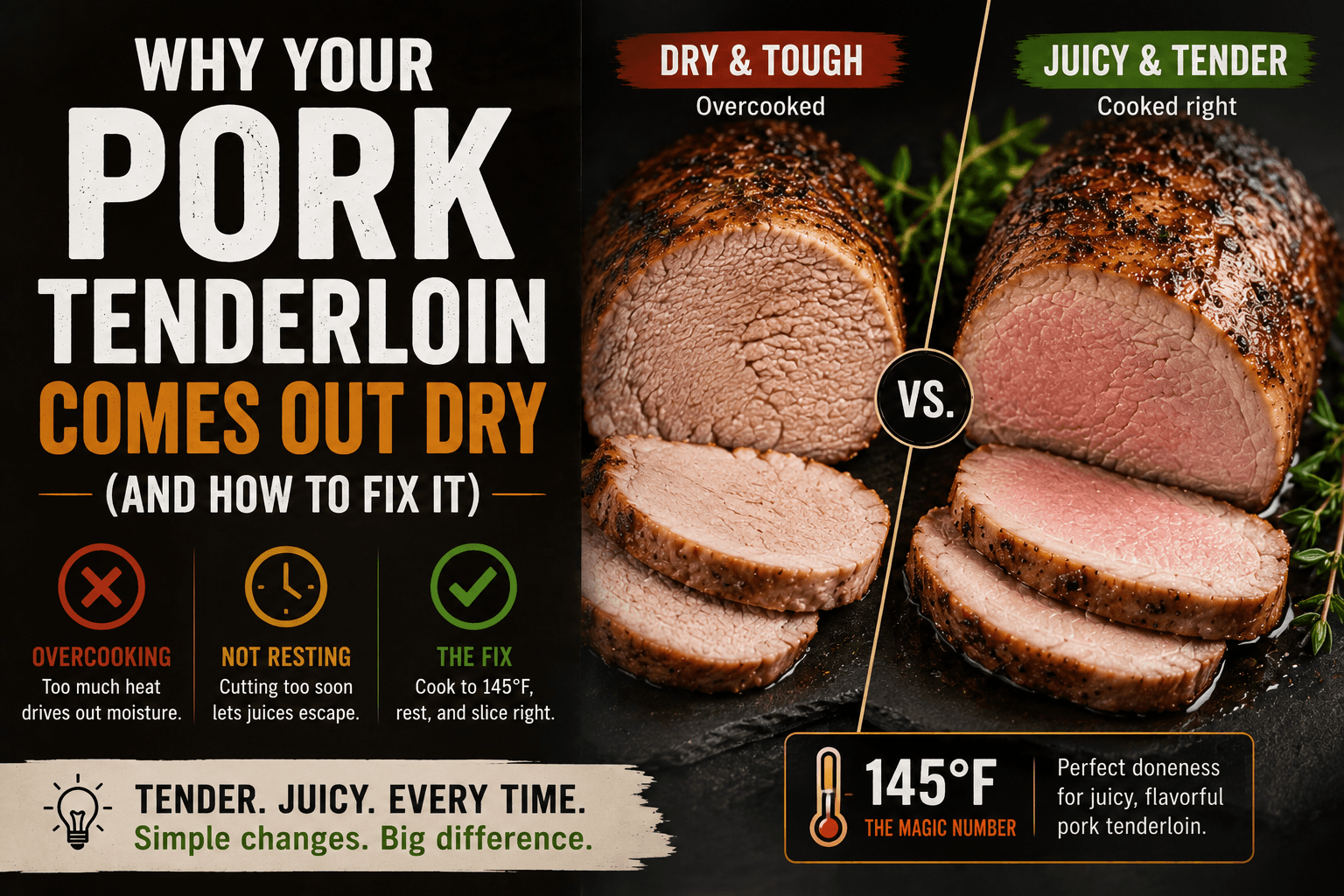
Pork tenderloin dries out because it is the leanest whole-muscle cut on the animal — almost no fat, almost no collagen, and no margin for error. Most cooks then finish it off by pulling it at the old 160°F target instead of 145°F, and by ignoring the 5 to 10 degrees it keeps climbing after the pan.

The real reason: it's the leanest cut you can buy
Every other cut of pork forgives you. Shoulder has collagen that melts into gelatin and coats the meat from the inside. Belly has fat that renders and bastes as it goes. Even a thick chop carries enough intramuscular marbling to survive an extra four minutes of inattention.
The tenderloin has neither. It sits tucked along the spine and does essentially no work over the animal's life, which is exactly why it's so tender — and exactly why it holds almost no fat and almost no connective tissue. There is nothing in there to melt. Nothing to render. Nothing to hide behind.
What that means in practice: the window between perfect and ruined is roughly ten degrees wide. Ten. On a shoulder you have hours of slack. On a tenderloin you have about ninety seconds.
Modern pork makes this sharper still. Michigan State University Extension notes that pork today is leaner than it has ever been, which is a genuine nutritional win and a genuine cooking problem. The cut your grandmother overcooked had more fat to lose than the one in your fridge.
The short version: tenderloin isn't drying out because you're a bad cook. It's drying out because it has no buffer, and every technique you learned on forgiving cuts fails on this one.
Cause 1 — You're cooking to a number that changed in 2011
This is the big one, and it catches people who are otherwise excellent in a kitchen.
On 24 May 2011, the USDA lowered the recommended safe internal temperature for whole cuts of pork from 160°F to 145°F, with a three-minute rest. The agency's own guidance is blunt about why: cooking to 145°F with the rest is as safe as cooking to 160°F without it, and it produces a result that is, in their words, both safe and at its best quality.
Fifteen degrees. On a tenderloin, fifteen degrees is the difference between dinner and a chew toy.
The 160°F rule was never arbitrary. It came from a real fear of Trichinella spiralis, the parasite behind trichinosis, back when pigs were raised outdoors and rooted through whatever was in the dirt. But the parasite dies at 137°F, and modern indoor husbandry has made infection vanishingly rare. The University of Minnesota's CIDRAP covered the change when it was announced; the National Pork Board now lists tenderloin explicitly at 145°F.
Here's the part that still surprises me. The correction went out in 2011 and it simply never reached most home kitchens. No one recalls a cookbook. Nobody sends a letter. A generation was taught 160°F in a home economics class or by a parent, and that number is still sitting there doing damage fifteen years later.
| What you're cooking | Target temperature | Rest | Why |
|---|---|---|---|
| Whole cuts — tenderloin, loin, chops, roasts | 145°F / 63°C | 3 minutes | Bacteria live on the surface only; searing handles them |
| Ground pork — mince, sausage, meatballs, dumpling filling | 160°F / 71°C | None required | Grinding distributes surface bacteria through the whole mass |
| Pork shoulder, Boston butt (for pulling) | 195–205°F / 91–96°C | 15–30 minutes | Safe long before this — you're melting collagen, not killing bacteria |
| Poultry, including ground chicken and turkey | 165°F / 74°C | None required | Unchanged by the 2011 revision |
| Wild boar or wild game pork | 160°F / 71°C | 3 minutes | Outdoor foraging means the old parasite risk still applies |
If you take one number away from this article, take 145. If you want the full story behind the change, we covered it separately in why pork is safe at 145°F when most people still cook it to 160°F.
Cause 2 — Carryover finishes the job after you stop
Meat doesn't stop cooking when you take it off the heat. The outside is far hotter than the centre, and that heat keeps moving inward until the whole thing evens out. On a tenderloin the effect runs about 5 to 10°F.
So if you pull at 145°F, you eat at roughly 152°F. If you pull at 150°F because you wanted to be careful, you eat at close to 160°F — the exact number you were trying to leave behind.
Pull it at 138°F. I know that reads like a typo. It isn't. Take it out at 138°F, tent it loosely, walk away for five minutes, and it will settle right around 145°F with juice still in it.
The USDA's three-minute rest exists for this reason — FSIS is explicit that during the rest the temperature holds or continues to climb, which is what completes the pathogen reduction. The rest isn't a nicety. It's part of the cooking.

One more thing, because it's the mistake I made for years: don't wrap it tightly in foil. A tight foil parcel traps steam against the crust you just spent eight minutes building, and it keeps driving heat inward. Tent it loosely, or just leave it on a warm plate.
Buy the thermometer. Not a dial thermometer — an instant-read digital one. Every piece of advice in this article is unusable without one, and a tenderloin moves too fast to guess. This is the single highest-return purchase in a home kitchen and it costs less than the pork you've already wasted.
Cause 3 — You started from fridge-cold
A tenderloin straight out of the fridge sits at around 40°F. You need the centre at 138°F. That's a hundred degrees of travel, and while the centre is making that journey the outer half-inch is sitting in a hot pan going well past where you want it.
The result is a grey band. You slice it open and there's a ring of dry, tight, overcooked meat around a centre that's finally correct. The centre reads fine on the thermometer. The bite is still disappointing, because two-thirds of what's on the fork is that grey band.
Take it out 30 to 40 minutes before cooking. Not to bring it to room temperature — that's a myth, and 30 minutes on a counter barely shifts the core temperature. What it does is take the hard chill off the surface layer, which meaningfully narrows the gap between outside and centre.
Frozen pork is the aggravated version of this. It's worth noting that this comes up often enough in live classes that instructors build it into their prep notes — Mackaeda Mc Kenzie's pork tenderloin class tells students plainly to thaw the pork completely before the session starts. A chef doesn't put that in writing unless she's watched it go wrong repeatedly.
Cause 4 — You cooked until the pink was gone
This is the one that's hardest to unlearn, because it's not a rule you were taught. It's a reflex.
You cut into the tenderloin, you see pink, something in your gut says not done, and back it goes. Four more minutes. Now it's grey all the way through and it's also 160°F, and you've done exactly what you were trying to avoid.
Pork cooked to 145°F and rested is meant to be faintly pink in the centre. The USDA says so directly: properly cooked pork may still be pink and is safe to eat. Colour is not a doneness indicator. It's affected by cooking method, by pH, by whether the pork was enhanced with a salt solution at the plant, and by nothing you can reliably read across the counter.
There's a related trap in cured pork. Cured ham and cured chops stay pink no matter how long you cook them, because the curing salts fix the colour. If you're using colour as your guide, cured pork will let you cook it into oblivion and still look underdone.
Trust the thermometer. Ignore your eyes. It takes about three attempts before it stops feeling wrong.
The tapered end nobody tells you about
Look at a tenderloin side-on. The thick end is roughly twice the diameter of the thin end. That's not a defect — that's the shape of the muscle.
It also means that if you cook it flat in a pan, the thin end hits 145°F while the thick end is still at 120°F. By the time the thick end is right, the thin end has been sitting at 160°F-plus for several minutes and is genuinely, irreversibly dry. Most people diagnose this as "the whole thing was dry." It wasn't. Half of it was.
Two fixes, and both work:
- Tuck the thin tail under the body of the tenderloin and tie it with a loop of butcher's twine. You've now got an even cylinder, and it cooks evenly.
- Cut the tenderloin in two at the point where it starts narrowing, and cook the thin piece for less time. Less elegant, no twine required, works perfectly.
And when you check temperature, probe the thick end. That's the last part to come up, and it's the part that determines when the whole thing is done.
Cook a whole tenderloin live with a chef watching
Mackaeda Mc Kenzie runs a 60-minute live class built around a whole 1–1.5 lb tenderloin — hard sear, mustard binder, Cajun and allspice rub, then an apple, rum and cinnamon reduction lifted off the fond. Beginner level. She's watching your pan in real time, which is the part a recipe can't do.
Ground pork is the one real exception
Everything above applies to whole muscle. The moment pork is ground, the rules change, and this is worth understanding rather than memorising.
On a whole tenderloin, bacteria are on the surface. The interior of an intact muscle is effectively sterile. When you sear the outside you've dealt with the risk, which is why 145°F at the centre is fine.
Grinding takes that surface and mixes it through the entire mass. There's no longer an inside and an outside — contamination is distributed evenly. So the whole thing has to reach 160°F, and no rest time is required. Same logic as ground beef versus a steak.

Practical version: sausages, meatballs, meat loaf, burger patties and dumpling filling all go to 160°F. Your tenderloin does not. If you've been applying one number to all pork, that's very likely part of why some of your pork is dry and some of it is fine.
The ground-pork side of the equation
Denise Fan teaches pork and cabbage pot stickers using 225g of minced pork — the 160°F case in practice. She also teaches the wet-filling fix most home cooks miss: salt the cabbage, wait fifteen minutes, then squeeze the liquid out before it turns your filling to soup.
The method that actually fixes it
Nothing exotic here. Sear, then finish gently, then rest.
- Pull it from the fridge 30–40 minutes ahead. Pat it completely dry — wet meat steams instead of browning.
- Deal with the silverskin. That iridescent membrane along one side won't render and won't soften; it just tightens and curls the meat. Slide a thin knife under one end, angle the blade slightly upward, and pull.
- Tuck and tie the thin tail so you have an even cylinder.
- Salt it properly. Generously, on all sides, at least 15 minutes before it hits heat. Earlier is better if you have the time.
- Sear hard. Heavy pan, high heat, oil shimmering. Two to three minutes a side until you've got real colour on roughly four faces. You're building the fond your sauce will come from.
- Drop the heat, or move it to a 375°F oven. Blasting it the whole way through is what creates the grey band.
- Probe the thick end. Pull at 138°F. Trust the number, not the colour.
- Rest five minutes, tented loosely, never wrapped tight.
- Build the pan sauce while it rests. Deglaze the fond with rum, wine or stock, add something with a bit of sweetness — apple works beautifully with pork — and mount it with cold butter.
- Slice against the grain into medallions about half an inch thick.
On brining: you can. A 30-minute soak in a 5% salt solution buys you a real safety margin, and if you're cooking for people and nervous about it, brine. I usually don't, because a properly salted and correctly pulled tenderloin doesn't need the insurance and brining slightly softens the texture that makes this cut worth buying. Your call.
Learn it live with a working chef
Temperature you can learn from a chart. What you can't learn from a chart is what the pan should sound like when the sear is right, or how the meat should feel when you press it, or whether the reduction has gone one minute too far. That's the gap a live class closes — someone watching your actual pan, on your actual stove, correcting you before the mistake sets.

Verified Host · Trinidad and Tobago · 6 years experience
★★★★★ 4.9 from 14 reviews
Caribbean and African home cooking. Her tenderloin class is the only whole-cut pork class on P2Bridge, and the technique is the one described above: hard sear, gentle finish, pan reduction built on the fond.
$60 private$30 group60 minbeginner
Verified Host · South Africa · 10 years experience · English + Afrikaans
★★★★★ 5.0 from 3 reviews
The ground-pork counterpart. Her pot sticker class is where the 160°F rule stops being trivia and starts being the thing standing between you and a filling that's actually safe.
$60 private$50 group60 minintermediate
Not pork tenderloin, but worth knowing if dumplings are where this took you. Her pierogi class is the most-booked Eastern European class on the platform.
$60 private$20 groupintermediate
More on the site: live online pork cooking classes, the full culinary class catalogue, upcoming group sessions, and every verified host.
Frequently asked questions
What temperature should pork tenderloin be cooked to?
145°F (63°C) measured at the thickest part, followed by a three-minute rest. Because carryover heat adds another 5 to 10 degrees, pull the tenderloin off the heat at around 138°F and let it climb to 145°F while resting. The USDA lowered this from 160°F in 2011.
Is it safe if my pork tenderloin is still pink in the middle?
Yes. Pork cooked to 145°F with a three-minute rest is safe even when the centre is pink. The USDA states this directly. Colour is affected by cooking method, meat pH and added ingredients, so it is not a reliable doneness indicator. Only a thermometer reading is.
Why does my pork tenderloin dry out when my pork shoulder never does?
Shoulder is full of collagen and fat that melt during long cooking and keep the meat moist. Tenderloin is the leanest whole-muscle cut on the pig, with almost no fat and no connective tissue, so it has nothing to fall back on. Its window between juicy and dry is roughly ten degrees.
Should I brine a pork tenderloin?
You can, and a 30-minute soak in a 5% salt solution gives you a genuine margin for error. It is not required. A tenderloin that is salted 15 minutes ahead and pulled at the correct temperature stays juicy without brining, and skipping the brine preserves slightly more of the fine texture that makes the cut worth buying.
Why is ground pork 160°F when tenderloin is only 145°F?
Bacteria on a whole cut sit on the surface, and searing destroys them. Grinding mixes that surface throughout the entire mass, so there is no longer a sterile interior. The whole quantity has to reach 160°F. This is the same reason ground beef needs a higher temperature than a steak.
Do I need to remove the silverskin from a pork tenderloin?
Yes. Silverskin is the iridescent membrane running along one side. It never renders or softens, and it contracts during cooking, which curls the tenderloin and makes it cook unevenly. Slide a thin knife underneath one end, angle the blade slightly upward and pull it away in strips.
How long should pork tenderloin rest before slicing?
Five minutes is right, and the USDA minimum is three. During the rest the internal temperature holds or rises, which completes the pathogen reduction, and the juices redistribute instead of running onto the board. Tent it loosely — wrapping tightly in foil traps steam and softens the crust you just built.
Is pork tenderloin the same thing as pork loin?
No. They are different muscles that did different jobs. Tenderloin is a small, narrow cut weighing 1 to 1.5 lb; pork loin is a much larger, wider roast. Cooking times are not interchangeable, and swapping one for the other in a recipe is a common cause of dry pork.
Still working through the pork numbers? Read why pork is safe at 145°F when most people still cook it to 160°F, and why pork tenderloin and pork loin are not the same cut.
Sources
- USDA — Cooking Meat? Check the New Recommended Temperatures
- USDA FSIS — Fresh Pork From Farm to Table
- National Pork Board — Pork Cooking Temperature
- CIDRAP, University of Minnesota — USDA: 145 degrees is safe temp for pork
- Michigan State University Extension — Cook pork so it is juicy and safe to eat