











The Jollof Wars: why one rice dish divides West Africa
Nigeria and Ghana have been arguing about this for decades, loudly and joyfully. Here's the part both sides skip: neither of them invented it.
The short answer
The Jollof Wars are a long-running, mostly good-natured rivalry over which West African country makes the best jollof rice — a one-pot dish of rice cooked in a tomato, pepper and onion base. Nigeria and Ghana are the loudest combatants, but Senegal, Liberia, Sierra Leone, Cameroon and The Gambia all have a claim.
The twist: jollof originates in Senegambia, from the Wolof people — the word itself comes from Wolof. Its ancestor is Senegal's thieboudienne. The dish is older than the borders being defended.
What the Jollof Wars actually are
If you've spent any time in West African corners of the internet, you've watched this argument happen. Someone posts a photo of jollof rice. Within minutes the comments are a pile-up of national pride, culinary insults, and at least one person explaining that everyone else is doing it wrong.
The Jollof Wars aren't a real conflict. They're a running joke that has been going for decades — a rivalry played out in comment sections, comedy sketches, diaspora dinner parties and the occasional celebrity feud. Nigeria and Ghana are the headline acts. Both are entirely certain.
What makes it more than a joke is that the food underneath it is genuinely serious. Jollof is the dish that shows up at weddings, naming ceremonies, funerals and Christmas. It's what a grandmother makes to demonstrate that she still can. Arguing about whose is best is a way of arguing about whose home is best, which is why nobody ever concedes and nobody actually wants to.
Jollof is frequently named as Nigeria's national dish, and Ghanaians would tell you that's a scheduling error.
The part both sides skip
Here's where most articles on this topic stop being useful, because they treat it as a two-horse race between Lagos and Accra.
Jollof rice comes from neither.
The dish traces back to the Wolof people of the Senegambia region — present-day Senegal and The Gambia. The name is the giveaway: jollof is a rendering of Wolof. Its clearest ancestor is thieboudienne (also written ceebu jën), Senegal's national dish of rice cooked with fish, tomato and vegetables in a single pot. Tradition credits its creation to a nineteenth-century Senegalese cook named Penda Mbaye, working in Saint-Louis.
The Gambian name for the dish makes the lineage even plainer. Gambians call it benachin — which in Wolof means one pot. That's not a poetic flourish. It's a description of the method, and the method is the thing that travelled.
In 2021, UNESCO added Senegal's ceebu jën to its list of Intangible Cultural Heritage — formal recognition of a dish that had already spent a couple of centuries quietly spreading across the region and turning into something new everywhere it landed.
Nigeria and Ghana are arguing about who does the better version of a dish they both inherited.
Which is, if anything, a better story than the one everyone tells. It means the Jollof Wars aren't really about ownership. They're about interpretation — and every country in the argument is genuinely doing something different with what it received.
Nigeria's case
Nigerian jollof is built on long-grain parboiled rice — the kind often sold as sella. Parboiled rice has been partially steamed in the husk before milling, which firms up the grain and means it can sit in a wet, heavily seasoned base without turning to mush. That resilience is the entire point, because Nigerian jollof asks the rice to cook in the stew rather than alongside it.
The base goes in first: blended tomato, red bell pepper, scotch bonnet and onion, cooked down hard until the raw tomato sharpness has gone and the oil starts to separate out. Then the rice goes in and takes on everything.
And then there's the smoke. Party jollof — the version cooked in enormous pots for a crowd — is prized for a faint smokiness that comes from the bottom layer catching very slightly against the pot. Over firewood this happens naturally. On a home stove it's a controlled risk: too little and you've missed the point, too much and you've burnt dinner for forty people. Nigerians will tell you this is the flavour Ghana cannot produce. Ghanaians will tell you it's a burnt pot with good PR.
Ghana's case
Ghanaian jollof usually starts from a completely different rice. Jasmine or basmati — aromatic long-grain varieties that arrive with their own perfume already built in.
This is not a small substitution. Aromatic rice contributes floral, almost tea-like top notes that parboiled rice simply doesn't have, and it changes what the finished dish is trying to be. Ghanaian jollof tends to be fragrant and layered where Nigerian jollof is deep and smoky. Ghanaian cooks often lean harder on stock and on the seasoning built into the meat, letting the rice carry aroma rather than absorb everything.
Ask a Ghanaian why theirs is better and the answer is usually some version of: because you can smell it from the next room, and because we didn't have to burn it to get flavour.
The contenders nobody mentions
The two-country framing does a disservice to a genuinely regional dish.
- Senegal has the strongest claim of all and rarely bothers making it, possibly because thieboudienne is already recognised on its own terms. Broken rice, fish, tamarind, vegetables — closer to the original form than anything downstream of it.
- The Gambia calls it benachin, and the name is the argument.
- Liberia makes a version that frequently carries several meats at once, and Liberian jollof has a devoted following that finds the Nigeria-Ghana squabbling slightly beside the point.
- Sierra Leone has its own seasoning traditions and its own strong opinions.
- Cameroon sits at the eastern edge of the jollof map, and Cameroonian jollof is its own thing again.
Each of these is a real tradition with real people who grew up on it. If you've only ever tried one version, you haven't been in the argument — you've been standing near it.
What actually differs in the pot
Strip away the national pride and the differences are specific and cookable.
| Nigeria | Ghana | Senegal | |
|---|---|---|---|
| Rice | Long-grain parboiled | Jasmine or basmati | Broken rice |
| Method | Rice cooks in the base | Rice cooked with stock and base | One pot, fish first |
| Signature | Smoke from the pot | Aroma from the grain | Fish, tamarind, vegetables |
| Texture | Firm, separate | Fluffy, fragrant | Soft, dense |
| Heat | Scotch bonnet, generous | Present but restrained | Milder, savoury-forward |
| Usually with | Fried plantain, suya, chicken | Shito, salad, chicken | Fish and vegetables in the pot |
Learn it from someone who grew up making it
P2Bridge hosts teach jollof live — you cook along in your own kitchen while they watch your pot and tell you when to stop stirring. Three jollof classes are running now.
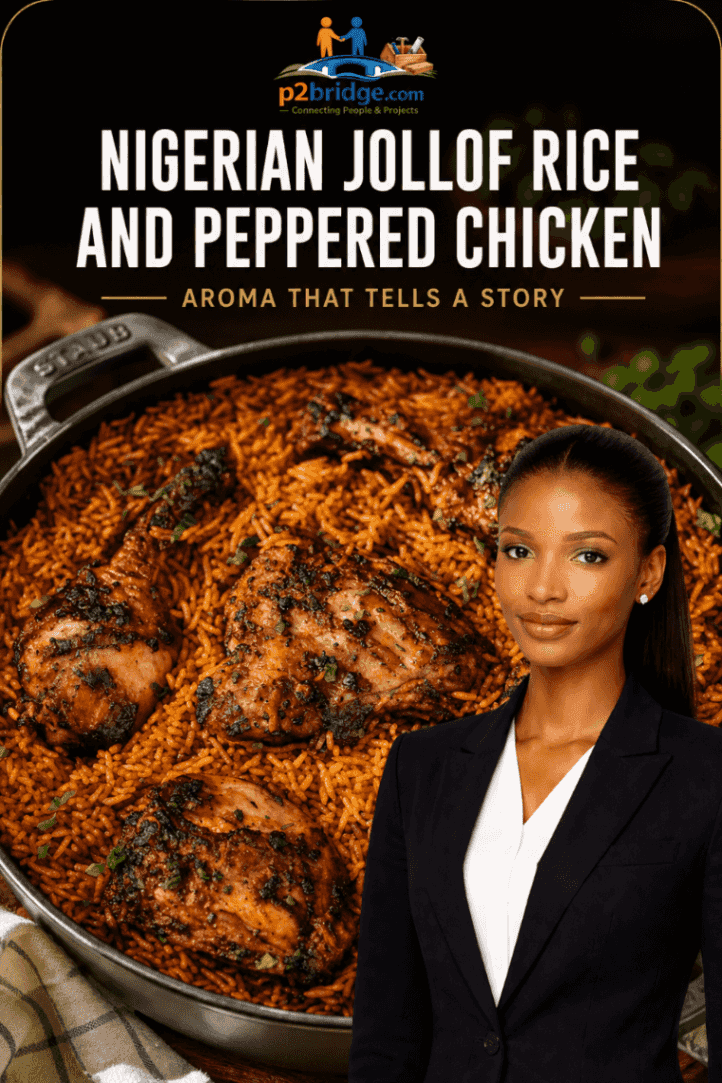
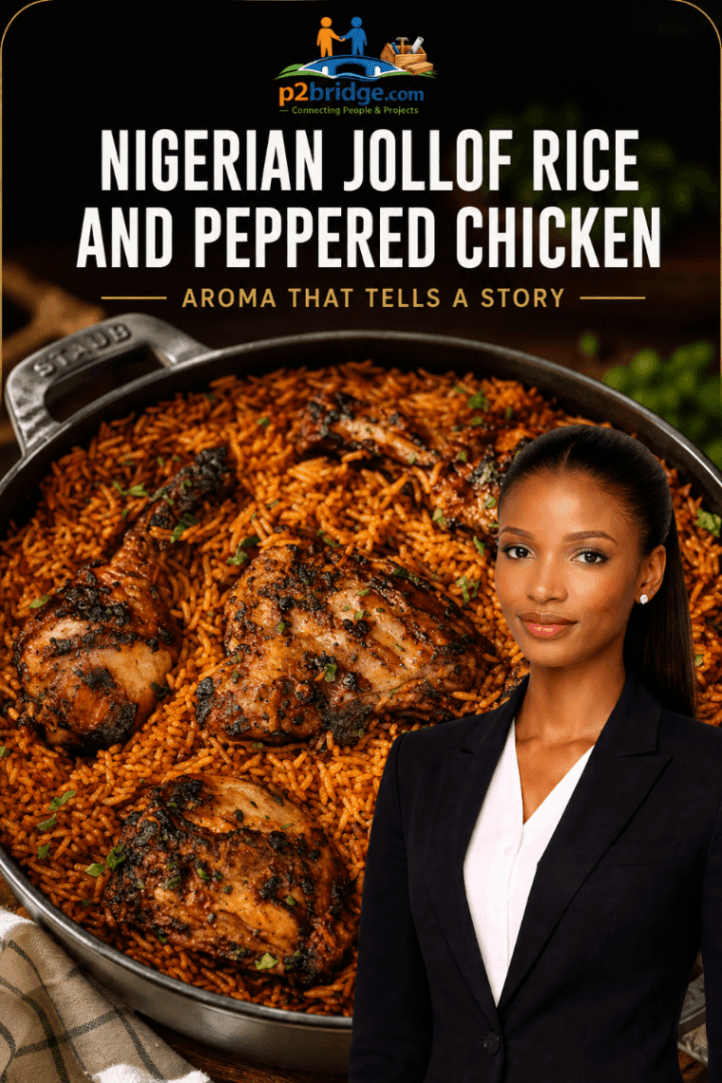
Native Jollof Rice Jollof & Black Peppered ChickenParty jollof vs native jollof
A distinction that trips up outsiders, because both terms get used as though everyone already knows.
Party jollof is the version cooked in vast quantities for an event, traditionally over firewood, in a pot big enough to be a piece of furniture. Scale changes the cooking: the volume, the heat source and the long contact with the pot base all produce that smoky depth people chase. It's the version most Nigerians will tell you is the real one, and it's genuinely hard to reproduce for four people on an induction hob.
Native jollof — sometimes called palm oil jollof or iwuk edesi — is a different dish rather than a lesser one. Palm oil instead of vegetable oil, often with dried fish, periwinkle or assorted meats, and a deeper, earthier, more rustic result. Less photogenic, frequently better.
If you've only had the party version, the native one will surprise you.
So who wins?
No.
That isn't diplomatic cowardice, it's the correct answer, and anyone inside the argument would tell you the same thing with a straight face before laughing. The Jollof Wars work precisely because they're unresolvable. A verdict would end the joke, and the joke is doing real work — it's how a region with a shared inheritance and a lot of separate histories celebrates something it holds in common while pretending to fight about it.
There's also the practical point. Nobody is comparing like with like. You're not judging Nigerian jollof against Ghanaian jollof; you're judging your friend's mother's Nigerian jollof against a Ghanaian version you ate once at a restaurant. The rivalry is really thousands of small loyalties to specific kitchens, aggregated up into national teams.
What we'd say instead: if you've only eaten one country's jollof, the interesting move isn't to pick a side. It's to eat the other four.
Cooking it yourself — what goes wrong
Four failure modes account for most disappointing home jollof.
The base isn't cooked down enough
This is the big one. Blended tomato and pepper needs to be reduced properly — until it darkens, thickens, and the oil begins to separate at the edges. Rush it and you get a sharp, raw-tomato taste that no amount of seasoning fixes. It takes longer than you think. Keep going past the point where you'd normally stop.
Wrong rice, wrong expectations
Using aromatic rice and expecting Nigerian results, or parboiled and expecting Ghanaian ones. Both work — for the dish they belong to. Decide which jollof you're making before you shop.
Too much liquid
Jollof is not a risotto and it is not boiled rice. The rice should steam in a controlled amount of stew, absorbing rather than swimming. Excess liquid gives you mush, and mush cannot be rescued.
Chasing smoke and getting char
The smoky note comes from a very slight catch at the base, not from burning. This is the single hardest thing to learn from a written recipe, because it's a judgement about smell and sound rather than a time or temperature. It's also the clearest argument for learning it live from someone who's done it a thousand times — they can hear your pot.
Cook it live with a host
Group classes are the low-pressure way in, and West African cooking is one of the deepest categories on P2Bridge — jollof, moi moi, puff puff, egusi, yam porridge and more.
Smoky Jollof & Chicken Skewers See group classesQuestions people ask
How do you pronounce jollof?
JOL-of — two syllables, stress on the first, the "o" as in "doll." It comes from Wolof, the name of the people and language of the Senegambia region where the dish originates.
Where did jollof rice actually come from?
Senegambia — the region covering present-day Senegal and The Gambia — from the Wolof people. Its closest ancestor is Senegal's thieboudienne, a one-pot rice and fish dish, and the Gambian name for jollof, benachin, literally means "one pot" in Wolof. Nigeria and Ghana, the two loudest voices in the rivalry, both inherited the dish rather than invented it.
What's the actual difference between Nigerian and Ghanaian jollof?
Mostly the rice. Nigeria uses long-grain parboiled rice, which stays firm and absorbs the tomato-pepper base, and prizes a smoky note from the bottom of the pot. Ghana typically uses aromatic jasmine or basmati, which brings its own floral perfume so the dish is fragrant rather than deeply absorbent. Same foundation, two genuinely different results.
Is jollof rice spicy?
Usually warm rather than punishing, though it varies a lot by cook and by country. Scotch bonnet is the standard heat source and Nigerian versions tend to use it more generously. Heat is easy to adjust at home — reduce the scotch bonnet and you keep the flavour of the base without the burn.
What rice is best for jollof?
Depends which jollof. Long-grain parboiled rice, often sold as sella, is the standard for Nigerian jollof because it holds its shape in a wet, heavily seasoned base. Jasmine or basmati suits Ghanaian jollof for the aroma. Broken rice is traditional for Senegalese thieboudienne. Short-grain and risotto rices don't work — they release too much starch and turn the dish claggy.
Can jollof rice be vegetarian or vegan?
Yes, and easily. The base — tomato, red pepper, onion, scotch bonnet, seasoning — is plant-based already. Swap meat stock for vegetable stock, skip the chicken or fish, and you have a genuinely good vegan jollof rather than a compromise. Senegalese thieboudienne is the exception, since fish is structural to the dish rather than an addition.
What do you serve with jollof rice?
Fried plantain is the near-universal partner. Beyond that: grilled or fried chicken, suya, beef, fish, moi moi, coleslaw, or a simple salad to cut the richness. In Ghana, shito — a dark, fiery pepper sauce — often appears alongside. Jollof is substantial enough to stand alone, but almost nobody serves it that way.
What does jollof rice taste like?
Savoury, tomato-rich and warmly spiced, with a depth that comes from the base being cooked down properly rather than from heavy seasoning. Nigerian versions carry a distinct smokiness. Ghanaian versions are more aromatic and floral. If you've had Spanish paella or Cajun jambalaya, the family resemblance is real — one-pot rice dishes built on a cooked-down base — but jollof tastes like none of them.
Who actually wins the Jollof Wars?
Nobody, deliberately. The rivalry is unresolvable by design and that's the point of it — a verdict would spoil a joke that's been running happily for decades. Practically, most people are loyal to a specific kitchen rather than a country. The honest answer is that the best jollof is whichever one you grew up eating, and the second best is the one you haven't tried yet.
Start with one live class
West African cooking is P2Bridge's deepest culinary category, taught by hosts who grew up with these dishes. Group sessions or one-to-one, from anywhere.
Browse cooking classes Book a private session